Introduction
Attorneys, doctors, and real estate firms pour money into marketing — ads, SEO, referrals — then watch leads quietly disappear without knowing where or why. The problem usually isn't the marketing itself. It's the funnel: the series of steps between "first contact" and "signed client" that nobody has systematically examined.
According to the 2024 Edelman-LinkedIn B2B Thought Leadership Impact Report, 95% of business clients are not actively seeking services at any given time — meaning most of your marketing touches people who aren't ready to buy yet. Without a funnel designed to nurture them until they are, you're spending money on leads you'll never close.
Here's what this guide covers:
- What sales funnel optimization actually means for service businesses
- How to identify where your funnel is leaking
- Strategies that move prospects through each stage
- The metrics that tell you it's working
Key Takeaways
- Sales funnel optimization is an ongoing, data-driven process — not a one-time fix
- Service buyers need trust built across multiple touchpoints before committing
- Funnel leaks most often happen when interest stalls before desire forms — and again at the point of action
- Response time matters more than most expect: conversion odds drop dramatically after 5 minutes
- Track stage-by-stage conversion rates, not just total traffic or lead volume
What Is Sales Funnel Optimization (and Why It Matters)
Sales funnel optimization is the continuous process of improving each stage of the customer journey — from first awareness to signed contract — so more leads become clients and fewer fall through the cracks. It's a diagnostic and improvement cycle that never really ends, not a one-time website overhaul.
For service businesses, this matters more than in almost any other sector.
Why Service Businesses Face Higher Stakes
Unlike eCommerce, where a buyer can add to cart on impulse, service buyers are making a considered decision. They're hiring an attorney, choosing a doctor, or selecting a real estate investment firm. Trust has to be built before any conversation about fees or next steps. A leaky funnel compounds the cost of every lead you generate — because you've already paid to acquire them before losing them.
Two related concepts often get conflated here:
- Sales funnel optimization addresses the full customer journey — awareness through retention
- Sales conversion strategy focuses specifically on the bottom of the funnel — turning qualified leads into paying clients
The most effective growth systems address both layers simultaneously — optimizing the full journey while building a sales infrastructure designed to close. That's the model Gross Consulting implements for service business clients: not just strategic advice, but the actual systems that connect awareness to revenue.
The 5 Stages of a Sales Funnel
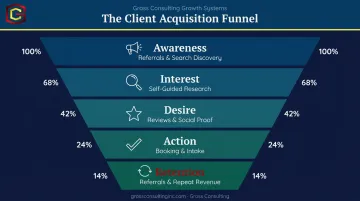
Every service business funnel runs through five stages, each requiring a different strategy.
Awareness
This is where a prospect first encounters your brand — through a Google search, a Meta ad, a referral from a colleague, or a social post. For professional service firms, referrals carry particular weight: research from Hinge Marketing found 71% of professional services buyers find new firms by asking another person, compared to just 11% through online search.
The goal at this stage isn't to sell. It's to capture attention and establish enough credibility that a prospect wants to learn more.
Interest
At this stage, a prospect is actively researching solutions — reading, comparing, and forming opinions before they speak to anyone. Gartner's research shows 75% of B2B buyers prefer a rep-free sales experience, meaning they want to reach their own conclusions before engaging directly. The content you provide here — educational blog posts, explainer videos, detailed FAQs — needs to inform without pressure.
Desire
Now the prospect is comparing you against alternatives. This is where testimonials, case studies, and social proof carry the argument. For local service providers, reviews are particularly powerful: 97% of consumers read reviews for local businesses, and 31% will only use businesses with 4.5 stars or higher, per BrightLocal's 2024 Local Consumer Review Survey.
What moves someone from curious to convinced is differentiation — making clear not just what you do, but why you do it better than the alternatives.
Action
This is the conversion moment: a booked call, a submitted intake form, a signed engagement letter. Friction here kills high-intent leads. The most common culprits are:
- Confusing or buried calls to action
- Slow follow-up after a form submission
- Intake processes that ask for too much, too soon
A prospect who's ready to hire you will still walk away if the path forward isn't clear and fast.
Retention
Most funnel guides stop at Action — which means most businesses are leaving revenue on the table. For service businesses, a retained client generates referrals, repeat revenue, and dramatically lower acquisition costs. Hinge's research found 79% of professional services buyers want to buy more services from their current provider — a number that rewards firms with a deliberate post-sale strategy, not just a good first impression.
Signs Your Funnel Has a Leak
Before you can fix a funnel, you have to find where it's broken. Here are the most common warning signs:
- High traffic, low form submissions — your website attracts visitors but fails to convert them to inquiries
- Leads going cold after initial contact — prospects express interest then stop responding
- Long sales cycles with no clear reason — deals drag on without identifiable sticking points
- High proposal volume, low close rate — HubSpot benchmarks suggest a healthy proposal-to-close rate sits between 25–40%; anything below 20% warrants investigation
Spotting these patterns is step one. The next step is tracing each one back to a specific stage in your funnel.
Using Analytics to Find Drop-Off Points
Tools like Google Analytics funnel reports and heatmap platforms reveal exactly where prospects are leaving. Look for:
- High bounce rates on key landing pages (visitors leaving without taking any action)
- Drop-offs between inquiry submission and booked appointment
- Pages with high visit counts but low click-through on CTAs
- Heat maps showing users ignoring your primary CTA button entirely
Analytics pinpoint the location of the problem — but the reason behind it usually requires a different kind of investigation.
The Qualitative Layer
The most useful qualitative diagnostics include:
- Surveying lost leads — a short, non-pushy email asking what made them choose a competitor
- Reviewing recorded sales calls — identifying objections that recur and aren't being addressed
- Asking current clients what nearly stopped them — these answers consistently reveal friction points no analytics tool would catch
Sales Funnel Optimization Strategies That Drive Results
Map and Segment Your Funnel by Buyer Stage
Optimization starts with knowing which channels bring leads in and which stage those leads occupy when they arrive. Treating all leads the same — sending a "ready to get started?" message to someone who just read a blog post — accelerates churn instead of conversion.
Lead segmentation by source, behavior, and intent level lets you deliver the right message at the right moment:
- Source-based segmentation: A referral lead needs different nurturing than a cold paid-ad lead
- Behavior-based segmentation: Someone who visited your pricing page has higher intent than someone who read a general overview article
- Intent-level segmentation: Leads who downloaded a case study are closer to the decision stage than those who signed up for a newsletter
Funnel mapping also reveals misaligned messaging — the single most common source of funnel leakage that doesn't show up in bounce rate data.
Gross Consulting uses tools like GoHighLevel (GHL), Zapier, and CRMs to build the infrastructure that supports this kind of segmentation for service business clients — automating the backend so that the right communication reaches each lead at the right time.
Create Stage-Specific Content That Builds Trust
Each funnel stage needs different content. Sending the wrong type at the wrong moment either overwhelms or under-informs.
| Funnel Stage | Content That Works |
|---|---|
| Awareness | Educational blog posts, how-it-works videos, social proof snippets |
| Interest/Consideration | Case studies, comparison content, detailed FAQs |
| Desire/Decision | Testimonials, service walkthroughs, objection-handling FAQs |
| Post-conversion | Onboarding content, check-ins, referral prompts |
For service businesses, trust is the conversion catalyst — not features, not price. Prospects hiring an attorney or choosing a physician are making a deeply personal decision. Content that educates and demonstrates expertise builds the familiarity those decisions require.
Optimize Your Lead Capture Points
Forms, landing pages, and CTAs are the physical infrastructure of your funnel. When they're clunky, vague, or misaligned with what brought the prospect there, conversions die before they start.
Key optimizations to implement:
- Shorten forms — collect only what you need to qualify the lead (name, contact info, one qualifying question). Every additional field reduces submission rates
- Replace vague CTAs — swap "Learn More" for "Book Your Free Strategy Call" or "Get a Custom Quote"
- Match message to source — if your Meta ad promises a free consultation, the landing page it leads to must deliver exactly that promise, in similar language. Any disconnect creates doubt
- A/B test systematically — test headline copy first (highest impact), then CTA button text, then page layout. Don't test everything at once
Automate Follow-Up Without Losing the Human Touch
Delayed follow-up is one of the most measurable causes of lost leads in service businesses. Research from InsideSales/XANT across 55 million sales activities found that conversion rates were 8x higher when a lead was contacted within the first 5 minutes versus waiting even 5 minutes to 24 hours. Meanwhile, a 2016 Workato study of 114 B2B companies found only 1 of 114 sent a personalized response within 5 minutes.
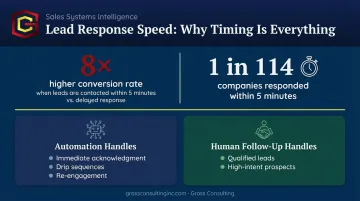
Closing that gap doesn't require someone monitoring inquiries around the clock. It requires a hybrid automation model:
- Automation handles: Immediate acknowledgment (within seconds of form submission), educational drip sequences, re-engagement campaigns for cold leads
- Human follow-up handles: Qualified, high-intent leads who have engaged with nurture content or requested a call
This is the model Gross Consulting builds for service business clients — the automation handles the immediate response and nurture sequences, while human follow-up activates for leads that are qualified and ready to move forward.
Use Retargeting to Recapture Lost Leads
Most service leads don't convert on first contact. Retargeting campaigns on Meta and Google Display keep you visible to people who showed interest but didn't act.
Effective retargeting is stage-aware:
- Blog readers → Serve educational content or a case study ad
- Pricing page visitors → Serve a testimonial or "Book a Call" ad
- Form starters who didn't submit → Serve a friction-reducing offer (free consultation, no commitment)
Match the ad to where the prospect was in their decision process, not where you want them to be.
Continuously Test and Refine Funnel Elements
A/B testing is the engine that keeps a funnel improving over time. The key is prioritizing tests where volume is highest and impact is greatest.
What to test, in order of priority:
- Headline copy on landing pages (biggest conversion impact)
- CTA button text and placement
- Form length and field order
- Email subject lines in nurture sequences
- Offer framing (free call vs. free audit vs. free strategy session)
One caution: funnel optimization is never finished. Buyer behavior shifts, market conditions change, and a funnel that performed well last quarter may already be losing leads today. Build a review cadence — monthly for high-traffic pages, quarterly for full funnel assessments — and treat each review as a new diagnostic cycle.
Key Metrics to Measure Funnel Performance
Tracking the right numbers tells you exactly where your funnel is working and where it isn't.
Core Funnel KPIs
| Metric | What It Reveals | Benchmark (where available) |
|---|---|---|
| Lead-to-opportunity rate | How well you're qualifying leads | 15–25% (HubSpot) |
| Lead-to-customer rate | Overall funnel efficiency | 10–15% for professional services |
| Proposal-to-close rate | Sales conversation quality | 25–40% (HubSpot) |
| Average time-to-close | Sales cycle efficiency | 1–3 months for most B2B |
| Cost per lead | Marketing efficiency | Track internally by channel |
Vanity Metrics vs. Conversion Metrics
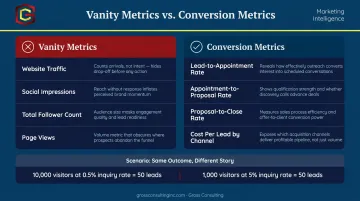
Website traffic and social media impressions are easy to report but tell you almost nothing about funnel health. A law firm with 10,000 monthly visitors and a 0.5% inquiry rate has a worse funnel than a firm with 1,000 visitors and a 5% inquiry rate.
Focus on quality-of-lead metrics instead of volume: lead-to-appointment rate, appointment-to-proposal rate, and proposal-to-close rate tell you far more than raw traffic numbers.
Establish a Baseline First
Document your current conversion rates at every stage before changing anything — otherwise, you can't separate real improvement from seasonal noise. Even rough numbers work as a starting point:
- "We close 1 in 8 proposals"
- "About 30% of discovery calls become proposals"
- "Roughly 20% of leads book an appointment"
These give you a concrete baseline to measure optimization against.
Frequently Asked Questions
What are the 5 stages of a sales funnel?
The five stages are Awareness, Interest, Desire, Action, and Retention. Each stage calls for a different approach: educational content builds awareness, social proof and fast follow-up convert interest into desire, and post-conversion nurturing keeps customers engaged.
How do I know if my sales funnel needs optimization?
Watch for high traffic with low inquiry rates, leads that go cold after initial contact, unusually long sales cycles, or a proposal-to-close rate below 20%. Any of these signals a leak at a specific stage.
What is the most important stage of a sales funnel to optimize?
The highest-impact stage to fix is wherever your biggest drop-off occurs. For most service businesses, that's the interest-to-desire transition — the point where prospects disengage because trust hasn't been established yet.
How long does it take to see results from sales funnel optimization?
Quick wins from CTA changes or landing page fixes can show up within weeks. Deeper improvements (nurture sequences, content strategy, A/B testing programs) typically take 60–90 days to produce measurable results.
What metrics should I track to measure sales funnel performance?
Track lead-to-opportunity rate, lead-to-customer rate, proposal-to-close rate, average time-to-close, and cost per lead by channel. These stage-by-stage metrics show exactly where your funnel is losing ground instead of masking problems in blended averages.