Introduction
Running a service-based business often means wearing too many hats. You're managing client delivery, chasing approvals, fixing recurring mistakes, and trying to grow — all at once. According to SCORE, 33% of small business owners work more than 50 hours per week, and 25% work more than 60 hours. Much of that time gets eaten by operational friction, not actual growth work.
Business process optimization consulting is built for exactly this problem. Rather than adding staff or complexity, a consultant analyzes how your business actually works, identifies where time and money are leaking out, and redesigns those workflows so the operation runs faster and at scale.
This article breaks down what business process optimization consultants actually do, which workflows they target first, and how service-based businesses — law firms, medical practices, real estate investment firms, accounting offices — use this work to scale without adding unnecessary headcount or complexity.
Key Takeaways
- A BPO consultant identifies workflow bottlenecks and redesigns processes for speed, consistency, and scale
- External consultants bring objectivity that internal teams, too embedded in daily operations, rarely can
- The best consultants don't just deliver a report — they implement systems and drive team adoption
- Service-based businesses benefit most because their revenue depends on repeatable, high-quality client delivery
- Optimized processes free owners from reactive task management so they can focus on leading
What Is a Business Process Optimization Consultant?
A business process optimization consultant is an external expert hired to analyze how a business operates, identify where time, money, and effort are being lost, and redesign those processes for better performance.
The ABPMP defines this discipline as identifying, designing, executing, documenting, measuring, monitoring, and controlling both automated and non-automated processes to achieve results aligned with business strategy.
BPO Consulting vs. General Business Consulting
General business consultants work at the strategic level — market positioning, competitive analysis, business model design. BPO consultants go deeper, into the mechanics of how work actually gets done:
- How does a client intake request move through your system?
- Where do handoffs break down between team members?
- Which tasks are still manual that could be automated?
- What's causing the same errors to repeat?
Confusing the two often explains why businesses walk away with polished strategy decks but no actual change in how work gets done.
Process Improvement vs. Process Optimization
These terms get used interchangeably, but they describe different scopes of work:
- Process improvement is reactive: fixing a specific broken step after something goes wrong
- Process optimization is proactive: redesigning an entire workflow end-to-end to reach peak performance aligned with business goals
Improvement is a fix. Optimization is a foundation.
Core Services BPO Consultants Provide
Process Mapping and Workflow Redesign
Before anything gets fixed, it has to be understood. BPO consultants document the current state of workflows from start to finish — every step, every handoff, every approval point. Forrester found that 57% of organizations now use process intelligence tools like process mining and task mining to get data-driven visibility into what's actually happening versus what's assumed.
That distinction matters. Most organizations think they know how their workflows run. The mapped reality is almost always different — and more inefficient.
Once the current state is documented, consultants design a future-state blueprint:
- Restructuring steps to remove redundancy and friction
- Clarifying ownership so tasks don't fall through handoff gaps
- Standardizing procedures so output quality doesn't depend on who's working that day
Technology Integration and Automation
Mapping the workflow is only half the work. The other half is building the technology layer that eliminates repetitive, error-prone manual tasks. For service businesses managing client intake, scheduling, communications, and billing, this typically means:
- Workflow automation platforms (like Zapier) that connect disparate tools and trigger actions automatically
- CRM systems that track client progress through service pipelines without manual data entry
- Client-facing platforms (like GoHighLevel) that handle appointment scheduling, follow-up sequences, and pipeline management
At Gross Consulting, this automation layer is central to how operational engagements are structured. The firm deploys Zapier, GoHighLevel, and CRMs not as add-ons but as core infrastructure — replacing scattered manual processes with systems that run consistently even when the owner steps away.
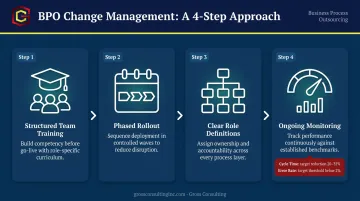
Change Management and Continuous Improvement
New workflows only deliver results when teams actually use them — and many BPO engagements fall short precisely because the human side of change goes unmanaged. Effective consultants address this through:
- Structured team training on new processes and tools
- Phased rollouts that minimize operational disruption
- Clear role definitions so everyone knows their responsibilities in the new workflow
- Ongoing monitoring using benchmarks like cycle time, error rate, and cost per transaction
The Business Benefits: How BPO Consultants Boost Efficiency
Speed and Cost Reduction
Eliminating bottlenecks and automating manual tasks compresses turnaround times across the board. McKinsey estimates that streamlining processes and tasks can produce a 5% to 15% efficiency impact, with technology-enabled optimization — including RPA and intelligent automation — potentially delivering higher gains in specific functions.
Cost reduction through process optimization works differently than cutting headcount. The goal is removing waste and redundancy so existing resources produce more output. The same team, running cleaner processes, handles greater volume without proportional cost increases.
Service Quality and Client Retention
For service businesses, consistency is reputation. Standardized, well-designed processes reduce the variability that leads to errors, missed steps, and inconsistent client experiences. That matters economically: HBR research shows that acquiring a new customer costs 5 to 25 times more than retaining an existing one, and a 5% retention increase can raise profits by 25% to 95%.
That's why process consistency shows up directly on the income statement — fewer errors mean fewer lost clients.
Scalability and Owner Freedom
Optimized processes allow a business to handle more clients, more transactions, and more complexity — without chaos scaling alongside them. For service businesses moving from six to seven figures, this is the inflection point.
Gross Consulting's founder, Jaiden Gross, built the firm specifically around this transition, working with attorneys, doctors, real estate investors, and accountants who had vision and drive but were held back by scattered systems. The operational work goes beyond efficiency metrics: it gives owners the infrastructure to step out of daily fire-fighting and into genuine leadership.
When SOPs are documented, automation handles routine tasks, and team roles are clearly defined, no single person becomes the bottleneck for every operational decision. That's the difference between a business that scales and one that stalls.
When those foundations are in place, the result looks like:
- SOPs that let team members execute independently, without constant owner input
- Automation handling routine tasks through tools like Zapier, GHL, or CRM workflows
- Clearly defined roles that eliminate overlap, dropped handoffs, and confusion
- An owner who leads the business rather than running inside it
Tools and Methodologies BPO Consultants Use
Proven Frameworks
Three methodologies form the backbone of most BPO engagements:
| Framework | Core Focus | Best Used When |
|---|---|---|
| Lean | Eliminating waste and non-value-added steps | Workflows have too many steps or handoffs |
| Six Sigma | Reducing variation and defects through data | Recurring errors or inconsistent output quality |
| Agile | Iterative, cross-functional improvement cycles | Requirements are changing or unclear |
For most service businesses, Lean applies broadest — workflows tend to accumulate unnecessary steps over time, not by design. Six Sigma enters the picture when quality issues are measurable and recurring, while Agile suits engagements where conditions are shifting fast enough that iteration beats planning.
Change management frameworks belong in the same conversation. Forrester found that 75% of organizations expect their own people to handle process optimization, yet 57% lack a clear strategy and only 8% mandate automation training. That gap is exactly what structured consulting support fills.
Enabling Technologies
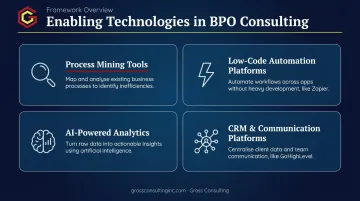
The technology layer consultants bring has grown considerably:
- Process mining tools reveal what's actually happening in workflows versus what's documented or assumed
- Low-code/no-code automation platforms (like Zapier) make workflow automation accessible without engineering resources
- AI-powered analytics identify hidden bottlenecks and patterns at scale
- CRM and communication platforms (like GoHighLevel) centralize client management and automate touchpoints
These tools are no longer enterprise-only. Service businesses of all sizes can access them at practical cost, and the real differentiator now is knowing how to implement them — not whether you can afford them.
Warning Signs Your Business Needs a Process Optimization Consultant
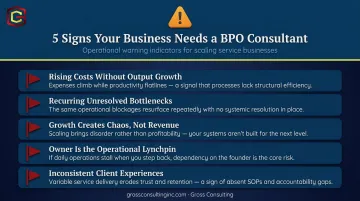
Most service businesses don't decide to engage a BPO consultant proactively. They get there because something has become undeniable. Watch for these signals:
- Rising costs without proportional output growth — waste and inefficiency are accumulating silently
- Recurring bottlenecks that internal fixes haven't resolved — the root cause hasn't been identified
- Growth creates chaos, not just revenue — more clients means more dropped balls, not just more income
- The owner is still the operational lynchpin — nothing runs without their direct involvement
- Inconsistent client experiences — quality depends on who handles the work, not on the process
These warning signs don't appear randomly. For attorneys managing case workflows, medical practices juggling patient scheduling and billing, and real estate investors tracking deal pipelines, they tend to surface at the same inflection point: the transition from early growth to scaling. That's where scattered systems — tolerable at smaller volume — become genuinely unsustainable.
Gross Consulting works specifically with service businesses at this stage — designing and implementing the operational structure, workflow automation, and compliance-aware systems that close the gap between where a business is and where it needs to be. The focus isn't on producing a recommendations deck. It's on building the actual systems and seeing them through to implementation.
How to Choose the Right Process Optimization Consulting Partner
Three criteria separate effective BPO partners from those who deliver polished documents and little else.
1. They build, not just advise.
The most common failure in BPO consulting is receiving a strategy deck with no implementation support. Prioritize firms that take ownership through execution: designing the process, deploying the technology, and ensuring adoption across your team.
Gross Consulting's positioning captures this directly: "We don't just give advice. We build." The difference between recommending a new intake workflow and actually building it in your CRM is what determines whether optimization happens at all.
2. They understand your specific industry.
A consultant experienced with service-based businesses understands the workflow patterns, compliance considerations, and client experience dynamics specific to professional services. This isn't interchangeable with manufacturing or product consulting. Each client type brings distinct operational challenges:
- Attorneys manage case workflows, deadlines, and client communication protocols
- Medical practices navigate scheduling, billing, and regulatory compliance
- Real estate investors run deal pipelines and transaction coordination across multiple parties
3. They use AI and automation as tools, not talking points.
Deloitte's 2026 AI report found that 34% of organizations are starting to use AI to deeply transform by reinventing core processes — not just experimenting at the margins. Firms that blend modern automation tools with hands-on human expertise deliver faster, more durable results than those relying solely on traditional consulting methodologies. The right question to ask a prospective partner: How specifically do you use automation in engagements like mine? Generic answers are a red flag.
Frequently Asked Questions
What is a process optimization consultant?
A process optimization consultant is an external expert who analyzes how a business operates, identifies inefficiencies and bottlenecks, and redesigns workflows to improve speed, reduce costs, and support sustainable growth. Where general business consultants focus on strategy, process optimization consultants focus specifically on how work gets done.
What are the signs your business needs a process optimization consultant?
Watch for these warning signs:
- Operational costs rising without proportional output growth
- Recurring bottlenecks your internal team can't resolve
- Inconsistent client service quality across projects or staff
- Business growth creating chaos rather than just more revenue
What is the difference between process improvement and process optimization?
Process improvement is typically reactive — fixing a specific broken step after a problem occurs. Process optimization is proactive and holistic, redesigning entire workflows end-to-end to reach peak performance aligned with broader business goals.
How do business process optimization consultants use AI and automation?
Modern BPO consultants apply AI-powered analytics and process mining to expose hidden bottlenecks — including gaps between how work is assumed to flow versus how it actually moves. From there, automation platforms like Zapier eliminate repetitive manual tasks and free teams to focus on higher-value work.
How long does a business process optimization engagement typically take?
Targeted process audits typically take a few weeks, while full redesign and implementation engagements span several months. Ongoing monitoring is built into most sustainable programs, because process design without sustained adoption rarely holds.