Outsourced bookkeeping gets discussed often, but usually in vague terms — "save time," "reduce stress." What's less discussed is what it actually does for cash flow visibility, compliance exposure, and the quality of decisions being made at critical growth stages. This article covers the measurable, practical advantages, with a particular focus on why service-based businesses stand to gain the most.
Key Takeaways
- Outsourced bookkeeping replaces fixed in-house staffing costs with a predictable monthly service fee
- Real-time financial reports give you accurate data for decisions around pricing, hiring, and growth investment
- Professional bookkeeping reduces compliance risk and IRS penalty exposure year-round, not just during tax season
- Service businesses in the $300K–$2M revenue range benefit most: enough complexity to require professional oversight, not enough volume to justify a full-time hire
- Consistent, ongoing bookkeeping compounds in value as an operational system built for long-term financial clarity
What Is Outsourced Bookkeeping?
Outsourced bookkeeping means hiring an external professional or firm to manage your business's day-to-day financial records — transactions, reconciliations, accounts payable and receivable, and financial reporting — rather than handling it internally or leaving it to whoever has time.
In practice, the scope typically includes:
- Recording income and expenses as they occur
- Reconciling bank and credit accounts monthly
- Managing accounts payable and receivable
- Generating P&L statements, balance sheets, and cash flow reports
- Organizing financial records for tax season
For a scaling service business, this isn't just administrative task delegation. Clean, current financial data is what makes confident decisions possible. Hiring decisions, pricing changes, vendor contracts, taking on debt — none of those calls should rest on instinct or a three-month-old snapshot. Without reliable numbers, cash flow gaps show up late, tax exposure goes unnoticed, and growth stalls where it shouldn't.
Key Advantages of Outsourced Bookkeeping Services
Each advantage below connects directly to how a business operates, scales, and stays compliant. Consistent bookkeeping builds on itself — clean records from last month make this month faster, more accurate, and more useful for decisions.
Advantage 1: Cost Efficiency Compared to In-House Bookkeeping
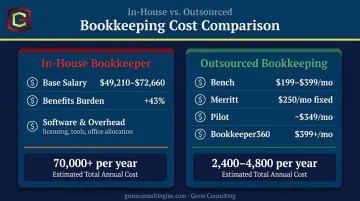
Hiring a bookkeeper in-house carries costs that go well beyond salary. According to the Bureau of Labor Statistics, the median annual wage for bookkeeping, accounting, and auditing clerks was $49,210 as of May 2024, with experienced hires reaching $72,660 or more.
On top of base pay, BLS data shows employer benefits add roughly 43% to total wage costs — covering payroll taxes, health insurance, and paid leave. Factor in onboarding time, software licenses, and office overhead, and the true annual cost of an in-house bookkeeper frequently exceeds $70,000 for mid-market service businesses.
Outsourced bookkeeping costs a fraction of that. Named providers currently list entry-level monthly pricing starting around:
- Merritt Bookkeeping: $250/month (fixed)
- Bench: $199–$399/month
- Bookkeeper360: from $399/month
- Pilot: from approximately $349/month
More complex arrangements — accrual-based reporting, multi-entity, payroll add-ons — run higher, but the cost comparison still favors outsourcing at most service-business revenue levels.
Where this matters most: Businesses in the $300K–$2M revenue range. At that stage, financial complexity has grown beyond DIY capacity, but the transaction volume doesn't yet justify full-time financial staffing. Outsourcing closes that gap without locking in fixed headcount costs.
The money not spent on an in-house hire doesn't just disappear from the expense column — it becomes available for marketing, systems, or growth-driving roles. Outsourced providers also bring existing software, workflows, and processes, which eliminates setup time and reduces early errors.
KPIs affected: Labor costs as a percentage of revenue, overhead per employee, net margin.
Advantage 2: Financial Clarity That Drives Better Decisions
Outsourced bookkeeping gives owners access to accurate, current financial reports on a regular cadence. Cloud-based accounting platforms sync bank accounts and merchant processors automatically, which means P&L statements, cash flow reports, and balance sheets reflect reality — not last quarter's data pulled together in a hurry.
That matters because business decisions don't wait for clean books. Pricing changes, new hires, vendor negotiations, and growth investments all depend on knowing the current financial position. Without reliable data, owners make reactive calls — overspending in areas that look healthy on paper, or holding back on investments the business could actually support.
The scale of the problem is real. According to a 2025 Federal Reserve report on employer firms, 56% of small businesses cited paying operating expenses as a challenge, and 51% cited uneven cash flows. Cash flow struggles at that scale are partly a visibility problem — owners who can't see where money is moving can't intervene early enough to manage it.
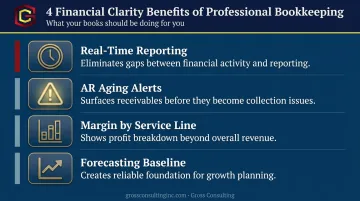
Regular, professional bookkeeping addresses this directly by:
- Eliminating gaps between financial activity and reporting
- Surfacing accounts receivable aging before it becomes a collections issue
- Showing profit margin by service line, not just overall revenue
- Creating a reliable baseline for forecasting and growth planning
Most valuable when: When a business is scaling, adding revenue streams, or evaluating whether to take on significant new costs. Every one of those decisions benefits from knowing exactly where the business stands.
KPIs affected: Cash flow accuracy, accounts receivable aging, profit margin visibility, financial report turnaround time.
Advantage 3: Compliance Accuracy and Tax Readiness
Bookkeeping errors aren't just inconvenient — they carry real financial penalties.
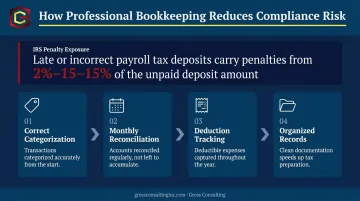
The IRS imposes failure-to-deposit penalties on late payroll tax deposits ranging from 2% for deposits 1–5 days late to 15% for deposits not made after IRS notice. Late filing penalties run 5% of unpaid tax per month, up to 25%. Late payment adds another 0.5% per month, also up to 25%.
These aren't edge cases. The IRS identifies underpaying estimated taxes, depositing employment taxes incorrectly, filing late, and mixing personal and business expenses as common — and costly — small-business tax errors. Each of those errors is directly preventable with proper bookkeeping.
Professional outsourced bookkeepers reduce this exposure by:
- Categorizing transactions correctly from the start
- Reconciling accounts monthly rather than letting discrepancies accumulate
- Tracking deductible expenses throughout the year
- Maintaining organized records that make tax preparation faster and more accurate
For service businesses with payroll, contractor relationships, or multiple revenue streams, compliance complexity is elevated. Firms that work with a Gusto-certified partner — Gross Consulting holds Verified Gusto Accountancy Partner status — get payroll and compliance workflows already aligned with IRS and state reporting requirements. That alignment reduces duplicate entries, missed filings, and the back-and-forth that typically causes compliance errors.
Compliance risk is highest: During growth phases — when adding employees, crossing revenue thresholds that create new tax obligations, or operating in compliance-heavy industries like healthcare, real estate, or legal services.
KPIs affected: Error rates in financial records, tax preparation time, penalty exposure, deduction capture rate.
What Happens When Bookkeeping Is Neglected or Kept In-House Too Long
Delaying professional bookkeeping rarely saves money. It defers costs while quietly compounding risk. Common consequences include:
- Inaccurate financial records that make tax filing complicated, error-prone, and slower
- Missed deductions and compliance gaps from miscategorized expenses or unreconciled accounts
- Cash flow blind spots that push owners into reactive decisions: overspending in some areas, underinvesting where it actually matters
- Disorganized records create friction at growth milestones — lenders, investors, and SBA loan programs all require clean, auditable financials before moving forward
- Owner time consumed by admin instead of high-value strategic work, stalling the decisions that actually move the business forward
Working with attorneys, doctors, and real estate investors, Gross Consulting founder Jaiden Gross saw this pattern consistently: the vision and capability to grow were there — the financial systems weren't keeping up.
How to Get the Most Value from Outsourced Bookkeeping Services
Outsourced bookkeeping delivers its full return when treated as an ongoing operational system — not a reactive cleanup project pulled together before April 15th.
Three conditions maximize the value:
- Consistency — Books maintained monthly without gaps. Sporadic bookkeeping doesn't create the financial baseline needed for good decisions.
- Active review — Owners who read their reports and ask questions get more from the data than those who file reports without looking at them.
- Integration — Financial data connected to broader business decisions: pricing strategy, hiring plans, growth investments, and forecasting.
Service businesses working with an integrated consulting partner like Gross Consulting can take this further. Bookkeeping insights feed directly into operational work — including team structure and compensation planning — so financial data drives decisions instead of collecting dust in a compliance folder.
That integration starts at the setup stage. A few practical steps determine whether an engagement delivers value from day one:
- Define the scope of services clearly upfront (what's included, what's not)
- Confirm software compatibility — QuickBooks, Xero, Gusto, or other platforms the business already uses
- Establish a monthly reporting cadence with defined deliverables
- Set expectations around response times and communication before work begins
Conclusion
The real value of outsourced bookkeeping comes from three advantages that reinforce each other: cost efficiency that frees capital for growth, financial clarity that sharpens decision-making, and compliance accuracy that protects the business as it scales. None of these deliver full impact as a one-time engagement. They build on each other the longer books are maintained consistently and professionally.
For service-based business owners focused on scaling, clean financials aren't overhead. They're the data layer that makes confident hiring, pricing, and investment decisions possible. Treating bookkeeping as that foundation — rather than a task to catch up on later — is a practical shift with measurable consequences. Businesses that get there early scale with structure. Those that don't often find themselves rebuilding while trying to grow.
Frequently Asked Questions
What does an outsourced bookkeeper do?
An outsourced bookkeeper manages a business's day-to-day financial records — recording transactions, reconciling accounts, tracking income and expenses, and generating financial reports, all without being an in-house employee. They handle the foundational financial layer that keeps books current and organized year-round.
How much does it cost to outsource bookkeeping?
Basic outsourced bookkeeping typically starts between $200–$500 per month — providers like Bench ($199–$399/month) and Bookkeeper360 (from $399/month) reflect current market benchmarks. Arrangements with payroll integration or accrual-based reporting run higher, yet still cost far less than a full-time in-house hire.
When should a small business start outsourcing its bookkeeping?
When bookkeeping is consuming several hours per week, records are falling behind, or cleaner financial reporting is needed to support growth, it's time to outsource. For most service businesses, that threshold falls somewhere in the $300K–$2M revenue range.
What is the difference between a bookkeeper and an accountant?
Bookkeepers handle day-to-day transaction recording and financial organization. Accountants analyze that data, prepare tax returns, and provide strategic financial guidance. Professional bookkeeping builds the accurate foundation that makes an accountant's work faster, more accurate, and less expensive.
Is outsourced bookkeeping secure?
Reputable providers use encrypted, cloud-based platforms with access controls and audit trails. Before sharing financial access, verify the provider's credentials, confirm their data security protocols, and ensure they carry professional liability coverage.
Can outsourced bookkeeping help with tax preparation?
Yes. Outsourced bookkeepers maintain IRS-compliant records year-round — categorized expenses, reconciled accounts, and structured financial statements — so tax filing is faster, cleaner, and less likely to miss deductions.