
Introduction
Consultants are skilled at delivering results for clients. The financial back-end is another matter. Tracking income across multiple billing models, chasing reimbursable expenses, and managing quarterly tax obligations can quietly erode both time and profit. Leave it unaddressed long enough, and missed deductions or unexpected IRS notices become the real business problem.
This guide covers the bookkeeping fundamentals every consultant needs: setting up a reliable system, managing irregular income, maximizing deductions, and staying compliant with 1099 obligations.
Whether you're a solo consultant billing by the hour or a growing firm managing subcontractors across multiple projects, accurate books are the foundation for sound decisions and long-term growth.
Key Takeaways
- Good bookkeeping prevents IRS penalties, surfaces missed deductions, and gives you the financial clarity to price and grow confidently
- Irregular income, mixed billing models, reimbursable expenses, and 1099 compliance make consulting bookkeeping distinctly complex
- Separate business and personal finances completely, choose cloud-based software with invoicing and contractor tracking, and categorize every income stream
- Methodically tracking deductions, home office, travel, software, and health premiums, can meaningfully cut your tax bill
Why Bookkeeping Matters for Consultants
Bookkeeping for consultants goes beyond compliance. It provides the real-time financial visibility needed to price services accurately, plan for slow periods, and make strategic investments in the business. Without clean books, growth decisions are made blind - you can't confidently hire a subcontractor, invest in new software, or negotiate a retainer if you don't know your true profit margins or cash position.
The risks of neglecting bookkeeping are concrete and costly. In fiscal year 2024, the IRS assessed 12.9 million individual underpayment of estimated tax penalties totaling $2.9 billion, a clear signal that self-employed consultants without reliable books routinely underestimate quarterly obligations.
Beyond penalties, disorganized records lead to missed deductions, inaccurate invoicing, and cash flow crises when you can't distinguish between revenue earned and cash actually collected.
Understanding what each discipline covers helps clarify what's actually at stake:
- Bookkeeping is the daily recording of transactions - logging income, categorizing expenses, capturing receipts, and tracking invoices
- Accounting interprets that data for strategy and tax purposes, analyzing trends and preparing returns
Consultants need both, but bookkeeping is the foundation. Without accurate transaction records, even the best accountant can't rescue you at tax time.
Setting Up Your Bookkeeping System
The first structural step is non-negotiable: open a dedicated business bank account and credit card to fully separate personal and business finances. This separation protects you in audits, shields personal assets from business liability, and makes reporting accurate. Commingling funds is the fastest way to lose deductions and credibility with the IRS.
From there, set up a chart of accounts tailored to consulting businesses. Your chart of accounts is the organizational framework for every transaction. Example categories include:
- Income: Client payments, retainer fees, project-based revenue
- Expenses: Subcontractor payments, software subscriptions, travel, home office costs, professional development
- Assets: Accounts receivable (money clients owe you), business equipment
- Liabilities: Credit card balances, loans, deferred revenue (deposits for work not yet delivered)

Keep categories specific enough to track meaningful data but broad enough to avoid clutter. You should be able to answer "How much did I spend on software last quarter?" or "What percentage of revenue comes from retainer clients?" without manual calculations.
Cash Basis vs. Accrual Basis Accounting
Choose between two primary accounting methods based on your business size and complexity:
Cash basis records transactions when money changes hands. You recognize income when a client pays you and expenses when you pay a vendor. It's simpler, matches your bank account closely, and works well for solo consultants and small firms. Most consultants with average annual gross receipts under $31 million can use the cash method under IRS rules.
Accrual basis records income when earned (when you invoice or complete work) and expenses when incurred (when you receive a bill), regardless of cash timing. It provides a more accurate picture of profitability, especially for larger firms with significant accounts receivable or long project cycles. You'll see earned revenue even if clients haven't paid yet, helping you spot cash flow gaps before they become crises.
Solo consultants and firms under $1 million in revenue benefit most from cash basis, it's simpler and easier to maintain without dedicated accounting staff. Larger or faster-growing consultancies should move to accrual to manage receivables and obligations accurately.
Choosing the Right Bookkeeping Software
Prioritize software with features that save time and reduce errors:
- Invoicing with customizable templates and automated reminders
- Automated bank feeds that sync transactions daily
- Expense tracking with receipt capture via mobile app
- Time tracking for hourly billing
- Cloud access for real-time visibility from any device
- 1099 contractor payment tracking to simplify year-end compliance
Popular options for consultants:
| Software | Starting Price | Best For | Key Features |
|---|---|---|---|
| QuickBooks Online | $38/month | Growing firms needing robust reporting | Invoicing, bank feeds, time tracking (higher tiers), multi-user access |
| FreshBooks | $23/month | Solo consultants prioritizing ease of use | Invoicing, estimates, retainers, time tracking, client limits by tier |
| Xero | $25/month | Multi-currency or project-based billing | Invoicing, bank reconciliation, project tracking (higher tiers) |
| Wave | $0–$19/month | Budget-conscious solopreneurs | Free accounting/invoicing, paid add-ons for payments/payroll |
As a Verified Gusto Accountancy Partner, Gross Consulting integrates payroll and contractor payment tools directly into your bookkeeping setup, so HR data and financial records stay in sync without manual reconciliation.
Invoicing and Payment Tracking
Protect cash flow with disciplined invoicing practices:
- Define services clearly on every invoice - avoid vague line items that clients can dispute
- Include payment terms (e.g., "Net 15," "Due upon receipt") and late fees if applicable
- Send invoices promptly after project milestones or at regular intervals (weekly for hourly, monthly for retainers)
- Use automated reminders for overdue payments - most software can send polite follow-ups automatically at 7, 14, and 30 days past due
Track accounts receivable weekly - outstanding invoices are earned revenue, not cash in hand. Many consultants mistake high receivables for healthy cash flow. When clients delay payment, that gap can make covering basic expenses impossible.
Consultant-Specific Bookkeeping Challenges
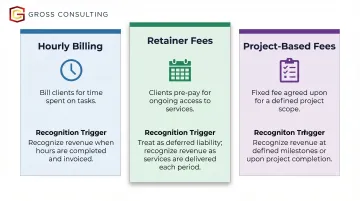
Consultants operate on irregular income that complicates forecasting. You might bill hourly for one client, monthly retainers for another, and project-based fees for a third. Each model requires different revenue recognition:
- Hourly billing: Recognize revenue as you complete and invoice hours
- Retainer fees: Treat deposits as deferred revenue (a liability) until you deliver the work; move them to income as services are performed
- Project-based payments: Recognize revenue at project milestones or completion, depending on your contract terms
Categorize each income type separately in your chart of accounts. This lets you analyze which billing model is most profitable and stable, useful data when making pricing decisions or evaluating which clients to pursue.
Revenue recognition is only part of the picture. Once you know how income flows in, you need equally precise tracking of where your time, and your subcontractors' time, actually goes.
Managing Multiple Clients and Billable Hours
Time tracking is critical for consultants who bill hourly or need to price future projects accurately. It supports:
- Accurate invoicing with detailed breakdowns clients can verify
- Identification of non-billable time drains like admin work, proposal writing, or scope creep
- Data for future pricing - knowing how long tasks actually take prevents underpricing
Implement a dedicated time-tracking tool or use software that integrates tracking with invoicing (FreshBooks, QuickBooks Time, or Harvest). Track time daily, categorize by client and project, and review weekly to spot trends.
Reimbursable Expenses and Mixed-Use Assets
Client-reimbursable expenses, travel, software, materials bought on a client's behalf, must be logged separately from regular overhead. Record them as a pass-through expense and invoice them back promptly. Skipping this step creates revenue leakage and distorts your expense reporting.
Mixed-use assets like a home office or laptop require clear documentation of business-use percentage. For example, if you use your laptop 70% for business and 30% personally, you can deduct 70% of its cost. Track usage with a log or a reasonable method, and apply the same percentage consistently.
Subcontractors and 1099 Compliance
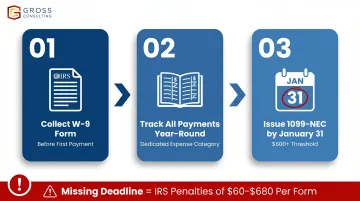
When you hire subcontractors, you have specific bookkeeping and reporting obligations:
- Collect W-9 forms before making any payment - this captures their legal name, address, and tax ID
- Track all payments throughout the year in a dedicated expense category
- Issue 1099-NEC forms by January 31 to any contractor paid $600 or more during the calendar year
Missing the deadline triggers IRS penalties ranging from $60 to $680 per form, with steeper fines for intentional disregard. Use bookkeeping software to flag contractor payments automatically - that way, year-end 1099 filing is a quick export, not a last-minute hunt through bank records.
Tax Deductions Every Consultant Should Know
Diligent bookkeeping is what makes deductions claimable. Without receipts, logs, and categorized records, even legitimate deductions vanish at tax time. Consultants operating as self-employed individuals also owe self-employment tax (15.3% on net earnings: 12.4% Social Security plus 2.9% Medicare) and should account for this in quarterly estimated tax payments.
Common deductible expenses for consultants:
- Home office: Dedicated space used exclusively and regularly for business. Use the simplified method ($5 per square foot, max 300 sq ft, capped at $1,500/year) or the regular method (percentage of actual home expenses like rent, utilities, insurance)
- Business travel: Flights, hotels, meals (50% deductible), and mileage at the IRS standard rate (70¢/mile for 2025)
- Professional development: Courses, certifications, industry memberships, conferences
- Software and tools: Accounting software, CRM platforms, project management tools, design subscriptions
- Marketing and advertising: Website hosting, paid ads, content creation, branding costs
One home office note: The IRS disallows dual-purpose spaces - a guest bedroom that doubles as an office won't qualify, even part-time.
Health insurance and retirement contributions are powerful above-the-line deductions for self-employed consultants:
- Health insurance premiums: Deductible using Form 7206, subject to limits tied to net profit
- SEP-IRA contributions: Up to 25% of net self-employment earnings, capped at $69,000 for 2024 (indexed annually)
- Solo 401(k) contributions: Employee elective deferral of $23,000 (2024), plus employer contributions, with total annual additions capped at $69,000 and catch-up contributions of $7,500 if age 50+
Capturing these deductions accurately in your books is also what makes quarterly tax planning reliable, which brings us to estimated payments.
Quarterly Estimated Tax Payments
Consultants without employer withholding must estimate and pay taxes four times per year if they expect to owe $1,000 or more when filing. Underpayment penalties add up fast - the IRS assessed 12.9 million of them in 2024 alone.
Safe harbor rule: Pay at least 90% of current-year tax or 100% of prior-year tax (110% if prior-year AGI exceeded $150,000) to avoid penalties.
2025 quarterly due dates:
- Q1: April 15
- Q2: June 16 (June 15 is Sunday)
- Q3: September 15
- Q4: January 15, 2026
Use your bookkeeping data, net profit year-to-date, to calculate estimated payments accurately. Review quarterly to adjust for income fluctuations.
Bookkeeping Best Practices to Scale Your Consulting Business
Build a sustainable bookkeeping routine to avoid year-end panic:
- Daily: Capture receipts via mobile app immediately after purchase
- Weekly: Review invoices sent, follow up on overdue payments, log any cash expenses
- Monthly: Reconcile bank and credit card accounts, review profit and loss statement, update cash flow forecast
- Quarterly: Analyze financial performance, calculate estimated taxes, audit expense categories for accuracy

This cadence keeps your records current and gives you an accurate picture of profitability whenever you need it, not just at tax time.
When to bring in professional support: Consider moving beyond DIY bookkeeping when you're dealing with:
- Growing subcontractor relationships that complicate expense tracking
- Multi-state client work with varying tax obligations
- Inconsistent or backlogged records
- Spending more than a few hours per week just keeping up
Gross Consulting works with service-based businesses at exactly this stage, helping owners set up clean financial systems, stay compliant, and free up time to focus on client delivery.
Regular financial reviews, monthly P&L analysis, cash flow forecasting, and expense audits, reveal where to adjust pricing, cut redundant costs, and plan for growth. Accurate books show you exactly where revenue is strong and where cash is quietly leaking out.
Frequently Asked Questions
How much should I pay my bookkeeper per hour?
Freelance bookkeepers typically charge $20–$60/hour, while median employed bookkeeper wages sit around $23.66/hour. Monthly outsourced retainers commonly run $250–$2,500/month depending on transaction volume, complexity, and whether the bookkeeper specializes in service-based businesses.
What expenses can I deduct as a consultant?
Common deductible categories include home office (exclusive business use only), business travel and mileage, software subscriptions, professional development, and self-employed health insurance premiums. Keep receipts and detailed records for every deduction to hold up under IRS scrutiny.
What is the best bookkeeping software for independent contractors?
Cloud-based tools like QuickBooks Online, FreshBooks, or Xero offer the best combination of ease of use, automation, and accessibility. Solo contractors benefit most from platforms that handle invoicing, expense tracking, and 1099 preparation in one place, eliminating the need to sync multiple systems.
What are the 4 types of bookkeeping?
The four main types are single-entry (simple, one transaction record), double-entry (debits and credits, industry standard), cash-basis (records when cash changes hands), and accrual-basis (records when income is earned or expenses incurred). Most consulting businesses use double-entry paired with either cash or accrual basis.
Should consultants use cash or accrual accounting?
Solo consultants and small firms typically start with cash basis - it's simpler and mirrors bank activity directly. Growing consultancies often switch to accrual accounting for a clearer picture of earned revenue and outstanding obligations, particularly when accounts receivable becomes significant.
Do I need to make quarterly estimated tax payments as a consultant?
Yes, self-employed consultants are generally required to make quarterly estimated tax payments if they expect to owe $1,000 or more when filing. Accurate bookkeeping records, showing net profit year-to-date, make calculating these payments straightforward and help you avoid underpayment penalties.