Introduction
Even the most motivated sales teams hit a wall. Routine kills growth, and training that doesn't evolve becomes background noise your reps tune out. Without reinforcement, salespeople forget up to 80% of newly learned information within 90 days, and 85-90% of training investment disappears by 120 days. The problem isn't effort - it's the lack of a system that makes training stick.
That's exactly what these 30 sales training ideas are built to fix. Organized into actionable categories, they're practical tools for sales managers, service-based business owners, and team leaders who want lasting behavior change and compounding results, not just a temporary lift that disappears by next week.
Key Takeaways
- Ongoing, varied training - not one-time events - is what drives real behavior change in sales teams.
- The 30 ideas are grouped into four categories: foundational skills, practice and coaching, prospecting and negotiation, and technology and systems.
- Top-performing teams combine self-assessment, role play, coaching, and reinforcement tools to close skill gaps systematically.
- For service-based businesses, training that sharpens consultative selling, rapport-building, and value communication directly impacts close rates.
Ideas #1–8: Start With the Foundation
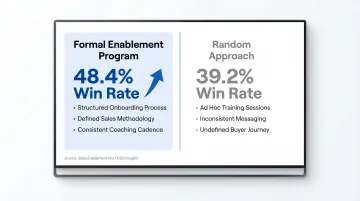
Foundational training establishes the baseline every rep needs before layering on advanced skills. Skipping this step is one of the most common reasons training fails. According to CSO Insights research, organizations with formal enablement programs achieve a 48.4% win rate for forecast deals, compared to just 39.2% for those using a random approach. Foundational work includes self-awareness, communication, and clarity of purpose.
Idea 1: Run a Sales Skills Self-Assessment
Have reps honestly rate themselves across core selling capabilities:
- Prospecting
- Discovery
- Objection handling
- Closing
- Account growth
Use results to build personalized development plans rather than one-size-fits-all programs. Self-assessments reveal skill gaps that generic training misses, allowing you to target coaching where it matters most.
Idea 2: Train on Communication and Active Listening
Reps who can't listen effectively miss the cues that move deals forward. Training should cover not just what to say, but how to ask questions that surface the buyer's real priorities, pain points, budget constraints, decision process, and urgency. The difference between a consultative seller and a pitch-driven vendor is usually this skill.
Idea 3: Build a Rapport Worksheet
Have reps identify specific buyers they want to build trust with, the techniques they'll use, and the outcomes they want to achieve in each relationship. Walk through these worksheets in team sessions to surface gaps and share best practices.
Rapport isn't accidental - it's built systematically through:
- Researching buyer backgrounds
- Identifying common ground
- Demonstrating genuine interest
- Following through on commitments
Idea 4: Create a Customized Sales Question Bank
Break reps into small groups to collectively build lists of discovery questions tailored to your actual buyer personas. Strong sales questions reveal business pain, aspirations, and buying urgency.
Example questions for service-based businesses:
- What prompted you to explore this now?
- What happens if you don't solve this problem in the next 90 days?
- Who else is involved in this decision?
- What does success look like six months from now?
This is far more effective than a generic script.
Idea 5: Train on Value Proposition Positioning
Have reps complete a positioning statement covering:
- Target customer profile
- Specific buyer needs
- The impact of solving them
- Relevant offerings
- Proof points (case studies, results)
- What makes the solution distinct
This transforms vague pitching into precise, resonant messaging that connects features to outcomes buyers care about.
Idea 6: Conduct New Rep Onboarding Programs
Onboarding should go beyond product knowledge. Include the sales methodology, buyer personas, objection handling, and CRM proficiency. According to CSO Insights data, organizations with structured enablement achieve 68.5% quota attainment and 107.8% of revenue plan, versus just 97.6% where expectations aren't formally set.
Tie onboarding to a 30/60/90-day curriculum with clear milestones. This reduces ramp time and accelerates time-to-productivity in a measurable way.
Idea 7: Map Your Competitive Differentiation
Beyond positioning, reps need to know exactly where your offering wins - and where it doesn't. Have each rep build a simple two-column comparison: your solution's strengths against the two or three alternatives buyers typically consider.
This exercise prevents reps from being caught off guard by competitor comparisons during calls. When they can articulate why your approach fits the buyer's specific situation better than the alternative, they close with confidence rather than deflection.
Idea 8: Build Goal-Setting and Action Plans
Reps set short- and long-term revenue goals, then reverse-engineer the daily activities required to hit them. A strong action plan includes:
- Specific revenue and deal count goals
- Prioritized daily tasks
- Habits to build or break
- Identified time-wasters to eliminate
A rep who sets a $500K annual target but hasn't mapped out how many calls, demos, and proposals that requires each week has a wish, not a plan.
Ideas #9–16: Build Skills Through Practice and Coaching
Knowing what to do and being able to do it under pressure are two different things. These eight ideas use coaching loops, structured feedback, and active practice to build the kind of skill that holds up in real sales conversations.
Idea 9: Use Real-World Role Play Scenarios
Pair reps to practice specific sales situations:
- Cold calls
- Discovery calls
- Objection responses
- Closing conversations
Use real accounts or anonymized buyer profiles to make scenarios as realistic as possible, and debrief with structured feedback after each round. Running two to three rounds per session - with a different rep playing the buyer each time - sharpens adaptability, not just script recall.
Idea 10: Record and Review Sales Calls
Recorded call reviews are among the highest-ROI training activities available. Reps hear themselves as buyers hear them, filler words, missed opportunities, pacing issues, and confidence gaps become obvious.
Sales managers should review calls and provide timestamped comments. Group call reviews normalize feedback and accelerate skill development across the team by establishing a visible benchmark for performance everyone can reference.
Idea 11: Run 1:1 Coaching Sessions
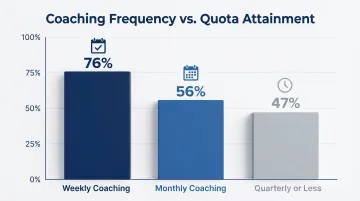
Regular, structured one-on-one coaching sessions should be tied to specific skill gaps identified through assessments or call reviews, not just deal updates. Research shows that weekly coaching or more is associated with 76% quota attainment, while monthly coaching drops to 56% and quarterly or less falls to 47%.
The data is clear: frequency matters. Weekly sessions tied to specific skill gaps consistently outperform sporadic check-ins.
Idea 12: Practice Proposal Presentations
Have reps record themselves delivering a practice proposal for an active opportunity, then share with peers and managers for feedback. Practicing out loud before the real meeting improves:
- Confidence
- Pacing
- Persuasiveness
- Ability to handle interruptions
Reps who rehearse out loud arrive more composed and better prepared to handle interruptions mid-pitch.
Idea 13: Invite Buyers to Give Panel Feedback
Bring in one or more actual customers or buyers to share honest feedback on what the buying experience was like, what worked, what didn't, and what they were really looking for. This is one of the most underused training formats available - and one of the highest-impact. Internal reviews can't replicate what a real buyer reveals in 20 minutes.
Idea 14: Develop a Mentoring Program
Pair junior reps with senior performers for structured, ongoing mentorship, not just informal shadowing. Define:
- Meeting cadence (weekly or biweekly)
- Discussion topics (skill development, deal strategy, objection handling)
- Accountability checkpoints
Mentorship accelerates skill transfer and builds team culture simultaneously. It also reinforces best practices in senior reps by making them articulate what they do and why.
Idea 15: Use Spaced Repetition for Knowledge Retention
Spaced repetition re-exposes reps to key concepts at increasing intervals, counteracting the natural forgetting curve. Peer-reviewed research confirms the spacing effect improves learning and retention across domains, including workplace training.
Use quiz-based tools or LMS platforms that automate the scheduling of review content so retention compounds over time without manual effort from managers.
Idea 16: Gamify Training Activities
Introduce leaderboards, badges, and point-based rewards tied to training completion, quiz scores, or skill milestones. A corporate training study found that gamification significantly improved knowledge retention (explaining 61.7% of variance, p=0.003) and job performance.
When training has a scoreboard, reps engage with it differently - completion rates climb and skills that might otherwise fade get reinforced through healthy competition.
Ideas #17–24: Prospecting, Negotiation, and Pipeline Growth
This category targets the revenue-generating mechanics of selling, getting meetings, handling tough conversations, and moving opportunities forward. These activities are where skill gaps most directly impact the bottom line.
Idea 17: Draft Practice Prospecting Emails
Have reps write prospecting emails for real targets in their pipeline, then workshop them as a group. Strong prospecting emails include:
- A customized hook that references the prospect's situation
- A clear value offer for the meeting
- A specific call to action
Generic templates get ignored. Personalized, value-driven emails get responses.
Idea 18: Brainstorm Prospecting Value Offers
In small teams, have reps generate ideas for what they can offer prospects in exchange for a meeting, educational content, audits, assessments, or insights specific to the buyer's situation. Value offers should answer:
- Why Act?
- Why Now?
- Why Us?
- Why Trust?
When reps lead with something genuinely useful, the prospect's first interaction becomes a demonstration of competence, not a pitch.
Idea 19: Apply a Buyer Qualification Framework
Train reps to qualify opportunities systematically using a framework like FAINT (Funds, Authority, Interest, Need, Timing). Use real or anonymized pipeline opportunities as practice cases, then debrief on which deals deserve priority and which are dead ends.
Regular qualification debriefs also reveal patterns, common deal killers, overlooked stakeholders, or stages where pipeline consistently stalls.
Idea 20: Do the BATNA Negotiation Exercise
Have reps identify their Best Alternative to a Negotiated Agreement, and their buyer's likely BATNA, for a current opportunity. Understanding both sides' walk-away points transforms negotiations from reactive pressure to strategic positioning.
Knowing your walk-away point in advance means reps stop making concessions out of discomfort - they make them deliberately, and only when it moves the deal forward.
Idea 21: Simulate Sales Negotiations
Role-play common buyer negotiation tactics with one rep playing the buyer and the other responding as the seller. Practice handling:
- Anchoring (buyer sets a low initial price)
- Red herring (introducing irrelevant issues to distract)
- Cherry-picking (taking only parts of your offer)
Create a master list of tactics and rehearsed responses the whole team can draw from in live deals.
Idea 22: Build a Referral Generation Plan
Have reps map out their top clients and create a simple plan for asking for referrals: the right timing, the right framing, and the right offer (if applicable). 88% of global respondents trust recommendations from people they know more than any other channel.
Referral leads close at dramatically higher rates than cold outreach because trust is pre-established.
Idea 23: Complete a Sales Opportunity Plan
For each major deal in the pipeline, reps build a structured plan covering:
- Opportunity snapshot
- Key stakeholders
- Buyer needs
- Value case
- Competitive threats
- Next steps
Use these plans as coaching tools in pipeline reviews rather than just as documentation. They reveal strategic thinking gaps and surface risks early.
Idea 24: Run a Prospecting Meeting Calculator Exercise
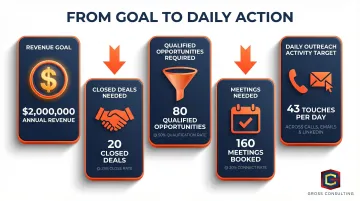
Once reps understand what's in their pipeline, the next step is ensuring they're building enough of it. Walk them through a reverse-engineering exercise: starting from their revenue goal, calculate the number of closed deals, opportunities, meetings, and outreach activities needed to hit the target.
This turns abstract goals into concrete daily activity benchmarks. If you need 20 new deals and your close rate is 25%, you need 80 qualified opportunities, and if your meeting-to-opportunity rate is 50%, you need 160 meetings.
Ideas #25–30: Leverage Technology, Systems, and Mindset to Scale
Modern sales training doesn't end in the classroom. Technology extends coaching into daily workflows, while mindset and systems training creates durable performance habits. These final six ideas are especially relevant for growing service-based businesses that need to scale without adding headcount proportionally.
Idea 25: Train Reps on LinkedIn and Social Selling
Develop a structured 15-day LinkedIn challenge or equivalent cadence:
- Optimize profile headlines and summaries to speak directly to target buyers
- Connect with decision-makers using personalized, non-pitch messages
- Share relevant content consistently to build credibility in the feed
- Engage in existing conversations before starting new ones
Social selling builds pipeline without cold outreach friction, especially in professional services. LinkedIn data shows that sellers with at least four LinkedIn connections at a target account are 16% more likely to close.
Idea 26: Master Virtual Selling Techniques
Train reps on virtual meeting structure, visual engagement tools (whiteboarding, screen sharing, polls), camera presence, and follow-up. McKinsey research found that 65% of B2B customers prefer remote human interactions or digital self-service over in-person.
As more service-based business conversations move to video, virtual selling competency has become a baseline expectation across industries.
Idea 27: Integrate AI-Powered Coaching and Call Analysis Tools
Introduce AI tools that analyze recorded calls for talk time ratios, keyword triggers, sentiment shifts, and next-step clarity. Managers get prioritized coaching queues instead of reviewing every call manually - focusing attention where it actually moves the needle.
Salesforce's 2026 State of Sales report found that top performers are 1.7x more likely to use AI agents than struggling teams, and AI is expected to reduce research time by 34%.

Idea 28: Identify and Protect Greatest Impact Activities (GIAs)
Have reps and managers each identify the 2-3 daily activities that, if done consistently, would have the greatest effect on revenue, then build their schedule around protecting those blocks.
Training on time management and distraction avoidance is as important as any sales skill. GIAs might include:
- Prospecting outreach
- Discovery calls
- Proposal follow-up
- Deal coaching
Everything else should be delegated, automated, or eliminated.
Idea 29: Run a "Train the Trainer" Program
Certify your best internal performer or sales manager to deliver standardized training using a proven methodology. This scales training delivery without outsourcing every session and creates ownership of the training culture internally.
The result: consistent delivery, lower per-session cost, and a team that understands the methodology well enough to adapt it as the business grows.
Idea 30: Hire or Consult an External Sales Expert
External consultants bring fresh perspective, structured frameworks, and cross-industry pattern recognition that internal teams rarely develop on their own. This investment makes the most sense when you're experiencing:
- Rapid growth that's outpacing internal training capacity
- Stagnating win rates despite effort
- Entering a new market segment
Gross Consulting works with service-based businesses, attorneys, real estate firms, medical practices, accountants, and eCommerce brands, to build the sales systems and growth strategies that turn training into repeatable, measurable revenue growth.
How to Build a Sales Training Program That Actually Sticks
Most training fails because it's treated as a single event rather than a system with reinforcement built in. Without reinforcement, up to 80% of training content is forgotten within 90 days. The most effective programs combine foundational skill-building, repeated practice, ongoing coaching, and measurement.
A simple framework for choosing which ideas to prioritize:
- Start with a skills assessment to identify gaps (Idea 1)
- Pick 3–5 ideas to build a 90-day training cycle
- Assign accountability for each training element
- Measure impact through win rate, ramp time, or pipeline velocity
That framework is a starting point - but executing it consistently is where most teams struggle. For service-based businesses that need more than a training plan, Gross Consulting designs and implements the operational and sales infrastructure that makes each training cycle build on the last. The firm combines AI, automation, and hands-on human strategy, covering sales scripting, team coaching, real-time performance reviews, and recruitment support.
To explore building a repeatable sales system, reach out to Gross Consulting at +1 (424) 347-6865 or support@grossconsultinginc.com.
Frequently Asked Questions
What should be included in sales training?
Sales training should cover prospecting, discovery, negotiation, and closing skills, along with product knowledge, communication training, and CRM proficiency. Equally important are soft skills like active listening, rapport-building, and objection handling. Strong programs combine foundational skill-building with ongoing coaching and reinforcement.
What are the five methods of sales training?
The five core methods are instructor-led training, e-learning/microlearning, role play and simulation, on-the-job coaching, and peer or mentorship-based learning. The best programs combine multiple methods to address different learning styles and reinforce concepts through varied delivery formats.
What is the 3-3-3 rule in sales?
The 3-3-3 rule refers to following up three times in three different ways over three days. It helps reps stay focused and structured in their outreach cadence, ensuring consistent engagement without overwhelming prospects or appearing too aggressive.
What is the 2-2-2 rule in sales?
The 2-2-2 follow-up rule suggests contacting a prospect 2 days after initial contact, again after 2 weeks, then once more after 2 months - balancing persistence with respect for the buyer's timeline.
What are the 7 C's in sales?
The 7 C's commonly include Connect, Clarify, Collaborate, Create, Confirm, Close, and Continue. They serve as a framework for structuring the full sales conversation or relationship cycle, covering everything from initial engagement through post-sale account management.
What are the 5 P's of sales?
The 5 P's typically cover Preparation, Presence, Probing, Presentation, and Post-sale follow-through - a framework that guides reps through every stage of the sales process.