Most service-based businesses rely on sporadic training events or ad-hoc guidance when performance dips. Without consistent coaching, even capable professionals lose direction. They revert to old habits, miss critical selling moments, and leave revenue on the table. In 2026, this gap has become impossible to ignore.
This guide covers what sales performance coaching actually is, why it matters more than ever for service businesses, which techniques deliver measurable results, and how to build a repeatable coaching system, even without a large sales team.
Key Takeaways
- Sales performance coaching is an ongoing, data-driven process that helps reps hit quota consistently and build repeatable revenue habits
- Top techniques - role-playing, call shadowing, structured feedback loops, and GROW goal-setting - drive far higher retention than one-time training sessions
- Effective coaching is personalized, measurable, and embedded into weekly workflows, not saved for annual reviews
- Coached teams hit 76% quota attainment versus 47% for those coached quarterly or less - a gap that compounds directly into revenue
- Gross Consulting integrates sales coaching with CRM optimization, automation, and real-time performance reviews to help service businesses build scalable revenue systems
What Is Sales Performance Coaching (And How It Differs from Training)
Sales performance coaching is a structured, ongoing process focused on measurable outcomes, win rates, deal velocity, quota attainment, rather than general skill building. Unlike one-time training events that deliver information, coaching embeds behavioral change into the flow of real sales work through regular one-on-one sessions, call reviews, and targeted skill development.
The Three-Way Distinction Most Firms Miss
Many service businesses confuse three distinct development approaches:
Training is event-based and knowledge-focused, answering "what should I do?" through group workshops, online courses, or certification programs. A sales kickoff or CRM tutorial is a classic example: foundational, but delivered once and done.
Coaching is ongoing and behavior-focused. It answers "how do I apply this?" through personalized sessions that analyze real conversations, identify performance gaps, and build action plans. The result is knowledge that actually sticks, applied in live calls rather than forgotten after a workshop.
Mentoring is relationship-based and career-oriented. It pairs less experienced reps with senior practitioners for guidance on navigating organizational dynamics, client relationships, and long-term career development. Mentoring builds wisdom; coaching builds skills.
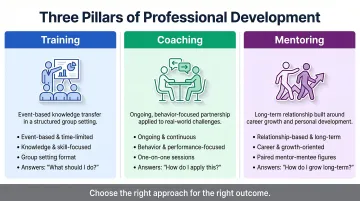
74% of leading companies cite coaching and mentoring as the most important role for sales managers, yet only 34% of sales leaders have ever received training on how to coach effectively.
The Knowledge Decay Problem
Training without reinforcement fails predictably. Research shows that approximately 87% of sales training content is forgotten within 30 days without follow-up, and within just one hour of a session, learners have already lost around half of what was covered. This is the Ebbinghaus forgetting curve in action.
Coaching breaks that pattern by embedding practice into daily work. Instead of attending a two-day workshop and returning to business as usual, coached reps apply new techniques immediately, receive feedback within 24 hours, and refine their approach in the next session. Over time, that repetition produces consistent behavior, not just awareness.
For service businesses where owners often double as sellers, attorneys managing client development, doctors handling consultations, accountants pitching advisory services, the decay problem hits hardest. Without structured reinforcement, even well-trained professionals default to old habits when it counts most - in front of a prospective client.
Why Sales Performance Coaching Is Critical for Service Businesses in 2026
The business case for formal coaching has never been stronger. Teams coached weekly achieve 76% quota attainment compared to 47% for those coached quarterly or less. Reps who rate their coaching as excellent or very good are 50% more likely to achieve or exceed targets. Yet only 27% of reps currently hit their quota overall.
The Coaching Investment Gap Creates Competitive Advantage
While the data proves coaching drives revenue, most organizations significantly underinvest:
- 73% of sales managers spend less than 5% of their time coaching
- 90% of leaders claim they coach monthly, yet 38% of reps say they're rarely or never coached
- 45% of reps rate the coaching they receive as below average, up from 29% the previous year
- Only 10-40% of manager time is available for value-add activities like coaching, according to McKinsey research
This perception gap, where leaders believe they coach but reps don't experience it, creates real opportunity. Service businesses that commit to structured coaching immediately differentiate themselves from competitors still relying on annual training events.
2026's Unique Pressures Demand Better Coaching
Three converging trends make coaching essential now:
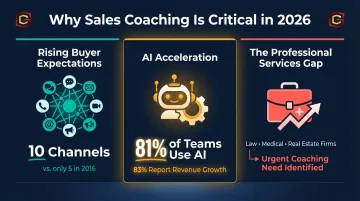
Rising buyer expectations. B2B buyers now use an average of 10 interaction channels, up from 5 in 2016. 61% prefer a rep-free buying experience for routine tasks, but still want human sellers for contextual judgment calls. The remaining seller interactions are more complex and consultative, exactly where coaching matters most.
AI acceleration. 81% of sales teams now use AI, and AI-using teams report 83% revenue growth versus 66% for non-AI teams. 75% of reps and leaders believe AI has increased the need for coaching because automation handles routine tasks, pushing professionals into higher-stakes conversations that require nuanced skills.
The professional services gap. For law firms, medical practices, real estate teams, and accounting firms, selling often feels uncomfortable. Owners and partners trained as technical experts struggle to structure client conversations in a way that feels natural and professional. Coaching gives them a repeatable framework for those conversations, one that earns trust without feeling transactional. This is a core part of what Gross Consulting addresses with service-based businesses: building sales infrastructure that pairs coaching with the CRM and workflow systems that make it stick.
Who Benefits and How
Structured coaching creates measurable impact across the entire team:
- Reps get targeted skill development for their specific gaps, not generic training that misses the mark
- Managers gain visibility into where deals fall apart (weak discovery, missed objection cues, inconsistent follow-ups) and can course-correct before opportunities are lost
- Buyers experience more relevant conversations that help them make decisions with confidence, not pressure
The ROI is clear: organizations report an average return of 7 times the cost of coaching, according to ICF and PwC research. 40% also report stronger employee retention, meaningful in an industry where sales rep turnover averages 35% annually.
Core Sales Coaching Techniques That Drive Results
Effective coaching relies on repeatable techniques, not improvised conversations. Each method below functions as a manager tool that can be applied weekly to develop specific skills.
Role-Playing
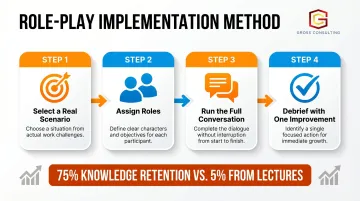
Role-playing delivers the highest ROI of any coaching technique. Active practice via role-play results in 75% knowledge retention versus just 5% from lecture-style learning. Sellers who engage in regular role-play close 20% to 45% more deals, and structured programs reduce ramp time by 2 to 4 weeks.
Implementation method:
- Select a real scenario - Choose an actual objection, cold outreach call, or closing conversation your rep will face this week
- Assign roles - Have the rep play themselves; you play the prospect using real language and resistance
- Run the conversation close to reality - No pausing to coach mid-scene; let the rep navigate the full interaction
- Debrief with one specific improvement - Ask what the rep would change, share one observation, agree on one behavior to practice (e.g., "Ask permission before presenting pricing")
Role-play works because it builds muscle memory for high-pressure moments. Reps rehearse objection handling, tonality, pacing, and question sequencing in a safe environment before stakes are real.
Shadowing and Call Reviews
Where role-play builds skills in advance, shadowing and call reviews surface gaps in real execution. Live shadowing (listening to calls in real-time) and asynchronous review (analyzing recorded calls) catch what metrics miss: poor discovery questions, failure to set next steps, weak value articulation, or rushing past objections.
Debrief structure:
- Ask the rep to self-reflect first - "What went well? What would you change?" This builds self-awareness and accountability
- Share two specific observations - One strength to reinforce, one gap to address (e.g., "You built great rapport early, but didn't ask about budget timeline")
- Agree on one action item - Define a concrete behavior for the next call (e.g., "Confirm next steps before ending every discovery call")
Gong's analysis of millions of B2B sales calls found the optimal talk-to-listen ratio is 43% talking to 57% listening. Companies using behavioral call analysis achieved a 57.1% win rate and shortened seller ramp time. Call reviews make these patterns visible and coachable.
Gross Consulting connects conversation intelligence tools with CRM data to automatically flag coaching moments: calls where reps dominate the conversation, skip next-step confirmation, or leave objections unaddressed. Managers get targeted coaching opportunities without manually reviewing every recording.
Structured Feedback Loops
Identifying gaps through call reviews only works if the follow-up is fast and specific. Generic praise ("great job") or delayed criticism ("your close rate was low last quarter") rarely moves the needle. Behavior-specific, timely feedback does.
The loop:
- Review a specific call or metric - Pull one recent conversation or a KPI like discovery-to-demo conversion rate
- Highlight one strength - Reinforce what's working (e.g., "You asked three strong discovery questions about their current process")
- Define one behavior-based action - Make it concrete and measurable (e.g., "In your next five calls, ask at least one question about implementation timeline")
- Track it in the next session - Begin the following coaching conversation by reviewing whether the behavior improved
Reps coached within 24 hours of a call are 2.5x more likely to improve performance, yet only 30% of managers provide coaching within that window. Structured feedback loops close this gap.
Goal Setting with the GROW Model
GROW (Goal, Reality, Options, Way Forward) is a practical framework for structuring every coaching conversation. Sir John Whitmore and colleagues developed it in the 1980s; it's now the most widely adopted coaching model in sales, translated into 20 languages.
How it works:
- Goal: Define the specific outcome (e.g., "Increase close rate from 25% to 35% by end of Q3")
- Reality: Assess the current state objectively (e.g., "Currently closing 25%; main drop-off is at negotiation stage")
- Options: Brainstorm solutions together (e.g., "Practice negotiation scripts, shadow top closer, review lost deals weekly")
- Way Forward: Commit to one action with timeline (e.g., "Role-play negotiation scenarios in next three coaching sessions; track close rate weekly")
GROW transforms vague intent into concrete plans. The rep builds the plan; the coach guides. That co-creation drives ownership and follow-through far better than top-down directives.
Peer Learning and Success Sharing
Peer coaching distributes best practices across the entire team without consuming one-on-one manager time for every lesson. Deal reviews, shared call highlights, and internal win/loss breakdowns all qualify.
Applications:
- Weekly team huddle where top performer shares one technique from a recent win
- Deal autopsy sessions analyzing why a major opportunity was lost
- Call library where reps can listen to anonymized examples of excellent discovery, objection handling, or closing
This approach is especially useful for small service-business sales teams where manager bandwidth is limited. Gross Consulting helps clients build peer learning sessions into a scalable coaching system - so skill development doesn't stall between formal training events.
How to Build a Sales Coaching Program Step by Step
Most service businesses have no formal coaching system - they react to poor performance rather than proactively developing reps. This blueprint creates a repeatable structure.
Step 1: Define Clear, Measurable Goals
Coaching goals must align with real business outcomes. Not "be better at sales," but "improve discovery-to-demo conversion from 40% to 55% in Q3."
Use SMART goal structure:
- Specific: Target one KPI (win rate, average deal size, activity volume, stage conversion)
- Measurable: Define baseline and target with numbers
- Achievable: Set stretch goals grounded in current performance
- Relevant: Connect to business revenue targets
- Time-bound: Assign a quarter or month deadline
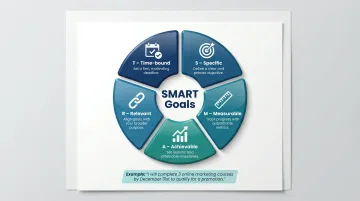
Example: "Increase proposal-to-close rate from 30% to 40% by end of Q2 by improving negotiation and objection handling skills."
Collaboratively set goals drive more ownership. Reps who help define their own development targets follow through at higher rates than those handed goals from the top.
Step 2: Build a Consistent Coaching Cadence
Consistency outperforms intensity. A short, regular coaching touchpoint beats a quarterly deep-dive every time.
Realistic rhythm for service businesses:
- Weekly or bi-weekly 30-minute 1:1s - Review one call, one metric, or one skill development area
- Monthly group session - Team deal reviews, peer learning, or skill workshop
- Brief post-call debriefs - 5-10 minute check-ins after important conversations
Only 26% of reps report receiving coaching weekly; 33% receive it monthly; 24% rarely; 14% never. Organizations that establish weekly cadence immediately outpace competitors.
Block time on your calendar and treat coaching sessions as non-negotiable. Manager spans of control are rising (now averaging 12+ direct reports), compressing available time further. Tools that automate coaching trigger identification, flagging which reps need attention based on CRM data and call patterns, help managers use limited time effectively.
Step 3: Use Data to Drive Every Conversation
Replace gut-feel coaching with objective, behavior-based guidance. Managers should come to each session with 2-3 specific data points, not general impressions.
Data sources:
- CRM pipeline metrics: Stage conversion rates, time-in-stage, next-step compliance
- Call recordings: Talk-listen ratio, question frequency, objection handling patterns
- Activity metrics: Outbound volume, follow-up rates, response times
Gross Consulting helps service businesses build systems that combine AI analysis with human judgment to surface coaching triggers automatically. Instead of manually reviewing every call, managers receive alerts when a rep consistently talks more than 65% of the time, skips discovery questions, or fails to confirm next steps.
This lets leaders spend time developing people rather than compiling reports.
Example data-driven coaching conversation: "I reviewed your last five discovery calls. Your average talk time is 68%, well above the 43% benchmark. Let's role-play your discovery script and practice asking three follow-up questions before sharing solutions."
Step 4: Create a Psychologically Safe Coaching Environment
Reps only improve when they feel safe sharing failures without fear of punishment. Google's Project Aristotle identified psychological safety as the #1 predictor of team effectiveness. Sales teams with high psychological safety exceeded sales targets by 17%.
The coach's role is guide, not auditor.
Use the CLEAR model (developed by Professor Peter Hawkins) to structure trust-building conversations:
- Contract: Agree on coaching purpose and confidentiality at the start
- Listen: Give reps space to self-reflect before offering input
- Explore: Ask questions to uncover root causes, not just symptoms
- Action: Co-create solutions rather than dictating fixes
- Review: Follow up on commitments in the next session
Psychological safety doesn't mean avoiding tough conversations. It means reps trust that coaching exists to develop them, not document their failures for HR.
Step 5: Iterate and Adjust Based on Results
No coaching program works forever without adjustment. Review effectiveness quarterly.
Questions to ask:
- Are reps improving on the KPIs tied to coaching topics?
- Are managers following through on coaching cadence consistently?
- Which techniques (role-play, call review, peer learning) drive the most behavior change?
- What obstacles prevent reps from applying coaching in real conversations?
Once you've answered those questions, use the OSKAR model (Outcome, Scaling, Know-how, Affirm & Action, Review) to guide your refinement sessions. Rather than dissecting what's broken, identify what's working and scale it. If role-play drives the biggest win rate improvements, double the frequency. If peer deal reviews aren't changing behavior, replace them with 1:1 shadowing.
Gross Consulting builds this iteration cycle directly into quarterly business reviews with clients, tracking which coaching methods moved the needle on win rates, conversion, and activity volume, then recalibrating the program around what actually works.
How to Measure Sales Coaching Effectiveness
Track three categories of metrics to assess coaching impact:
Performance Metrics (Lagging Indicators)
- Quota attainment rate: Percentage of reps hitting or exceeding targets
- Win rate: Percentage of qualified opportunities closed
- Average deal size: Revenue per closed deal
- Pipeline velocity: Time from first contact to close
- Revenue growth: Quarter-over-quarter or year-over-year increase
Benchmarks by segment (Aviso):
- Enterprise: 20-30% win rate
- Mid-Market: 30-40% win rate
- Velocity/SMB: 40-55% win rate
Observational Metrics (Leading Indicators)
- Call quality scores: Talk-listen ratio, question rate, objection handling frequency
- Stage conversion rates: Discovery-to-demo, demo-to-proposal, proposal-to-close
- Next-step compliance: Percentage of calls ending with confirmed next action (target >90%)
- Coaching session frequency: Actual 1:1 cadence versus target
- Manager follow-through rate: Percentage of coaching action items reviewed in subsequent sessions
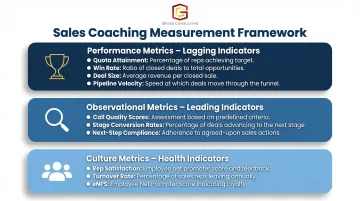
Culture Metrics (Health Indicators)
- Rep satisfaction with coaching: Survey rating of coaching quality and relevance
- Voluntary turnover rate: Attrition among coached versus non-coached reps (40% of organizations see better retention for coached employees)
- eNPS (Employee Net Promoter Score): Likelihood to recommend the company as a workplace
- Internal promotions: Percentage of reps promoted into leadership roles
The Leading vs. Lagging Balance
Those three categories only tell the full story when used together. If you only check quota at quarter-end, you miss the early signals that coaching is or isn't working. Leading indicators - activity levels, coaching participation rates, progress on specific skill benchmarks - let managers intervene before performance drops, not after.
Review cadence:
- Coaching KPIs: Monthly (session frequency, action item completion, call quality trends)
- Performance trends: Quarterly (quota attainment, win rates, pipeline health)
Share results transparently with the team. When reps see that coached peers consistently outperform those receiving only quarterly check-ins - with quota attainment gaps of 20-30 percentage points being common - they start asking for more coaching rather than tolerating it. That shift in mindset - from coaching as correction to coaching as advantage - is one of the clearest signs a program is working.
Frequently Asked Questions
What does a sales coach do?
A sales coach helps reps identify performance gaps, build specific skills, and develop structured action plans through regular one-on-one sessions. The goal is guided self-improvement through data-driven feedback, role-play, and behavioral reinforcement, not instruction or micromanagement.
How to effectively coach a sales team?
Start with a consistent weekly or bi-weekly cadence and use CRM data and call reviews to keep conversations objective. Focus on one behavior change at a time, then follow up in every subsequent session to reinforce accountability.
How much does a sales coach cost?
Costs vary widely based on engagement scope and coach experience. The average one-hour coaching session is $244 USD globally (ICF 2024 Annual Report), with freelance platforms showing median rates around $100 per hour. Internal coaching programs scale with team size; evaluate cost against measurable revenue impact of improved quota attainment.
What are the 5 C's of coaching?
The 5 C's typically refer to: Clarity (clear goals and expectations), Commitment (rep buy-in and ownership), Consistency (regular coaching sessions), Competence (skill development and mastery), and Culture (coaching as a team norm, not exception). Different frameworks use variations of this model.
What is the 70/30 rule in sales?
The traditional 70/30 rule suggests reps should listen 70% of the time and talk 30% during sales conversations. Gong's research puts the actual optimal closer to 43% talking and 57% listening - a meaningful distinction that effective coaching reinforces through call review and role-play.
What are the 5 C's of sales?
The 5 C's of sales refer to: Contact (prospecting and outreach), Connect (building rapport), Convince (presenting solutions and handling objections), Close (finalizing agreements), and Continue (nurturing ongoing relationships). Use them as a diagnostic lens to identify which stage a rep consistently struggles with.
Ready to build a sales coaching system that scales? Gross Consulting works with law firms, medical practices, real estate teams, and professional service providers to build structured coaching programs backed by CRM data, automation, and performance tracking, so your team sells with consistency, not guesswork.
Contact us at (424) 347-6865 or support@grossconsultinginc.com to schedule a free consultation.