
Introduction
Bookkeeping for service businesses is the systematic recording, organizing, and tracking of all financial transactions in a business that sells time, expertise, or deliverables rather than physical products. Most service business owners assume the absence of inventory simplifies their finances. It doesn't. 82% of small business failures cite cash flow problems as the primary cause, and 60% struggle with late customer payments.
Service businesses face a distinct set of financial challenges that product-based companies simply don't encounter:
- Irregular cash flow tied to project timelines and client cycles
- Time-based billing that requires precise tracking to avoid revenue leakage
- Retainer structures that complicate revenue recognition
- Client payment delays that strain operating budgets
These challenges make clean, accurate bookkeeping a core business function, not an afterthought. This guide covers what makes bookkeeping different for service businesses, how to set up the right system, the practices that protect cash flow, and when to bring in professional help. Whether you're a consultant, attorney, agency owner, or real estate investor, the financial systems you build now directly determine your capacity to grow.
Key Takeaways
- Service business bookkeeping centers on tracking time, invoices, and cash flow, not inventory
- Revenue recognition is complex due to retainers, milestone billing, and variable project scopes
- Keep personal and business finances separate, pick the right accounting method, and reconcile accounts every month
- Monthly financial reports drive strategic decisions about hiring, pricing, and profitability
- Hiring bookkeeping support pays off quickly once your financials grow too complex to manage solo
What Is Bookkeeping for Service Businesses?
Bookkeeping is the ongoing process of recording every financial transaction, income, expenses, payments, to maintain accurate books. According to the NYSSCPA Accounting Terminology Guide, bookkeeping is "the process of recording financial transactions and keeping financial records." This differs from accounting, which analyzes and interprets that data to provide strategic advice. In short: bookkeeping is data capture; accounting is analysis and reporting.
That distinction matters more in a service business than most owners expect. The financial mechanics here look different from product-based companies:
- Revenue is tied to time and deliverables, not physical inventory
- Cost of goods sold is primarily labor and software, not raw materials
- Profitability depends on rate accuracy and utilization (the percentage of billable hours your team actually invoices), not product margins
Four Primary Bookkeeping Methods
| Method | Definition | Best For |
|---|---|---|
| Single-Entry | Records each transaction once (income or expense) | Very small sole proprietorships with minimal transactions |
| Double-Entry | Records each transaction twice (debit and credit) to maintain balance | Most businesses beyond startup phase |
| Cash-Basis | Records income when received and expenses when paid | Service businesses under $26 million in annual gross receipts |
| Accrual-Basis | Records income when earned and expenses when incurred | Larger businesses with retainers, long-term contracts, or required by IRS |
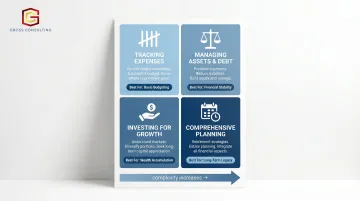
According to IRS Publication 538, most service businesses can use cash-basis accounting if their average annual gross receipts for the prior three tax years were $26 million or less. Service businesses typically start with cash-basis and transition to accrual-basis as complexity grows, particularly when managing retainer clients, milestone billing, or seeking outside financing.
Why Service Businesses Need a Different Bookkeeping Approach
Unlike product businesses, service businesses lack physical inventory to anchor financial tracking. This means cash flow, accounts receivable, and time utilization become your critical financial levers instead. When manufacturers or retailers run low on cash, they can convert inventory to cash through sales or liquidation. Service businesses have no such buffer, making bookkeeping vigilance essential for survival.
Revenue Complexity Unique to Service Businesses
Service businesses navigate four distinct revenue structures, each requiring different invoicing, income recognition, and cash flow forecasting methods:
- Retainer clients - Fixed monthly fees paid in advance or arrears
- Project-based fees - Lump-sum payments tied to deliverable completion
- Milestone billing - Staged payments tied to project phases
- Hourly rates - Time-and-materials billing based on actual hours worked
Conflating these revenue types leads to inaccurate books. For example, recording a $60,000 annual retainer as revenue in January when it's actually earned proportionally over twelve months inflates Q1 revenue and distorts profitability metrics throughout the year.
The Cash Flow Gap Problem
Service businesses typically invoice after work is done or on a predetermined schedule, but clients often pay on Net-15, Net-30, or later terms. According to a QuickBooks survey, 47% of U.S. small businesses are waiting on invoices at least one month overdue. That gap between revenue earned and cash received puts real strain on operations.
54% of small businesses have less than 31 days of cash on hand, far below the recommended 90-180 days of operating reserves. For service businesses on tight margins, this can mean missing payroll even when you're technically profitable on paper.
Tax and Compliance Implications
Service business owners face layered tax obligations that poor bookkeeping makes worse:
- Self-employment tax hits 15.3% on 92.35% of net earnings (12.4% Social Security + 2.9% Medicare), plus 0.9% above $200,000. Combined with federal income tax, effective rates often exceed 40%.
- Quarterly estimated payments catch many owners off guard. One-third don't know if they're required to pay, and 25% don't know how to file, per American University research.
- Worker classification errors expose service businesses to back taxes, interest, and penalties. The IRS three-factor test, behavioral control, financial control, and relationship type, must be applied correctly for every contractor.
For service businesses scaling toward seven figures, clean books do more than satisfy compliance. They supply the data behind confident pricing decisions, hiring projections, and lender or investor conversations.
How to Build Your Bookkeeping System Step by Step
Building a proper bookkeeping system starts with one foundational decision: choosing between cash-basis and accrual-basis accounting. Cash-basis is simpler and records income and expenses when money changes hands. Accrual-basis is more accurate for growing businesses with retainers or long-term contracts, recording transactions when earned or incurred rather than when paid.
Step 1: Separate Business and Personal Finances
Open a dedicated business bank account and business credit card immediately. Commingling funds creates legal liability exposure, IRS red flags, and makes reconciliation significantly harder. This is especially critical for single-member LLCs and S-Corps, which have strict distribution and documentation requirements.
The IRS scrutinizes mixed transactions during audits, and a single, dedicated business account with clean records is your first line of defense. It protects your legal standing and cuts reconciliation time substantially.
Step 2: Set Up Your Chart of Accounts
Your chart of accounts is the backbone of bookkeeping - it categorizes every transaction. Default templates in bookkeeping software are built for retail or product businesses, not service companies. Tailor your chart of accounts to service-specific categories:
Service Business Revenue Categories:
- Consulting fees (by service line)
- Retainer income
- Project-based revenue
- Hourly billings
Service Business Expense Categories:
- Contractor costs (1099 labor)
- Software subscriptions (CRM, project management, communication tools)
- Professional development and certifications
- Marketing and client acquisition
- Professional services (legal, accounting, insurance)
- Home office expenses
- Client entertainment and meals
Getting these categories right at setup, not retroactively, is what separates clean books from a quarterly scramble to find missing deductions.
Step 3: Choose and Configure Your Bookkeeping Software
QuickBooks holds over 62% of the SMB accounting software market, with particularly strong adoption among service industries: accounting firms (13.4%), IT services (12.5%), and marketing agencies (6.2%). For service businesses, look for software that includes:
- Invoicing capabilities with customizable templates
- Time tracking integration or built-in timer
- Recurring billing for retainer clients
- Bank feed sync for automatic transaction import
- Client-by-client profitability reporting
QuickBooks Online pairs well with payroll platforms, an important consideration when you're managing contractor payments, employee payroll, and owner distributions at the same time. Gross Consulting, as a Verified Gusto Accountancy Partner, configures these systems to work in sync so nothing falls through the cracks between payroll and your books.
Step 4: Build a Consistent Invoicing and Accounts Receivable Process
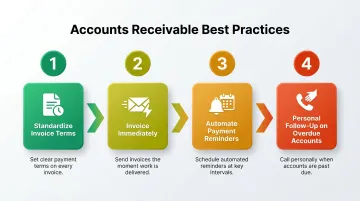
Late payments destroy cash flow. Implement these non-negotiable AR practices:
Standardize invoice terms: Choose Net-15 or Net-30 and enforce it consistently. Shorter terms improve cash flow; longer terms may win clients but strain your operating reserves.
Invoice immediately: Bill upon project completion or on your retainer schedule. A one-week delay in invoicing often becomes a one-week delay in payment, compounded across every client.
Automate payment reminders: Set up automated reminders at 7 days before due date, on due date, and at 7, 14, and 30 days past due.
Follow up personally on overdue accounts: Once an invoice reaches 30 days past due, personal outreach becomes necessary. A quick phone call often resolves payment issues that emails can't.
Key Bookkeeping Practices That Support Growth
Monthly Bank Reconciliation Is Non-Negotiable
Bank reconciliation means comparing your internal transaction records to your bank statements to catch errors, duplicate charges, or fraud. Service businesses that skip this step often discover costly discrepancies only at tax time, when it's too late to correct them cleanly.
Reconcile every account monthly: business checking, business savings, business credit cards, and payment processor accounts. This catches mistakes when they're fresh and ensures your books reflect reality.
Monthly Financial Reports Drive Strategic Decisions
42% of small business owners admit they had limited or no financial literacy before starting their businesses, and that gap costs an average of $118,121 in lost profit. Monthly financial reports close that gap by turning raw transaction data into decisions you can act on.
The three reports every service business needs:
- Profit & Loss (P&L) Statement: Tracks revenue, expenses, and net profit over a period. Use it to spot shrinking margins and identify your most profitable service lines.
- Balance Sheet: Captures assets, liabilities, and equity at a specific date - your snapshot of financial health and what you actually owe.
- Cash Flow Statement: Maps cash moving in and out. Critical for answering why a profitable business still can't make payroll.
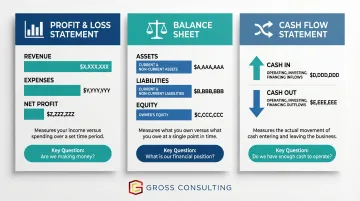
Owners who review these three reports monthly catch pricing problems and cash shortfalls before they compound.
Track Service-Specific Financial KPIs
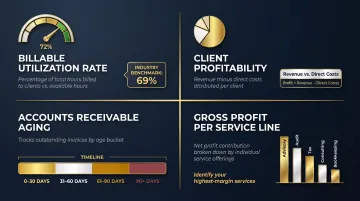
Beyond basic bookkeeping, service businesses must track operational KPIs:
Billable Utilization Rate: What percentage of available hours are actually billed? Professional services average around 69% - agencies typically hit 55-60%, consulting firms 70-85%. Below 65% means revenue walking out the door; above 85% risks burning out your team.
Client Profitability: Revenue minus direct costs (labor, software, out-of-pocket expenses) per client. Some clients look great on revenue and quietly destroy margin. This metric separates them.
Accounts Receivable Aging: Unpaid invoices sorted by age, 0-30, 31-60, 61-90, and 90+ days. A growing 90+ bucket is an early warning sign, not a bookkeeping detail.
Gross Profit Per Service Line: Which services actually make money after direct costs? This tells you what to sell more of and what to quietly phase out.
Categorize Expenses Precisely to Maximize Deductions
Lumping expenses under "miscellaneous" costs service businesses thousands in missed tax deductions. Common deductible expenses for service businesses include:
- Software subscriptions (CRM, project management, communication, design tools)
- Home office expenses (percentage of rent, utilities, internet)
- Mileage for client meetings and business travel
- Contractor payments (1099 labor)
- Professional development (courses, certifications, conferences)
- Marketing spend (advertising, website, content creation)
- Professional services (legal, accounting, insurance)
The more precisely you categorize throughout the year, the less you scramble, and the less you pay, come tax season.
Common Bookkeeping Mistakes Service Businesses Make
Structural Mistakes That Compound Over Time
Mixing personal and business finances: Using business accounts for personal expenses, or vice versa, creates legal liability, IRS scrutiny, and reconciliation nightmares. For single-member LLCs, this pierces the corporate veil and exposes personal assets to business liabilities.
Using cash-basis when you need accrual: If your business manages retainer clients or milestone billing, cash-basis accounting distorts revenue recognition. A $60,000 annual retainer received in January looks like massive Q1 revenue under cash-basis, when it's actually earned ratably over twelve months.
Failing to set aside funds for quarterly estimated taxes: 57% of small business owners admit to deducting questionable expenses, but far fewer prepare adequately for quarterly tax payments. The IRS assessed over $1.8 billion in underpayment penalties on nearly 12.2 million individual returns in a single fiscal year. Set aside 25-30% of net income for taxes to avoid surprise bills.
The Reactive Bookkeeping Trap
Many service business owners treat bookkeeping as a tax-time chore rather than an ongoing management tool. Catching up once a year means months of compounding errors, missed deductions, and no real-time visibility into business performance.
For businesses scaling from six to seven figures, this is the single biggest growth bottleneck. Without current financials, strategic decisions about hiring, pricing, and service mix become guesswork:
- You can't identify which services are actually profitable
- You're pricing based on gut, not margin data
- Cash flow surprises derail growth plans before they start
Overlooked Operational Mistakes
The reactive mindset also shows up in day-to-day operations. These three gaps are the most common, and the most costly:
- Track time against client profitability: Without knowing hours spent per client versus revenue earned, you can't price accurately. Underpriced services drain cash flow even as revenue grows.
- Monitor accounts receivable aging: Invoices sitting unpaid at 60, 90, or 120+ days don't just hurt cash flow - they become existential risks if left unaddressed.
- Reconcile every month, not once a year: Silent errors compound across quarters, and the cleanup bill almost always exceeds what consistent monthly reconciliation would have cost.
When to Hire a Bookkeeping Professional
DIY bookkeeping makes sense early on, but clear signals indicate when professional support delivers higher ROI than your time:
10+ hours lost monthly: If bookkeeping is consuming that much time, you're not billing clients. At a $150/hour consulting rate, that's $1,500 in lost revenue monthly - $18,000 annually.
Unreconciled accounts: If you can't remember the last time accounts were reconciled, errors are compounding silently. Professional cleanup becomes more expensive the longer you wait.
Tax season is a crisis: Frantically organizing receipts and chasing missing transactions every April means your bookkeeping system has failed. Year-round professional support eliminates that panic entirely.
Complexity is outpacing your system: Multiple contractors, retainer clients, S-Corp payroll distributions, and multi-state operations each add compliance layers. Professional bookkeeping ensures nothing slips.

What to Look for in a Bookkeeping Partner
For service businesses, generic bookkeeping isn't enough. Look for partners with:
- Experience with service-based revenue models (retainers, milestones, project billing)
- Familiarity with contractor and payroll compliance
- Ability to deliver clean monthly reports, not just annual tax packets
- Integration with your existing tools (accounting software, time tracking, CRM)
Gross Consulting goes beyond data entry - building the operational and compliance systems that keep a growing service business on solid ground. As a Verified Gusto Accountancy Partner, the firm configures payroll and bookkeeping to work together from day one, which matters when you're juggling contractor payments, employee payroll, owner distributions, and quarterly tax obligations simultaneously.
Frequently Asked Questions
What are the 4 types of bookkeeping?
The four primary bookkeeping types are single-entry (recording each transaction once), double-entry (recording each transaction as both a debit and credit), cash-basis (recording income when received and expenses when paid), and accrual-basis (recording income when earned and expenses when incurred). Most service businesses use double-entry with either cash-basis or accrual-basis accounting.
What is the golden rule of bookkeeping?
The golden rule of bookkeeping is the double-entry principle: every debit must have a corresponding credit, and the accounting equation (Assets = Liabilities + Equity) must always balance. This keeps financial records consistent and makes them defensible during audits or tax review.
Is QuickBooks good for service businesses?
Yes, QuickBooks Online is a strong fit for service businesses, offering invoicing, bank sync, time tracking, and solid reporting. It works best when configured for a service revenue model rather than the default retail templates it ships with.
What is a bookkeeper not allowed to do?
Bookkeepers record and organize financial data but are not licensed to provide tax advice, file tax returns, or perform audits. Those functions require a CPA (Certified Public Accountant) or enrolled agent. Bookkeepers maintain the books; CPAs analyze them and provide strategic tax and financial advice.
What hourly rate should a bookkeeper charge?
Bookkeeper rates vary significantly by experience, location, and scope. According to Bureau of Labor Statistics data from May 2023, the median hourly wage for bookkeeping clerks is $22.81. Freelance bookkeepers typically charge $25-$100+ per hour, and full-service bookkeeping firms often structure monthly retainers starting around $300 or 1%-3% of monthly revenue.
Is bookkeeping a specified service business?
Yes, bookkeeping falls under the "Accounting" category of Specified Service Trade or Business (SSTB) under IRC Section 199A. Above certain income thresholds in 2024 ($241,950 single / $483,900 married filing jointly), bookkeeping business owners face phase-out of the 20% qualified business income (QBI) deduction. Consult a CPA to understand how SSTB status affects your specific tax position.