Introduction
Most service-based business owners run their sales on a mix of gut instinct, warm referrals, and informal conversations. For a while, it works. Revenue comes in, clients are happy, and growth feels organic. Then something shifts: the referrals slow down, the pipeline feels unpredictable, and you realize you're stuck at a revenue ceiling you can't break through alone.
The problem isn't your skill or your service - it's that your "process" is really just a collection of habits. And habits don't scale. When buyers now complete 57% of their purchase decision before ever speaking to a sales rep, informal selling becomes a liability.
Service businesses, attorneys, consultants, real estate firms, healthcare providers, often resist formalizing their process, assuming relationship selling requires no structure. That assumption is the ceiling. Structure is exactly what converts inconsistent revenue into a predictable growth engine.
This article walks you through what sales process optimization actually means, how to build a seven-stage foundation, and how to turn a chaotic pipeline into a repeatable, scalable revenue system, without sacrificing the personalized service delivery your clients expect.
Key Takeaways
- Sales process optimization tightens every stage from first touch to close, reducing friction, shrinking cycle length, and improving win rates
- Most service businesses stall because their "process" is informal habits, not a repeatable system
- A scalable revenue engine needs clear stages, exit criteria, clean CRM data, and automation where it counts
- Track the right metrics, stage conversion rates, cycle length, win rates, not vanity numbers
- You don't need a huge team; you need the right systems and continuous improvement discipline
What Is Sales Process Optimization (and Why Most Service Businesses Skip It)
Sales process optimization is the ongoing practice of refining each stage of your sales cycle, from first touch to close, to reduce friction, shorten time-to-close, and increase conversion rates. Unlike broader "sales strategy" (which covers positioning, pricing, and go-to-market approach), optimization focuses specifically on the structure and execution of the process itself: how leads move through your pipeline, where they stall, and what actions advance them forward.
Why service businesses avoid it:
Service providers, attorneys, consultants, real estate firms, healthcare practices, commonly skip formalizing their sales process for three reasons:
- Referral dependency: When most new business comes from referrals, there's little urgency to systematize outreach or qualification
- Relationship-first mindset: Many believe "relationship selling" and process discipline are incompatible, when in reality, the best relationships scale through consistent systems
- Bandwidth constraints: Founders and partners are busy delivering services; building infrastructure feels like a luxury they can't afford
These gaps have a compounding cost. Revenue becomes unpredictable. Pipeline visibility disappears. Growth hits a ceiling tied directly to the founder's capacity, and stays there.
The buyer behavior shift:
Today's buyers, even for high-touch services, do extensive research before engaging a provider. According to Gartner research, buyers spend only 17% of their total buying time with suppliers, and when comparing multiple vendors, just 5-6% with any single rep.
That number is shrinking further. A 2025 Gartner survey of 632 B2B buyers found that 61% now prefer a rep-free buying experience.
This means your process must be buyer-aligned, not seller-convenient. Buyers expect responsive follow-up, clear value articulation, and seamless handoffs. Without a structured process, you lose deals to competitors who make buying easier.
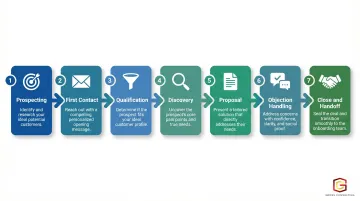
The 7 Stages of a Scalable Sales Process
Stage 1 - Prospecting and Lead Generation
Prospecting starts with defining your Ideal Client Profile (ICP) using firmographic (company size, revenue, industry), demographic (role, seniority), and behavioral signals (recent funding, tech stack, hiring activity) specific to your service niche.
Why it matters: Broad, untargeted outreach wastes time and dilutes your message. ICP-driven targeting focuses energy where conversion rates are highest. Service businesses with clear ICP alignment see higher engagement and shorter sales cycles than those chasing every opportunity.
Key actions:
- Build ICP criteria based on your best current clients
- Use intent data (website visits, content downloads, industry triggers) to prioritize outreach
- Focus prospecting efforts on accounts that match multiple ICP dimensions
Stage 2 - First Contact and Outreach
Initial outreach should be personalized to the prospect's specific context, their industry, pain points, and business stage. Modern buyers recognize generic scripts immediately and disengage.
Effective first contact references something concrete. The goal is to earn a conversation, not deliver a pitch.
Strong first-contact approaches:
- Reference a recent company announcement or funding round
- Connect over a challenge specific to their industry vertical
- Mention a shared connection or mutual context
- Lead with insight, not a product feature
Stage 3 - Qualification
Qualification frameworks, BANT (Budget, Authority, Need, Timeline), MEDDIC, or CHAMP, give you consistent criteria so you stop wasting time on low-fit prospects.
The discipline: Good qualification means disqualifying bad-fit clients early, not just advancing good ones. If a prospect lacks budget, decision authority, or timeline urgency, moving them into a nurture sequence keeps your pipeline focused on real opportunities.
Example qualification questions:
- What's driving this initiative right now?
- Who else is involved in the decision?
- What does success look like in 90 days?
- What happens if you do nothing?
Stage 4 - Discovery and Needs Assessment
Discovery should go beyond surface questions. The goal is to deeply understand the prospect's business problem, what they've already tried, and what success looks like, so your pitch becomes a tailored solution, not a generic service overview.
Key discovery principles:
- Ask about past attempts and what made them fall short
- Identify the business impact of the problem: revenue loss, inefficiency, or compliance exposure
- Understand decision criteria and internal stakeholder dynamics
- Map the buying committee and each member's priorities
When discovery is thorough, your proposal practically writes itself, because you've already aligned on the solution together.
Stage 5 - Proposal and Presentation
Proposals sent before thorough discovery almost always fail. Timing matters: present your proposal as a natural conclusion to the discovery conversation, not a document that arrives cold.
Best practices:
- Open by reviewing discovery findings to confirm alignment on the problem
- Frame your recommendation as a direct response to their stated needs
- Include clear deliverables, timelines, and success metrics
- Walk through the proposal live when possible, questions and objections surface faster that way
Stage 6 - Objection Handling and Follow-Up
Most objections, price, timing, "we need to think about it", signal unresolved trust or unclear value, not a hard stop. Treat them as questions worth exploring.
Objection reframing:
- Price objection: "Help me understand what you're comparing this to - what's the cost of not solving this problem?"
- Timing objection: "What's changing in [stated timeline] that makes it the right time then?"
- Think-about-it objection: "Of course - what specifically do you need to think through? Let's talk it through now."
Harvard Business Review found that responding to leads within one hour makes companies 7x more likely to qualify them. Speed and systematic follow-up cadences improve close rates measurably.
Stage 7 - Close and Post-Sale Handoff
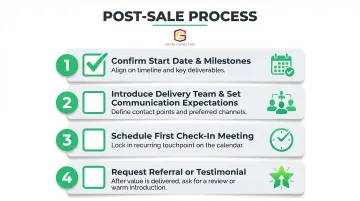
A clean close includes a clear onboarding plan, a warm handoff to delivery, and a process for capturing referrals and reviews. The best time to ask for a referral is after the client has seen their first concrete result, not at contract signing.
Post-sale checklist:
- Confirm start date, first deliverables, and key milestones
- Introduce the delivery team and set communication expectations
- Schedule the first check-in or review meeting
- Request a referral or testimonial after initial value delivery
How to Optimize Your Sales Process: 6 Practical Steps
Step 1 - Audit Your Current Process
Map what actually happens in your sales process, not what you think happens. Review recent won and lost deals, interview whoever handles sales, and document where deals commonly stall.
Most business owners discover the real friction isn't at close - it's earlier, in qualification or follow-up. Look for:
- Stages where deals sit longest without movement
- Inconsistent handoffs between marketing and sales
- Gaps in follow-up or unclear next steps
- Variation in how different team members handle the same stage
Step 2 - Define Stage-Based Exit Criteria
Every stage needs a specific, observable buyer action before a deal advances, not just a rep action.
Vague criteria (bad): "Sent proposal"
Buyer-outcome criteria (good): "Prospect confirmed they reviewed the proposal and scheduled a follow-up call"
This discipline produces cleaner CRM data and more accurate forecasting. It also prevents deals from artificially advancing through the pipeline without real buyer commitment.
Step 3 - Eliminate Friction and Automate Repetitive Tasks
Common friction points in service-business sales include slow follow-up, manual scheduling, inconsistent outreach, and scattered call notes. CRM workflows and automation tools handle these tasks so human touches happen at the right moments, not consumed by admin work.
According to Salesforce research, sales reps spend just 28% of their time actually selling. The rest is administrative work, data entry, and internal coordination.
Automation opportunities:
- Scheduling tools (Calendly, Chili Piper) eliminate email tennis
- Email sequences ensure consistent follow-up without manual tracking
- CRM workflows trigger reminders when deals haven't moved in 7 days
- Templates for common documents (proposals, onboarding) speed delivery
Step 4 - Build or Refine Lead Scoring
Once your pipeline is running cleaner, the next question is who to prioritize. Lead scoring answers that - directing immediate attention toward the best-fit prospects while everyone else enters a nurture track. For solo operators or small teams stretched thin, this distinction directly protects revenue.
Simple scoring framework:
| Category | Criteria | Points |
|---|---|---|
| Fit | Matches ICP firmographics | +10 |
| Engagement | Opened last 3 emails | +5 |
| Engagement | Visited pricing page | +8 |
| Urgency | Stated timeline within 90 days | +10 |
| Authority | Decision-maker role | +7 |
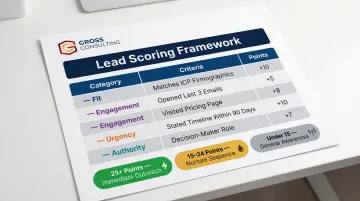
Leads scoring 25+ get immediate outreach; 15-24 enter nurture sequences; below 15 stay in general awareness.
Step 5 - Align Your Marketing and Sales Messaging
A lead scoring system only works if the leads arriving are the right ones, which brings up a less obvious problem. When marketing promises one thing and sales delivers another, trust collapses before a deal ever has a chance to close.
Audit for alignment:
- Review your ad copy, landing pages, and sales scripts side by side
- Ensure the problems you highlight in marketing match the discovery questions sales asks
- Verify that pricing, timelines, and deliverables are consistent across all touchpoints
- Record sales calls and compare actual conversations to your marketing claims
Step 6 - Test, Measure, and Iterate Continuously
Sales optimization doesn't end with implementation - it compounds through iteration. Run A/B tests across your process: outreach angles, discovery question sequences, proposal formats. Let the data drive decisions, not assumptions.
What to test:
- Subject lines and opening messages in outreach
- Discovery question order and depth
- Proposal formats (slide deck vs. PDF vs. live walkthrough)
- Follow-up timing and cadence
Set a review cadence, monthly works for most teams, and systematically cut what underperforms. Small improvements at each stage compound into measurably higher close rates over time.
From Process to Revenue Engine: Scaling With Systems, Automation, and the Right Support
Having a sales process and having a revenue engine are different. A process describes the steps; an engine describes a system that generates predictable, compounding output. The transition typically requires three things working together: a documented and repeatable process, technology that handles volume and visibility, and human expertise that adapts strategy as the market changes.
AI and Automation at Scale
For small and growing service businesses, the right tools compound your team's output without adding headcount. CRM platforms, conversation intelligence tools, automated follow-up sequences, and AI-assisted outreach drafting each eliminate low-value work so your people can focus on decisions that actually require judgment. HubSpot's 2024 AI Trends report found that AI adoption among salespeople jumped from 24% in 2023 to 43% in 2024.
The goal isn't to replace human judgment - it's to free up the business owner or sales lead to focus on high-value conversations while automation handles scheduling, data entry, and routine follow-up.
Connecting the Full Growth Stack
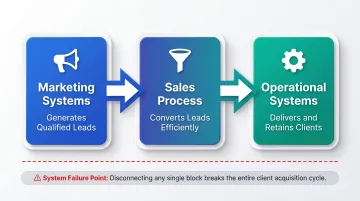
Scaling reliably requires three systems working in sequence:
- Marketing systems that generate qualified leads
- A sales process that converts them efficiently
- Operational systems that deliver and retain clients
Most service businesses optimize one of these in isolation. All three must connect for growth to hold. When marketing generates leads that sales can't convert, or sales closes deals that operations can't deliver well, growth stalls regardless of how strong any single piece is.
This is where partners like Gross Consulting accelerate results. Rather than giving business owners more homework, Gross Consulting designs, implements, and manages the full growth stack, from Meta ad campaigns and CRM workflows to sales training and operational SOPs. Knowing what needs to happen is one thing; having it built and running is another.
Building Repeatable Sales Motions
Growing beyond the founder's personal selling capacity means building infrastructure that works without you in every conversation:
- Sales playbooks documenting the process for each stage
- Talk tracks and objection-handling guides
- Onboarding templates for new hires
- CRM configurations that enforce consistent data capture
This documentation is what makes hiring and onboarding repeatable. New sales contributors can get up to speed without eroding the consistency or quality the business was built on.
The Metrics That Tell You Whether Your Sales Process Is Actually Working
Core KPIs for Service Businesses
Track these performance indicators to diagnose where your process breaks down:
| Metric | What It Measures | Typical Benchmark |
|------------|----------------------|------------------------|
| Lead-to-close conversion rate | % of leads that become customers | 2-7% (varies by service type) |
| Average sales cycle length | Days from first contact to close | 60-180 days for service businesses |
| Stage-by-stage conversion | % of deals advancing between stages | Helps locate bottlenecks |
| Cost per acquisition | Total sales/marketing spend ÷ new clients | Varies widely by service value |
| Revenue per closed deal | Average contract value | Tracks deal quality over time |
Use stage conversion data to locate bottlenecks. If 60% of deals stall between proposal and close, that's where to focus next. Don't track too many metrics at once. Pick 4-6 that directly answer "are we creating good opportunities and are they moving forward?"
Leading vs. Lagging Indicators
Leading indicators (discovery calls booked, outreach volume, qualified pipeline value) predict future performance. Lagging indicators (closed revenue, win rate) tell you what already happened.
That distinction matters for how you coach your team. Focus reviews on leading indicators, because once lagging indicators reveal a problem, the deals that caused it have already closed, or been lost.
Weekly Review Rhythm
A simple weekly review for service business owners:
- Check pipeline health by stage
- Review any deals that haven't moved in 7+ days
- Identify one thing to test or improve in the coming week
This doesn't need to be a two-hour process. A 30-minute review with a clear scorecard is more valuable than a quarterly deep dive. A Harvard Business Review study on formal sales processes found that managers spending at least 3 hours per month on pipeline coaching see 11% greater revenue than those who don't.
Frequently Asked Questions
What is sales process optimization?
Sales process optimization is the ongoing practice of refining each stage of the sales cycle, from lead to close, to reduce friction, shorten time-to-close, and increase conversion rates. The goal is to make revenue generation consistent and scalable.
How do you optimize the sales process?
Audit what's currently happening, define clear stage-based exit criteria, eliminate friction through automation, align marketing and sales messaging, and use data to continuously test and improve each stage.
What are the 7 stages of the sales process?
The seven stages are: prospecting, first contact and outreach, qualification, discovery and needs assessment, proposal and presentation, objection handling and follow-up, and close with post-sale handoff.
What are the 5 C's of sales?
The 5 C's typically refer to Contact, Connect, Communicate, Close, and Continue. Velocity Advisory Group's framework uses Connect, Consult, Convince, Confirm, and Conclude, both organize the sales conversation around relationship and progression toward close.
What is the 70/30 rule in sales?
The 70/30 rule suggests sales reps should spend 70% of a sales conversation listening and 30% talking. However, Gong's analysis of thousands of B2B calls found the optimal ratio is closer to 43% rep talk and 57% listening, with higher rep talk time linked to lost deals.
What are the 4 selling strategies?
The four core selling strategies are solution selling (matching your offer to a specific problem), consultative selling (acting as a trusted advisor), transactional selling (focused on speed and efficiency), and value-based selling (emphasizing ROI and outcomes rather than features).
Ready to build a more consistent, scalable sales process? Gross Consulting helps service-based businesses design, implement, and manage the full growth stack, from lead generation and sales systems to operational optimization and compliance. Contact us at +1 (424) 347-6865 or support@grossconsultinginc.com to schedule a free consultation and see what a structured revenue system looks like for your business.