
Losing control doesn't happen overnight. It looks like inconsistent delivery quality as client volume rises. It shows up as cash flow uncertainty even when revenue is growing. It means over-reliance on the founder for every decision, and a pipeline that only moves when you personally push it forward.
This article breaks down how to scale your consulting business the right way, by building the model, systems, team, and pipeline that grow with you rather than around you.
Key Takeaways
- Scaling without control happens when growth outruns your systems. Fix the model first
- Choose a business model that creates leverage instead of just adding hours
- Document processes so delivery doesn't depend on you being in every conversation
- Hire to eliminate bottlenecks, not fill seats. Define roles and reporting structure before you need them
- Protect margins by pricing on value, managing scope, and building a repeatable pipeline
Why Growing Fast Without a Plan Means Losing Control
The Founder Bottleneck Trap
When every client decision, delivery step, and business development conversation routes through the owner, the founder becomes the ceiling of their own business. Not because they lack skill, but because the business lacks structure.
This creates a valuation problem that's hard to ignore. Consulting firms under $5M enterprise value where owners generate 60–80% of revenue typically trade at 3.0x–4.0x EBITDA, compared to 8.0x–10.0x for institutionalized firms with systems, teams, and diversified clients.
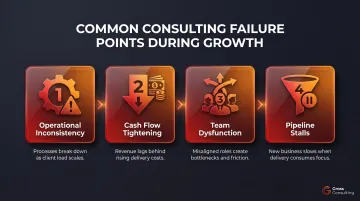
Four Common Breakdown Points
Consultants hit predictable failure points during growth:
- Operational inconsistency as client volume increases - delivery quality varies because processes live in your head
- Cash flow tightening even as revenue rises - higher costs without predictable income
- Team dysfunction from unclear roles and poor delegation - people don't know who owns what
- Pipeline stalls the moment you get busy with delivery - no systematic lead generation
Scaling vs. Simply Growing
Growth means doing more of the same. Scaling means building a business that can handle more without proportionally more effort or direct oversight from the owner.
This is the core mental shift required. The $2M–$5M revenue range is critical for transitioning from founder-led to team-led operations, where systems and institutional durability becomeessential, not optional.
This shift is particularly hard in professional services. When your expertise is personal and your reputation is tied to your name, staying hands-on feels like quality control. But if you're turning down qualified work, delivering below your standard, or unable to take a week off without things unraveling, the model needs to change, not just the workload.
Choose a Business Model Built for Scale
The model you operate on determines your revenue ceiling, margin profile, and how much control you can maintain as you grow.
Time-and-Materials Billing
Billing by the hour or day caps revenue at available hours. This creates the least leverage. It's useful in early stages but becomes a structural constraint when scaling - you can't sell more than you can personally deliver.
Project-Based Fees
Charging a fixed fee for defined deliverables decouples revenue from hours. This improves margin when delivery is efficient and begins to create the leverage needed for growth. The focus shifts from tracking hours to delivering results.
Retainer and Recurring Revenue
Monthly retainers create predictability. You know what's coming in next month, which makes hiring, cash planning, and capacity decisions far easier.
Even two or three solid retainers stabilize cash flow enough to plan ahead with confidence. Firms with 60%+ retainer or subscription revenue trade at a premium of 1–2 additional EBITDA turns vs. project-based firms.
Productized Consulting
Packaging a specific service at a fixed scope and price, delivered the same way every time, makes it easier to sell and easier to delegate. A documented process means you can run it at volume without the founder involved in every step.
Most scaling consulting businesses move through these models over time and often run a combination. The key is choosing deliberately. The model you lead with should match where you are now and where you intend to go in the next two to three years.
Build Systems That Scale Without Constant Oversight
A business that can only deliver consistently when the founder is directly involved is not scalable - it's a job with overhead. Systems convert founder-dependent delivery into repeatable, delegatable work.
Standard Operating Procedures (SOPs)
Document every recurring process: client onboarding, project delivery, reporting, invoicing. Without documentation, every new team member requires direct training, and every deviation falls back on the founder to resolve.
Automation and Technology
The right tools eliminate manual coordination that consumes founder time:
- CRM platforms for client tracking and pipeline management
- Project management software to keep delivery on schedule
- Automated reporting that surfaces data without manual pulls
- Client portals that reduce back-and-forth communication
A boutique consulting firm implementing Salesforce Essentials saved approximately 4 hours per week per user from eliminated manual data entry, achieving 998% ROI with a 1.2-month payback.
AI and automation tools are most powerful when built on top of documented processes. Without that foundation, automation speeds up the disorder rather than eliminating it.
Compliance Infrastructure
For consultants serving attorneys, doctors, real estate investors, or financial service clients, systems must account for regulatory compliance. Scaling without that layer creates liability exposure precisely when client volume is highest.
Gross Consulting builds compliance infrastructure directly into the operational growth plan, so businesses remain audit-ready as they scale rather than retrofitting controls after the fact.
Productizing Delivery
Turning services into repeatable frameworks, templates, and workflows means your team can maintain consistent quality at scale without each engagement being reinvented from scratch. This also makes pricing and proposals straightforward to structure.
Build and Structure a Team That Can Grow With You
Knowing When and Who to Hire First
The right trigger for hiring is consistent, sustained capacity strain, not a single busy month.
If administrative and coordination work consumes 30–40% of your week, that's what you hire for first. If delivery capacity is the limit, a junior consultant or specialist who can work within your documented process is the right move.
Delegation vs. Abdication
The difference comes down to structure:
- Delegation: Transfer a task with clear expectations, documented process, and a feedback loop
- Abdication: Hand something off and hope for the best
Founders who lose quality control during growth are almost always abdicating. The fix is straightforward - documented SOPs, regular check-ins, and defined accountability for every handoff.
Organizational Structure That Matches Your Stage
Your org structure should reflect where you are now, not where you hope to be. Three models fit most consulting firms at different stages:
- Hub-and-spoke: Founder at center, specialists handle delivery - works in early growth
- Practice area model: Organized by service lines, each led by a senior consultant - works at three or more senior people
- Integrated team model: Structured around client accounts - highest retention but requires strong leadership at multiple levels
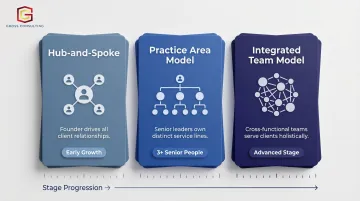
A good signal for moving between models: when client work consistently requires decisions that only you can make, your current structure has hit its ceiling.
Protect Your Pipeline and Profit Margins as You Scale
Building a Systematic Business Development Function
Solo consultants often win work through relationships and referrals. This works at lower revenue thresholds but becomes unreliable above them because it's not systematic.
At scale, business development must become a function with three components running simultaneously:
- A consistent source of new leads
- A structured process for moving prospects through the pipeline
- A nurture system for prospects not yet ready to buy
That structure pays off: organizations with formalized sales enablement reported an average win rate of 49.0%, 6.5 percentage points higher than those without it.
Define your ideal client profile. Without it, outreach is unfocused and inefficient.
Margin Protection as You Add Cost
Building a reliable pipeline matters little if scaling erodes what you keep. Four factors consistently compress consulting margins during growth:
Underpriced work: Billing hourly instead of on outcomes caps your upside regardless of how efficiently you deliver.
Low utilization rates: Revenue needs to stay ahead of headcount. SPI Research reported billable utilization of 68.9% across 403 firms in 2024, well below the healthy target range of 74–84%. Below that threshold, margin erosion accelerates.
Scope creep and delivery inefficiency: Unclear expectations and weak project management are expensive. According to project management research, 52% of projects experience scope creep, contributing to significant cost overruns.
Overhead growing faster than revenue: In the early scaling phase, hire cautiously. Use contractors before full-time employees until the delivery model is validated.
Frequently Asked Questions
How do you scale a consulting business?
Choose a leveraged business model, build repeatable systems and SOPs, hire to remove bottlenecks, and create a systematic pipeline, rather than simply taking on more clients within the same structure.
What does scaling business operations mean?
Scaling operations means building processes, and team structures that let a business handle greater volume and revenue without a proportional increase in cost, effort, or founder involvement.
What are the 4 pillars of scaling up?
People, Strategy, Execution, and Cash, drawn from Verne Harnish's Scaling Up framework. Applied to consulting: hire the right team, define a clear growth strategy, run it through documented processes, and manage cash flow to fund expansion without overextending.
What does a business operations consultant do?
A business operations consultant identifies where a business is losing time or money, then builds the processes, automations, and team structures needed to fix it. The goal is growth that doesn't depend entirely on the founder to hold everything together.
What is the average fee for a business consultant?
Fees vary widely based on scope, expertise, and engagement type. Project-based work can range from a few thousand dollars to well into six figures; retainers typically run $2,000–$15,000/month for small to mid-sized businesses. The right fit depends on what outcomes you need, not the lowest price point.