Introduction
Law firms, medical practices, and real estate investment companies often have skilled, committed teams — yet revenue stays inconsistent, a single top performer carries the pipeline, and growth stalls precisely when it should compound. The missing piece is rarely talent. It's structured sales development.
Sales coaching isn't the same as managing a team or running a quarterly training day. Management sets direction and enforces accountability. Training delivers a curriculum. Coaching is more personal: an ongoing, individualized process that changes how people actually think and perform in real conversations.
This guide covers the core principles of effective sales coaching and proven techniques that work in practice. It also addresses how to coach managers differently from reps, how to build a repeatable coaching structure, and how to measure whether any of it is working.
Key Takeaways:
- Sales coaching is personalized, ongoing, and tied to real performance data — not a one-time training event
- Organizations with structured coaching see 16.7% higher annual revenue growth than those with none
- Effective coaching focuses on one skill at a time, not sweeping overhauls
- Both leading and lagging indicators are needed to measure coaching impact
- A consistent coaching cadence, not ad hoc check-ins, is what drives lasting behavior change
What Is Sales Coaching and Why Does It Matter?
Sales coaching is a personalized, ongoing process where a manager or dedicated coach works with individual reps to identify skill gaps, reinforce strengths, and improve specific sales behaviors. Unlike a workshop or group training session, it's rep-centered by design. The International Coaching Federation defines coaching as "partnering with clients in a thought-provoking and creative process that inspires them to maximize their personal and professional potential" — which captures the facilitative, rep-centered nature of real coaching.
Sales training delivers knowledge to a group. Sales coaching applies that knowledge to an individual's actual performance in real situations. Both matter — but that distinction in application is exactly what the performance data reflects.
The Business Case for Investing in Coaching
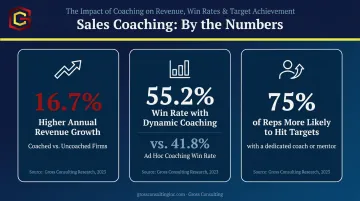
The performance gap between coached and uncoached teams is substantial. According to the Sales Management Association's 2015 Supporting Sales Coaching research report, firms that optimized both coaching quality and quantity realized annual revenue growth 16.7% higher than firms providing no coaching. CSO Insights' research found that organizations with dynamic coaching approaches achieved a 55.2% win rate on forecast deals — compared to just 41.8% for those using random, ad hoc coaching.
Salesforce's 2026 data adds another dimension: 75% of sales reps say they're more likely to hit their targets when they have a coach or mentor.
The Hidden Cost of Not Coaching
The cost of skipping structured coaching rarely shows up as a single line item. It appears as:
- High voluntary turnover (Korn Ferry reports consistent coaching cuts voluntary turnover by nearly 30%)
- Inconsistent deal flow driven by a small number of top performers
- New reps who take months longer than necessary to become productive
- Managers who default to micromanagement because they never learned to coach
For service businesses scaling past six figures, these compounding gaps slow revenue growth, extend ramp time, and make hitting consistent targets harder the bigger the team gets.
Core Principles of Effective Sales Coaching
Know the Person Before You Coach the Performance
Quotas alone never sustain motivation for long. Effective coaches invest time upfront understanding what drives each rep: what they want professionally, what fears make them hesitant on calls, and what kind of feedback they actually respond to. A paralegal who's transitioned into a business development role at a law firm needs different coaching than a career sales professional. The entry point is always the person, not the performance data. That understanding shapes every conversation that follows.
Ask More Than You Tell
Once you understand who you're coaching, the next shift is how you show up in the room. The most common mistake new coaches make is lecturing. Real coaching conversations are weighted heavily toward questions. When a rep comes out of a difficult call, "What do you think went wrong?" will surface more useful insight — and more buy-in — than "Here's what you should have said."
This isn't just a philosophy. Sandler's long-standing 70/30 framework for effective sales conversations — where the prospect talks 70% of the time — applies equally to coaching sessions. The person being coached should do most of the talking.
Build Psychological Safety First
Google's re:Work research on team effectiveness identified psychological safety as the single most important factor in high-performing teams: teammates need to feel confident that no one will embarrass or punish them for admitting a mistake. Without that safety, reps won't tell you what's actually going wrong. Instead, they'll say what they think you want to hear — and nothing changes.
Coaches build that safety through consistent behavior:
- Sharing their own past failures openly
- Responding to vulnerability without judgment
- Separating performance reviews from development conversations
- Reinforcing that questions and mistakes are expected, not penalized
Personalize Every Session
Gartner's 2025 research on customized sales coaching found that fewer than half of sellers feel their manager's coaching actually meets their individual needs or communication styles. Generic feedback is easy to deliver and easier to ignore. Effective sessions begin with each rep's actual performance data — call recordings, conversion rates, pipeline activity — not a generic agenda applied uniformly across the team.
Keep Coaching Ongoing, Not Episodic
The SMA research found that 62.9% of organizations still relied on random or informal coaching. That approach produces minimal lasting change. Consistent, scheduled touchpoints — weekly or biweekly 1:1s — allow progress to compound over time. They also signal to reps that development is a real organizational commitment, not a quarterly box to check.
Proven Sales Coaching Techniques That Actually Work
The GROW Model
Developed in the late 1980s by Sir John Whitmore, the GROW model structures coaching conversations around four questions:
- Goal — What do you want to achieve?
- Reality — Where are you right now?
- Options — What could you do?
- Will — What will you actually commit to?
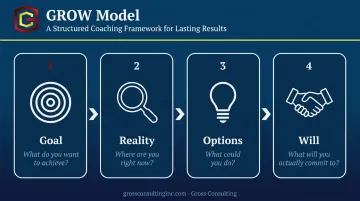
GROW works well for goal-setting conversations and for reps who need help clarifying direction. Its limitation is execution depth — it surfaces commitments but doesn't always build the specific skills needed to follow through on them.
The OSKAR Model
Created in 2002 by Paul Jackson and Mark McKergow, OSKAR stands for Outcome, Scaling, Know-how, Affirm & Action, and Review. Its distinguishing feature is the emphasis on positive reinforcement: the model focuses on what's already working and how to do more of it.
For reps who are close to a performance breakthrough but struggling with confidence, OSKAR's affirming structure tends to be more effective than approaches that lead with gaps.
Record and Review Sales Calls
Coaching from memory is coaching from bias. Reviewing actual call recordings lets both the coach and rep pinpoint the exact moment a conversation shifted: where discovery fell flat, where an objection wasn't handled, where a close was fumbled.
The highest-value practice is having reps self-review before the coaching session. Walking in having already identified what went wrong develops self-awareness and reduces defensiveness when the coach's observations follow.
Focus on One Skill at a Time
Trying to improve discovery questioning, talk-to-listen ratio, and objection handling simultaneously is a reliable path to improving nothing. Deliberate practice research supports isolating specific behaviors, developing them with focused feedback, and measuring progress before moving to the next skill. Pick one area, such as opening discovery questions, and stay there until measurable improvement shows up in the numbers.
Role-Play and Scenario Practice
Role-play gives reps a low-stakes environment to practice new behaviors before applying them in live deals. A coach who can simulate a skeptical prospect, asking hard questions, pushing back on pricing, or going quiet, builds the rep's range in a way that no amount of conceptual instruction can.
The debrief after each role-play matters as much as the exercise itself. Cover three things:
- What worked and why it landed
- What felt off or created hesitation
- What the rep would do differently in a live deal
Coaching Sales Managers vs. Coaching Sales Reps
The Manager Coaching Gap
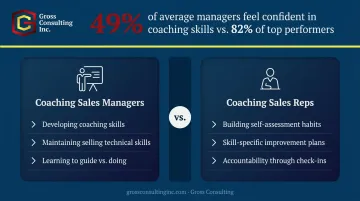
Promoting a top-performing rep to sales manager is common. It's also where many organizations create a problem rather than solving one. RAIN Group's 2025 research found that only 49% of average sales managers feel confident in their coaching skills — compared to 82% of top-performing managers. The skill sets are genuinely different: closing deals and developing others who close deals require different instincts entirely.
Coaching managers means developing two capabilities simultaneously:
- Selling skills — keeping their own technical abilities sharp
- Coaching skills — learning to guide others rather than doing it themselves
The SMA research found that 77% of firms provide too little coaching, and only 15% of managers believe their organization gives them the right amount. That gap starts at the top.
Coaching Reps Toward Self-Direction
Where manager coaching focuses on developing others, rep coaching works best when it builds self-assessment alongside skill. Before giving feedback, ask the rep to evaluate themselves: What was your goal for that call? What did you do well? What would you change?
This process builds the habit of self-analysis — so reps keep improving between sessions, not just during them.
From there:
- Let reps set their own improvement goals with manager input
- Create written action plans with clear timelines and one specific skill focus
- Hold accountability through check-ins, not surveillance
The "Shadow and Share" Approach
One of the most scalable coaching techniques for small service business teams is peer learning. Managers shadow senior leaders or participate in joint coaching sessions to develop their own skills. Reps shadow top performers or review curated "best call" libraries — real examples of what good looks like. In teams of three to ten people, this approach extends the value of coaching beyond what any single 1:1 can deliver.
How to Build a Sales Coaching Structure for Your Service Business
Start with a Documented Cadence
An ad hoc coaching culture is no culture at all. A formal, documented coaching schedule signals that development is an organizational priority, not something that happens when there's time. A practical structure includes:
- Weekly 1:1s — focused on one skill, tied to recent call data or pipeline activity
- Monthly group reviews — team-level performance patterns, shared learning
- Quarterly skill assessments — benchmarking individual progress against development plans
Ground Every Session in Data
The most useful data points to review per session include:
- Conversion rates by stage (where are deals stalling?)
- Call volume and activity metrics (are reps making the attempts?)
- Talk-to-listen ratio from call recordings
- Pipeline stage distribution (how healthy is the pipeline shape?)
- Deal velocity — how long deals sit at each stage before moving or dying
Feedback tied to observable data is harder to dismiss and easier to act on than feedback tied to impressions.
Build Individual Development Plans
An IDP for each rep documents:
- Current skill level in each competency area
- The target behavior and what "good" looks like
- The coaching approach being used
- A measurable milestone for progress
This gives both the manager and rep a shared reference point and prevents coaching sessions from drifting into vague encouragement.
For businesses formalizing a sales process that grew organically, designing this infrastructure from scratch takes time away from client work. Gross Consulting works with law firms, medical practices, and real estate investment companies to build the sales systems and coaching structures that let owners lead the business instead of carrying the entire pipeline themselves.
How to Measure Sales Coaching Effectiveness
Track Leading and Lagging Indicators Separately
A practical measurement framework separates coaching impact into three categories:
| Indicator Type | Examples | When They Show Impact |
|---|---|---|
| Lagging | Closed revenue, win rate, average deal size | 3–6+ months after coaching begins |
| Leading | Call activity, discovery quality scores, pipeline progression | Weeks after behavior change starts |
| Skill assessments | Self-assessment scores, manager observations | Ongoing throughout engagement |
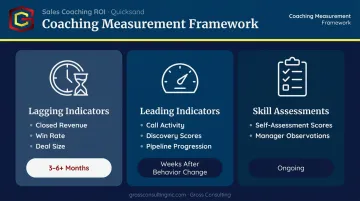
Relying only on lagging indicators means you won't know coaching is working until months after the fact — or recognize it isn't working until deals are already lost.
Use Before-and-After Benchmarking
Set a performance baseline for each rep at the start of a coaching engagement. Measure against it at 30, 60, and 90-day intervals. That baseline lets you isolate which behaviors changed and connect them directly to specific coaching interventions — rather than attributing gains to guesswork.
Collect Qualitative Signals Too
Some coaching impact doesn't show up in dashboards. Track these behavioral markers alongside the numbers — they often predict performance improvements before the metrics confirm them:
- A rep who starts volunteering to review their own calls, without being asked, is demonstrating internalized self-awareness
- A manager who begins asking their team questions instead of giving answers is making a meaningful shift in how they lead
Frequently Asked Questions
What is the 70/30 rule in coaching?
The 70/30 rule holds that the person being coached should speak about 70% of the time, while the coach speaks 30%. Asking questions and listening drives deeper self-discovery than instruction-heavy approaches — and the behavior change tends to last longer.
What is the 80/20 rule in coaching?
In sales, the 80/20 rule describes a pattern documented by Harvard Business Review: roughly 20% of a sales force produces 80% of revenue. Coaching uses this insight to prioritize the middle tier of performers, where incremental improvement typically generates the largest overall revenue gains.
What is the difference between sales coaching and sales training?
Sales training is a structured, often group-based curriculum focused on teaching specific skills or processes. Sales coaching is an ongoing, individualized practice where a coach works with a rep to apply those skills, address personal gaps, and improve real-world performance in actual deals.
How often should sales coaching sessions be held?
Weekly or biweekly 1:1s are the most effective cadence for sustained improvement. Brief check-ins between sessions reinforce momentum. The key factor isn't the exact frequency — it's regularity. Sporadic sessions rarely produce lasting behavioral change.
How do you measure the effectiveness of sales coaching?
Track behavioral metrics (call activity, discovery quality, self-assessment scores) alongside outcome metrics (win rate, conversion rate, average deal size). Establish a baseline at the start of the engagement, then compare performance before and after the coaching intervention to measure real impact.
What makes a sales coaching program effective?
Effective programs are personalized to individual skill gaps and grounded in real performance data — not assumptions. Consistency matters too: a steady cadence builds the trust and accountability that make behavior change stick.