This is the gap a marketing automation consultant is built to close. Not by recommending software. By building the systems that make consistent follow-up, nurture, and conversion happen automatically — whether or not your team has time to manage it manually.
This article covers what a marketing automation consultant actually does, the specific responsibilities they own, the signs your business needs one, what they build and manage, and how to choose the right partner.
Key Takeaways
- A marketing automation consultant designs, builds, and manages systems that turn marketing activity into consistent, predictable revenue growth
- Their work covers strategy, tool selection, workflow design, CRM integration, and ongoing optimization
- Service-based businesses — attorneys, doctors, real estate investors, accountants — are strong candidates when manual processes are holding back growth
- The best consultants blend strategic thinking with hands-on implementation, combining AI-powered tools with human oversight
What Is a Marketing Automation Consultant?
A marketing automation consultant helps businesses build the systems, workflows, and technology infrastructure needed to attract leads, nurture prospects, and convert customers — without relying on constant manual effort.
That's distinct from two related roles worth separating:
- General marketing consultant — focuses on strategy, campaigns, and messaging, but rarely builds the underlying systems
- CRM consultant — focuses specifically on customer data, pipeline management, and contact organization
- Marketing operations specialist — typically works in-house, executing within an existing system
A marketing automation consultant sits at the intersection of all three. They bring both strategic depth and technical capability, and unlike the roles above, they build — not just advise.
The work spans the full customer acquisition journey — how leads enter the business, how they're nurtured, and how that activity ties to revenue. That's a broader scope than CRM configuration alone, and a more hands-on role than most strategy consultants take on.
Core Responsibilities of a Marketing Automation Consultant
Workflow Mapping and Audit
Before building anything, a skilled consultant maps how leads currently enter the business, where follow-up happens, and where the process breaks down. This includes auditing existing tools, identifying data gaps, and documenting handoffs between marketing and sales.
This diagnostic step matters more than most clients expect. Automating a broken process doesn't fix it — it scales the broken parts faster. The audit is what separates consultants who build the right system from those who wire up the wrong one at higher speed.
Technology Selection and Stack Setup
The consultant evaluates and recommends platforms based on the business's size, goals, and existing infrastructure. A typical stack might include:
The consultant evaluates and recommends platforms based on the business's size, goals, and existing infrastructure. A typical stack might include:
- CRM systems for contact management and pipeline tracking
- Email marketing tools for nurture and broadcast campaigns
- Landing page builders tied to lead capture forms
- Ad platforms connected to CRM for closed-loop attribution
- Integration layers like Zapier or GoHighLevel to link it all together
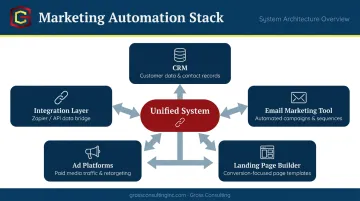
Just as important: they configure and connect those tools so data flows correctly between them. A business paying for five disconnected platforms gets no value from adding a sixth. The consultant's job is to turn a scattered stack into a unified system.
Campaign and Nurture Sequence Design
This is where the actual marketing workflows get built. That includes:
- Lead capture sequences that respond the moment a form is submitted
- Automated email nurture campaigns tied to prospect behavior
- Re-engagement flows for leads who've gone cold
- Appointment and consultation booking prompts built into the sequence
These workflows run continuously in the background. A prospect who submits a form at 11pm on a Friday still receives an immediate response, a timed series of educational content, and a consultation booking prompt — all without anyone on the team doing anything manually.
CRM Integration and Lead Management
The consultant connects marketing automation systems to the client's CRM, ensuring leads are captured, scored, routed, and tracked accurately. This includes setting up lead source tracking, pipeline stages, and automated updates so the sales team always has current context without manual data entry.
Without this integration, marketing and sales operate in silos. Leads fall through the gaps between platforms, and no one has a clear picture of where a prospect stands.
Performance Tracking and Ongoing Optimization
The consultant sets up reporting dashboards and tracks key metrics — open rates, conversion rates, cost per lead, revenue attribution — then uses that data to refine campaigns over time.
Markets shift, offers change, and audience behavior evolves. Regular review, testing, and adjustment are what prevent a well-built system from quietly becoming an outdated one — and what compound early wins into consistent pipeline growth.
Signs Your Business Needs a Marketing Automation Consultant
Most service businesses don't realize they need a marketing automation consultant until the cracks become costly. These four patterns tend to show up first.
Inconsistent Lead Follow-Up
Some leads get called back the same day. Others sit untouched for a week. Research from Harvard Business Review found that firms contacting leads within an hour were nearly 7x more likely to qualify them than firms that waited even one additional hour. Meanwhile, 23% of companies never responded to online leads at all.
When manual effort determines follow-up speed, conversion rate becomes hostage to whoever on the team remembered to check the inbox.
No Visibility Into What's Actually Generating Revenue
The business is running social ads, email campaigns, and referral programs — but can't connect any of it to closed clients. According to Nielsen's 2024 Annual Marketing Report, only 38% of marketers evaluate holistic ROI by measuring traditional and digital efforts together. Without attribution, there's no way to double down on what's working or cut what isn't.
The Founder Is Still in the Follow-Up Loop
If the owner is personally sending emails, coordinating outreach, or managing follow-up sequences, that's a scaling bottleneck. A 2024 Constant Contact survey of 1,300 small business owners found that 56% had one hour or less per day for marketing and 52% procrastinated on marketing tasks entirely. When the founder is the follow-up system, growth stalls the moment their attention shifts.
Disconnected Tools That Don't Talk to Each Other
The business has a CRM, an email platform, a scheduling tool, and a form builder — none of which sync properly. Leads get entered twice, data goes stale, and context gets lost between systems. This is where a marketing automation consultant earns the engagement — building the integrations that eliminate manual handoffs and keep every system working from the same data.
What a Marketing Automation Consultant Builds and Manages
Lead Generation and Capture Infrastructure
A well-built lead capture system connects landing pages to the CRM, triggers immediate follow-up sequences the moment a form is submitted, and tracks lead source so the business knows exactly where each contact came from.
Without this infrastructure, paid advertising and content marketing lose most of their return. Specifically:
- Follow-up delays drop conversion rates — prospects go cold within hours, not days
- Manual handoffs create gaps where leads fall through entirely
- Disconnected tools erase attribution data, so there's no way to know which campaigns actually worked
Automated Nurture and Conversion Sequences
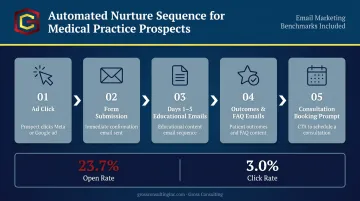
Consider a medical practice running Meta ads for a specific procedure. A prospect clicks the ad, lands on a form, and submits their contact information. Without automation, they might receive a call — eventually.
With a properly built system, they immediately receive a confirmation email, followed over the next 5–10 days by educational content about the procedure, patient outcomes, and an FAQ — culminating in a direct prompt to book a consultation.
This sequence runs regardless of what the front desk team is handling. Healthcare email benchmarks show open rates around 23.7% and click rates around 3.0% (Campaign Monitor, 2022) — that's consistent engagement from a sequence that runs on its own.
Retention and Referral Workflows
Strong automation consulting doesn't stop at acquisition. Post-sale workflows — onboarding sequences for new clients, check-in automations, review request triggers, and referral campaigns — often represent the highest-ROI deliverables for service businesses.
Hinge Research Institute's study of 523 professional services firms found that 72% of satisfied clients didn't refer because they were never asked. A referral campaign that automatically prompts happy clients at the right moment closes that gap — no one on the team has to remember to do it.
Gross Consulting takes this further by handling the build, not just the blueprint. That means designing and managing each of these workflows — lead capture, nurture, and post-sale retention — while combining automation with human oversight to keep systems accurate and compliant as the business grows.
How to Choose the Right Marketing Automation Consultant
Look for Process-First Thinking
The right consultant's first conversation should focus on your business model, current lead flow, and growth goals — not a software recommendation. A consultant who pitches a specific platform before understanding your business is optimizing for their own expertise, not your results.
At Gross Consulting, the approach starts from this exact position: initial strategy conversations center on understanding what's broken in the current lead and follow-up process before any system is proposed.
Evaluate Beyond Credentials
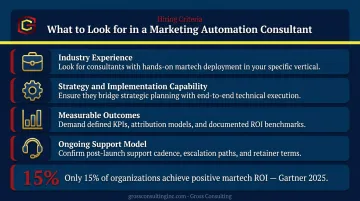
When assessing candidates, look for:
- Relevant industry experience — working with service-based businesses (attorneys, doctors, accountants, real estate investors), not just eCommerce or SaaS clients
- Strategy and implementation capability — the ability to both design a system and build it, not just one or the other
- Evidence of measurable outcomes — specific results from past clients, not just generic case study language
- Ongoing support model — what happens after launch, including who manages updates, monitors performance, and scales the system
That last point matters more than most buyers realize. Gartner's 2025 data found that martech utilization sits at just 49%, and only 15% of organizations qualify as high performers who meet strategic goals and show positive ROI. Buying the tool is the easy part — a qualified consultant is what closes the gap between ownership and actual results.
Clarify the Engagement Model Upfront
Some businesses need a consultant to build the system and hand it over with training. Others need a retained partner who monitors performance, updates campaigns, and scales the system as the business grows.
Both are legitimate options. The risk is choosing a model that doesn't match your team's capacity to manage what gets built. Clarify this before signing anything — it's one of the most overlooked decisions in the hiring process.
Frequently Asked Questions
What does a CRM automation consultant do?
A CRM automation consultant focuses on configuring and automating workflows within a customer relationship management platform — lead routing, pipeline updates, follow-up triggers, and contact data sync. A marketing automation consultant covers a broader scope: the full customer acquisition and nurture journey across multiple channels and tools, with CRM integration as just one piece.
What is the difference between a marketing automation consultant and a marketing automation specialist?
A specialist typically works in-house and executes within an existing system. A consultant is brought in externally to assess, design, build, or overhaul the system itself — working across strategy, technology selection, and implementation before handing off or staying on in an advisory capacity.
How much does a marketing automation consultant typically cost?
Most engagements are structured as project-based (one-time build), monthly retainer (ongoing management), or hourly advisory. Costs scale with scope — the number of systems involved, campaign complexity, and whether the engagement includes implementation or strategy only.
What tools does a marketing automation consultant typically work with?
Common tools include CRM platforms (HubSpot, Salesforce, GoHighLevel, Zoho), email marketing tools, ad platforms, landing page builders, and integration layers like Zapier. A good consultant recommends tools based on your needs and existing systems — not a single preferred platform.
How do I know if my business is ready for marketing automation?
A business is typically ready when it has a repeatable offer, a consistent source of leads, and a defined sales or intake process — but is losing time or revenue because that process depends too heavily on manual effort to run reliably.
Can a marketing automation consultant help with both strategy and implementation?
The best consultants do both — they assess current gaps, design the system architecture, build and configure the workflows, and either manage ongoing performance or train the internal team to do so. Businesses should specifically seek out consultants who will build, not just advise.