
Small businesses spend an estimated 5 hours per pay period just processing payroll, while 14% burn more than 20 hours monthly navigating federal regulations alone. When 40% of small and mid-sized businesses are fined by the IRS annually for payroll errors, it's clear that the stakes are high, and rising.
This guide explains exactly what HR managed services include, how payroll and benefits administration actually work, what you should expect to pay, and how to choose a partner who keeps you compliant without becoming another vendor you have to manage.
TLDR:
- HR managed services outsource payroll, benefits, compliance, and onboarding to expert providers who actively run these functions for you
- Managed services differ from PEOs (co-employment) and self-service software (you still operate it yourself)
- Base pricing typically ranges from $40-$180/month + $4-$22 per employee depending on service level and features
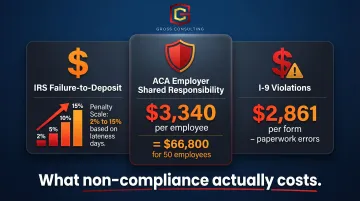
- Non-compliance is expensive: IRS failure-to-deposit penalties start at 2%, ACA penalties reach $3,340 per employee, and I-9 violations cost up to $28,619 per worker
What Are HR Managed Services?
HR managed services is the outsourcing of specific HR functions, payroll processing, benefits administration, compliance monitoring, and employee onboarding, to a specialized third-party provider who actively manages those processes on your behalf. This is not just software access; it's expert-operated service delivery.
Unlike traditional HRIS platforms (which are tools you operate yourself), managed services providers handle the execution: they run your payroll, file your taxes, manage benefits enrollment, track compliance deadlines, and respond to employee questions. You remain the employer of record, but the administrative burden shifts to professionals who do this full-time.
When you buy payroll software, you're responsible for configuring tax tables, entering hours, troubleshooting errors, and staying current on labor law changes. With managed services, the provider handles that work, and is accountable for accuracy and timeliness, not you.
Managed Services vs. PEO vs. ASO vs. BPO
These four models are frequently confused. Here's how they differ:
| Model | Definition | Co-Employment? | Who's the Employer of Record? | Liability |
|-------|------------|----------------|-------------------------------|-----------|
| HR Outsourcing (HRO) | Umbrella term for contracting specific HR functions to a third party | No | You | You retain liability; provider manages tasks |
| Administrative Services Organization (ASO) | Outsources specific HR tasks (payroll, benefits) with no co-employment | No | You | You retain all liability |
| Professional Employer Organization (PEO) | Co-employment model where PEO shares legal employer responsibilities | Yes | Shared (PEO for tax/insurance purposes) | Shared between you and PEO |
| Business Process Outsourcing (BPO) | Broad term for outsourcing any business process, not HR-specific | Depends | Depends on arrangement | Varies |
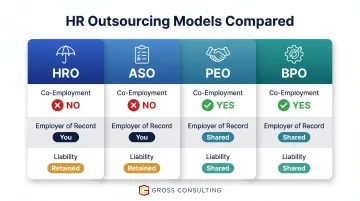
Key distinction: PEOs enter into a co-employment arrangement, meaning the IRS treats the PEO as the statutory employer responsible for employment taxes. HRO and ASO models keep you as the sole employer - the provider simply executes tasks you delegate.
Who HR Managed Services Are Best For
HR managed services are ideal for growing service-based businesses with 5-100 employees that have outgrown spreadsheets but aren't ready to hire a full HR department.
Concrete examples:
- Attorney practices managing a mix of W-2 paralegals, contract attorneys, and administrative staff across multiple office locations
- Medical offices balancing full-time clinical staff, part-time practitioners, and 1099 billing specialists while navigating ACA compliance and FLSA healthcare-specific overtime rules
- Real estate investment firms with salaried property managers, commissioned agents, and contracted maintenance workers operating across state lines
What they have in common: complex workforce structures, real regulatory exposure, and founders whose expertise lies in their profession, not HR. That's exactly where managed services fill the gap.
What's Included: Payroll and Benefits Administration Breakdown
Managed Payroll Processing
Managed payroll goes far beyond calculating paychecks. Here's what's included:
- Pay frequency setup: Weekly, biweekly, semi-monthly, or monthly schedules configured to match your operational needs and state requirements
- Payment distribution: Direct deposit setup, physical check printing and mailing, or pay card issuance
- Tax withholding calculations: Federal, state, and local income tax withholding based on employee W-4 elections and current tax tables
- Payroll tax remittance: Automated deposit of withheld taxes and employer-share taxes to the IRS and state agencies on your behalf
- Year-end tax forms: W-2 generation for employees and 1099-NEC/1099-MISC for contractors, filed electronically with the SSA and IRS
- Off-cycle payroll runs: Processing termination checks, bonuses, commissions, or corrections outside the regular pay schedule
- EIN setup and registration: Assistance obtaining your federal Employer Identification Number and registering with state tax agencies
For service-based businesses managing mixed W-2 and contractor workforces, common in law firms and real estate companies, this complexity multiplies. Each worker classification requires different tax treatment, reporting, and compliance tracking.
That complexity is also why the type of payroll system you use matters as much as whether you outsource at all.
The 4 Types of Payroll Systems
Understanding where you are helps clarify where managed services fit:
Manual/Spreadsheet Payroll: You calculate wages, withholdings, and deductions by hand or in Excel, then write checks or initiate bank transfers manually. Zero software cost, but maximum time burden and the highest error and compliance risk.
In-House Payroll Software: You purchase software (QuickBooks Payroll, ADP Run) and operate it yourself, entering hours, running reports, submitting tax payments. Lower cost than outsourcing, but configuration, troubleshooting, and tax law changes land on you.
Outsourced Payroll Services: A provider processes payroll for you based on data you submit (hours, wage changes, new hires), handles tax filings, and issues payments. Less hands-on than software, though you still manage data entry and employee questions.
Fully Managed Payroll: The provider owns end-to-end payroll, onboarding employees, configuring systems, processing pay runs, filing taxes, and managing compliance. Highest service level, typically higher cost, but minimal internal effort required.
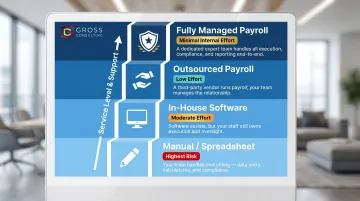
For businesses with mixed workforces, multi-state employees, or limited HR staff, the fourth category is typically where the math shifts in favor of outsourcing.
Benefits Administration as a Managed Service
Benefits administration includes far more than just enrolling employees in health insurance:
- Enrollment management: Coordinating open enrollment periods, processing new hire elections, and managing qualifying life event changes for health, dental, vision, and supplemental coverage
- COBRA administration: Tracking termination dates, issuing required notices, collecting premiums, and maintaining continuation coverage for separated employees
- ACA compliance and reporting: Determining full-time employee status, tracking hours for variable-hour workers, and filing Forms 1094-C and 1095-C annually to avoid employer shared responsibility penalties
- Retirement plan administration: Coordinating 401(k) or 403(b) plan enrollment, managing employee deferrals and employer match calculations, and submitting payroll contributions to plan administrators
- Employee benefits questions: Responding to inquiries about coverage, claims, and eligibility so you're not the middle person between employees and insurance carriers
Many managed services providers pool their clients' buying power, giving small businesses access to group benefits pricing typically reserved for much larger employers.
Compliance Management - The Hidden Risk
Most business owners underestimate compliance complexity until they face a penalty. Managed services providers handle:
- Automated payroll tax remittance: Ensuring federal, state, and local taxes are deposited on time to avoid IRS failure-to-deposit penalties ranging from 2% (1-5 days late) to 15% (after IRS demand)
- Overtime threshold monitoring: Tracking FLSA exemption criteria and flagging when employees approach overtime thresholds or when salary levels fall below minimum exempt thresholds
- I-9 verification and e-Verify: Managing Form I-9 completion, document retention, and e-Verify submission where required, avoiding penalties that reach $2,861 per form for paperwork violations
- State-specific labor law updates: Monitoring and implementing changes to minimum wage, sick leave accrual, pay frequency requirements, and meal/rest break rules across jurisdictions
- Audit-ready documentation: Maintaining organized records of payroll registers, tax filings, benefits elections, and compliance training to support DOL or IRS audits
40% of small and medium-sized businesses incur IRS penalties annually due to payroll errors, with the average payroll error rate sitting at 1.2% per pay period. For a 100-employee company paying $900/week per employee, that translates to roughly $56,647 in annual errors - a figure most owners don't see coming until the notice arrives.
Gusto as a Managed Services Platform
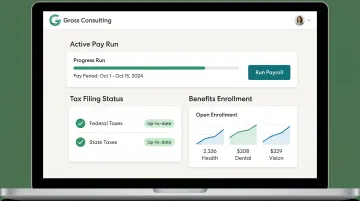
Gusto is one of the most widely used payroll and benefits platforms in modern HR managed services engagements. The platform handles:
- Automated federal, state, and local tax filing
- Direct deposit and contractor payments
- Benefits enrollment for health, dental, vision, and 401(k)
- Time tracking and PTO management
- New hire onboarding and I-9 verification
Gross Consulting is a Verified Gusto Accountancy Partner. In practice, that means the firm configures Gusto to your specific business structure, processes payroll on your behalf, manages compliance alerts, and handles employee support, so the platform runs correctly from day one without requiring you to become a Gusto expert.
Key Benefits for Service-Based Businesses
Cost Reduction
The fully loaded cost of in-house HR includes far more than salary. Consider:
- HR Specialist salary: The median annual wage for HR Specialists is $72,910 (2024 BLS data)
- Benefits loading: Employer-paid health insurance, 401(k) match, payroll taxes, and PTO typically add 25-40% to base salary
- Software licenses: HRIS platforms, payroll software, benefits administration tools, and compliance tracking systems
- Training and development: Ongoing professional education to keep current on FLSA, ACA, FMLA, and state labor law changes
- Compliance errors: IRS penalties, state fines, and back wage liability when mistakes occur
- Turnover overhead: Recruiting, onboarding, and lost productivity when HR staff leave
According to the ADP Research Institute, 55% of midsized and 64% of large employers who outsource HR report more cost-efficient administration as a realized advantage.
Specialized Expertise Without Full-Time Headcount
A managed services partner brings payroll specialists, benefits managers, and compliance officers to your business for a fraction of the cost of hiring each role separately. This is particularly valuable for professional services firms where billing-focused founders don't have the time or interest to become HR experts.
Example: A 25-employee law firm needs someone who understands multi-state payroll for attorneys licensed in different jurisdictions, contractor classification for freelance paralegals, and ACA compliance for support staff. Hiring an HR generalist with that expertise costs $72,910+ annually. A managed services engagement at $12-22 per employee per month totals $3,600-$6,600 annually for the same (or better) expertise.
Compliance and Risk Mitigation
The DOL Wage and Hour Division recovered more than $259 million in back wages for nearly 176,957 employees in FY 2025, and healthcare is among the most-investigated industries. Minimum wage updates, ACA requirements, FLSA overtime thresholds, and state-level paid leave mandates shift regularly. A managed services provider monitors these proactively and implements changes before they trigger penalties.
For attorneys and doctors specifically, non-compliance doesn't just cost money - it puts professional licenses and reputation at risk. The financial exposure is direct: employers who fail to offer minimum essential coverage to 95% of full-time employees face $3,340 per full-time employee (less the first 30) for 2026. For a 50-employee firm, that's a potential $66,800 annual penalty.
Scalability Without Proportional Cost
Managed services grow with you, whether you're adding your 10th employee or your 100th, or bringing on contractors during a busy season. There's no need to hire additional HR staff at each growth phase.
In-house HR doesn't scale the same way. As headcount grows, you add specialists, benefits administrator, payroll manager, compliance officer, each requiring salary, benefits, workspace, and management overhead. Managed services absorb that growth without the proportional cost increase.
Reclaim Time for Revenue-Generating Work
According to research from Group Management Services, small business owners spend an average of 1.6 hours per week on benefits administration and 8 hours on open enrollment alone, nearly a full work week each year on a single HR function.
When payroll, benefits, and compliance move to an external partner, that time shifts back to client delivery and growth. For founders of professional services firms, that's not a minor efficiency gain - it's the difference between running the business and building it.
The Real Cost of HR Managed Services
Common Pricing Models
HR managed services providers typically use one of three pricing structures:
Per-Employee-Per-Month (PEPM):
- Base platform fee (e.g., $40-$180/month) + per-employee fee ($4-$22/employee/month)
- Scales directly with headcount
- Most common for payroll and benefits administration
Flat Monthly Retainer:
- Fixed monthly fee regardless of employee count
- Works best for very small businesses (under 10 employees) or very large ones with predictable headcount
Modular Pricing:
- Individual services priced separately (payroll only, benefits only, compliance-only)
- Flexible, but costs compound quickly as services stack up
Realistic Cost Ranges
Based on publicly available vendor pricing and industry benchmarks, here's what the market shows for small business HR managed services:
| Provider Tier | Base Monthly Fee | Per-Employee Fee | Example: 25 Employees |
|---|---|---|---|
| Basic (payroll only, single-state) | $40-$80 | $4-$8 | $180-$280/month |
| Mid-Tier (multi-state, benefits, time tracking) | $80-$120 | $10-$15 | $330-$495/month |
| Premium (dedicated support, compliance alerts, full HR) | $120-$180 | $18-$22 | $570-$730/month |
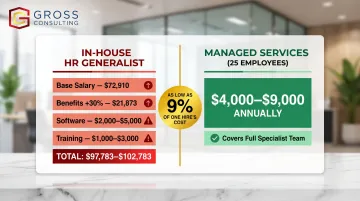
For a 25-employee service-based business, fully managed HR services typically cost between $4,000-$9,000 annually depending on service level.
The Value Calculation
Compare that to the fully loaded cost of one in-house HR generalist:
- Base salary: $72,910 (BLS median)
- Benefits (health, 401k, taxes): +30% = $21,873
- Software and tools: $2,000-$5,000/year
- Training and professional development: $1,000-$3,000/year
- Total annual cost: $97,783-$102,783
A managed services engagement at the premium tier ($8,760/year for 25 employees) costs roughly 9% of a single HR generalist's salary, and that price covers an entire team of specialists across payroll, benefits, and compliance.
Those numbers look compelling, but they only hold up if you know exactly what's in scope. Before signing, clarify what's included versus what costs extra:
What's Often Excluded from Base Pricing
- Advanced scheduling, shift management, and biometric clock-in are often billed separately from core time tracking
- Job posting, candidate screening, and background checks typically fall outside standard HR packages
- Full 401(k) administration (beyond basic payroll integration) usually carries additional fees
- Employee relations support, performance management, terminations, policy development, is commonly an add-on
Request a complete scope of services document and a sample Service Level Agreement (SLA) before committing to any provider.
How to Choose the Right HR Managed Services Partner
Key Evaluation Criteria
Industry and business size experience: Does the provider understand your business model? A firm serving restaurants won't necessarily know how to handle attorney-client privilege considerations for law firm HR files or HIPAA-compliant employee health data for medical practices.
Payroll and benefits depth: Can they handle multi-state payroll, mixed W-2/1099 workforces, commission structures, and complex benefits administration? Or are they best suited for simpler, single-state W-2-only businesses?
Compliance track record: Ask for evidence of compliance monitoring processes - how they track labor law changes, implement updates, and communicate them to clients. Request references from businesses in highly regulated industries.
Platform integrations: Does their system integrate with your accounting software (QuickBooks, Xero), CRM, time tracking tools, or practice management software? Seamless data flow reduces manual entry and errors.
Pricing transparency: Clear, documented pricing with no hidden fees. If a provider won't provide a written quote with all costs itemized, that's a red flag.
Questions to Ask Before Signing
How do you handle multi-state payroll? If you have employees in multiple states, or plan to, you need a provider experienced with varying state tax requirements, reciprocal agreements, and remote worker compliance.
What is your SLA for resolving payroll errors? Payroll mistakes damage employee trust. A good provider guarantees same-day or next-day resolution for critical errors and takes financial responsibility for penalties caused by their mistakes.
Who is my dedicated point of contact? You should have a named account manager or dedicated support team, not just a general support email. Ask how issues are escalated and how quickly you can expect responses.
How are compliance updates communicated? When minimum wage changes or ACA thresholds adjust, how will you know? The best providers proactively notify you, update systems automatically, and confirm implementation.
Do you implement and configure the technology, or just provide access? This is the core distinction between managed services and software licensing. A true managed services partner configures the platform, runs the processes, and manages ongoing operations, not just gives you a login.
That last question matters more than most businesses realize - and it's where the gap between providers becomes most visible.
Warning Signs of a Poor-Fit Provider
- Provides vague quotes or refuses to itemize costs in writing, expect surprise fees after signing
- Offers only generic ticket-based support with no named contact or account manager
- Can't explain how they monitor labor law changes or push updates to client systems
- Runs a rigid, one-size-fits-all platform that doesn't adapt to your pay schedules or workforce mix
- Lacks experience in professional services, and won't understand law firm timekeeping, on-call pay for medical staff, or real estate commission structures

If a provider checks more than one of these boxes during the evaluation process, keep looking. The right partner will make these answers easy to give.
HR Trends Shaping Managed Services in 2025 and Beyond
AI-Powered Payroll and Compliance
AI adoption gap by company size: According to ADP research (December 2025), 48% of large businesses have adopted agentic AI technologies, compared to just 25% of midsized companies and only 4% of small businesses. This gap means small firms lack access to AI-driven capabilities that improve accuracy and compliance monitoring.
What AI is enabling in managed services:
- Flags unusual pay amounts, duplicate entries, or miscalculations automatically before payroll runs
- Sends proactive notifications when employees approach overtime thresholds, ACA full-time status, or exempt salary minimums
- Guides employees through benefits plan selection via self-service portals, generating required forms and syncing elections with payroll automatically
Deloitte research shows automated payroll processing can cut errors by up to 50% and reduce processing time by 25%.
Multi-State and Remote Workforce Complexity
The shift to remote work has created compliance challenges for businesses managing employees across state lines, each with different:
- Tax withholding requirements and reciprocal agreements
- Minimum wage and overtime rules
- Paid sick leave and family leave mandates
- Workers' compensation and unemployment insurance obligations
Managed services providers with robust multi-state capabilities automate these complexities, ensuring compliance without requiring clients to become experts in 50 different state tax codes.
Why Managed Services Now Means More Than Payroll Processing
The market is shifting away from vendors who only process payroll toward partners who proactively optimize HR operations. According to NAPEO's 2025 survey, 87% of non-PEO users express interest in outsourcing HR for compliance and regulatory assistance, but they want strategic guidance, not just task execution.
Modern managed services providers blend AI-driven automation with human HR expertise, delivering both operational efficiency and strategic support. The right partner doesn't just keep up with regulatory changes - they flag exposure before it becomes a liability and help you build HR infrastructure that scales as your team grows.
Frequently Asked Questions
What are HR managed services?
HR managed services are the outsourcing of HR functions like payroll, benefits administration, and compliance to a specialized provider who actively manages those processes on your behalf, not just software you operate independently.
What is the average cost of an HR consultant?
HR consultants typically charge $150–$300/hour for project work, while full managed services for small businesses cost $4–$22 per employee per month. Managed services usually cost less than hiring even a part-time in-house HR specialist when all costs are factored in.
What is the difference between BPO and HRO?
BPO (Business Process Outsourcing) is a broad term covering any outsourced business function. HRO (Human Resources Outsourcing) specifically refers to delegating HR functions, payroll, benefits, compliance, and onboarding, to a dedicated HR provider.
What are the 4 types of payroll systems?
The four types are manual/spreadsheet payroll, in-house payroll software, outsourced payroll services, and fully managed payroll. Managed payroll is the highest-service tier, where a third party handles processing, tax filing, and compliance.
What are the top HR trends for 2025?
Key 2025 trends for small and mid-sized businesses include AI-assisted compliance monitoring, personalized benefits platforms, and the shift toward unified HR managed services that bring payroll, benefits, and workforce data under one roof.
Final Takeaway: HR managed services give service-based businesses, attorneys, doctors, real estate firms, access to payroll specialists, benefits experts, and compliance professionals without building an internal department. When choosing a provider, prioritize industry experience, compliance track record, dedicated support, and transparent pricing. The right partner handles the administrative load so you can focus on running your business.