You're not alone. Most small business owners face the same frustration: Facebook ads promise targeted reach at affordable prices, but figuring out how to make them actually work feels like learning a new language. The good news? You don't need a marketing degree to run profitable campaigns - you just need to understand the fundamentals that separate wasted spend from real growth.
This guide covers exactly what service-based small businesses need to know: why Facebook ads work specifically for your industry, how to set up campaigns correctly, what they actually cost, how to target the right people, and how to measure success.
Key Takeaways
- Facebook reaches 3.07 billion users monthly, giving you direct access to highly specific audiences by location, demographics, and behavior, for far less than traditional advertising costs
- The biggest mistake is using the Boost button instead of Meta Ads Manager, which limits targeting, budget control, and optimization
- Facebook ads require a 3-month ramp-up before delivering consistent ROI - the algorithm needs data before it can optimize effectively
- Success comes down to four things: precise targeting, authentic creative, goal-aligned budgets, and consistent performance review
Why Facebook Ads Are Worth It for Small Businesses
Facebook has 3.07 billion monthly active users worldwide. For service-based businesses, attorneys, healthcare providers, consultants, real estate investors, this means access to virtually any customer segment you need to reach. The platform functions as a discovery engine: nearly 40% of social users turn to Facebook to discover new products and services, making it a powerful channel for businesses that don't rely on high search volume.
Traditional advertising, billboards, radio spots, print ads, demands large budgets with minimal targeting control. You pay for exposure to everyone, whether they need your service or not. Facebook ads flip that model:
- Set budgets starting at $10-15 per day
- Target specific demographics, behaviors, and interests
- Track performance in real-time
- Adjust campaigns instantly based on data
70% of marketing leaders report that Facebook delivers positive ROI, but that number comes with a condition. Ads amplify what's already working in your business. A broken offer or unclear value proposition won't be fixed by ad spend. A proven service with the right targeting, though, can generate consistent lead volume. That ROI also depends on one factor most small businesses underestimate: time.
The 3-Month Performance Arc
Facebook ads aren't instant. The platform's algorithm needs time to learn what works. Expect this progression:
- Month 1: Reach and awareness build; the algorithm tests your audience
- Month 2: Engagement and clicks increase as the system identifies responsive users
- Month 3: Conversion optimization begins; you start seeing consistent leads
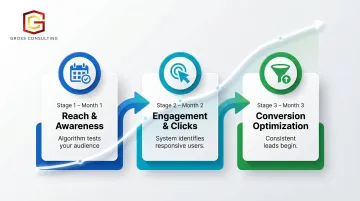
Most campaigns that "didn't work" were paused during Month 1, before the algorithm had enough data to optimize. Give the system the runway it needs, and the results follow.
How to Set Up a Facebook Ads Campaign: Step-by-Step
Before launching your first campaign, you need three things: a Facebook Business Page, a Meta Ads Manager account (not just Boost), and a verified payment method. Campaigns built in Ads Manager give you full access to targeting options, A/B testing, placement controls, and detailed analytics, none of which are available through the Boost button.
Choosing Your Campaign Objective
Meta offers six campaign objectives optimized for different business goals:
| Objective | What It Optimizes | Best Use Case |
|---|---|---|
| Awareness | Reach, brand recognition, ad recall | Introducing a service to a new market |
| Traffic | Link clicks, landing page views | Driving visits to a booking site or service page |
| Engagement | Interactions, video views, messages | Starting conversations via Messenger |
| Leads | Form submissions, calls, sign-ups | Collecting contact info directly on Facebook |
| App Promotion | App installs, app events | Not typical for service businesses |
| Sales | Conversions, booked consultations | Driving scheduled appointments or purchases |
Choose the wrong objective, waste your budget. If you want contact form submissions but select Traffic, Facebook will optimize for clicks, not conversions. For attorneys and consultants seeking new clients, use Leads. For local service businesses building brand recognition, start with Awareness or Traffic.
Setting Your Audience and Budget
Audience setup starts with baseline criteria: location, age, and language. From there, you layer in more sophisticated targeting:
Custom Audiences let you upload existing email lists to retarget people who already know you, ideal for reactivating dormant leads or upselling past clients.
Lookalike Audiences analyze your best customers and find users with similar profiles. For a solo attorney or boutique consulting firm, this means Facebook does the prospecting work, finding new potential clients who mirror your existing ones without requiring a large ad budget to test manually.
Meta Advantage+ Audience offers an AI-powered alternative for businesses without deep audience data. The system treats your targeting inputs as suggestions, then expands to find additional high-potential users.
Budget options:
- Daily budget: Facebook spends up to 75% over your daily budget on high-opportunity days, but caps weekly spend at 7x your daily budget
- Lifetime budget: Total spend across the entire campaign duration
Start with a daily budget of at least $10–15/day. Budgets below this threshold limit Facebook's ability to enter competitive auctions and gather enough data to optimize. Meta's algorithm needs 50 conversion events per ad set per week to exit the learning phase, under-budgeting prevents this from happening.
Building and Publishing the Ad
Choose your ad format based on your goal:
- Video ads: Best for service businesses demonstrating expertise before the first consultation
- Carousel ads: Showcase multiple offerings or case studies
- Single image: Clean, direct response ads driving one action
- Collection ads: Product catalogs (less common for service businesses)
Write compelling copy:
- Headline that leads with the outcome (e.g., "Get More Clients This Month" beats "Welcome to Our Firm")
- Body copy that addresses a specific frustration your audience has, not a feature list
- CTA that removes friction: "Book a Free 15-Minute Call" converts better than "Contact Us"
Image specs: Facebook limits text overlay to 20% of image area. Excessive text triggers ad rejection.
After submitting, expect approval within 24 hours. Watch your email for compliance flags, then shift focus to monitoring early performance data.
How Much Do Facebook Ads Cost for Small Businesses?
There's no fixed price. Costs vary based on audience competition, industry, seasonality, ad placement, and campaign duration. Two metrics drive your budget decisions: Cost Per Click (CPC), what you pay per click, and Cost Per Lead (CPL), what you pay per actual inquiry or form submission.
CPC alone doesn't tell the full story. Higher CPC in high-value industries like legal or healthcare can still yield strong ROI when conversion rates are solid. The benchmark data below shows why both numbers matter.
Industry Benchmarks: Traffic Campaigns
WordStream's 2025 data analyzing 554 US-based traffic campaigns reveals significant cost variation by industry:
| Industry | Avg. CPC (Traffic) | Avg. CTR |
|---|---|---|
| Finance & Insurance | $1.22 | 0.98% |
| Real Estate | $0.91 | 1.68% |
| Attorneys & Legal | $0.86 | 1.76% |
| Physicians & Surgeons | $0.82 | 0.83% |
| Business Consulting | $0.75 | 1.38% |
| Restaurants | $0.72 | 1.67% |
| Arts & Entertainment | $0.49 | 2.10% |
| All Industries | $0.70 | 1.71% |
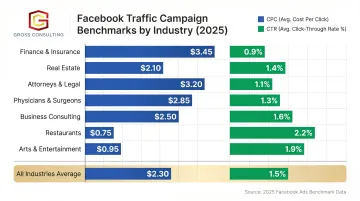
Finance & Insurance commands the highest CPC at $1.22, 2.5x higher than Arts & Entertainment. This reflects auction competition for high-value service leads.
Industry Benchmarks: Lead Generation Campaigns
WordStream's 2025 lead campaign data (726 US campaigns) shows even wider cost gaps:
| Industry | Avg. CPL | Avg. CPC (Leads) | Avg. CVR |
|---|---|---|---|
| Dentists | $76.71 | $9.78 | 6.38% |
| Physicians & Surgeons | $47.47 | $2.23 | 4.51% |
| Attorneys & Legal | $18.17 | $4.10 | 10.53% |
| Real Estate | $16.61 | $1.57 | 9.53% |
| Restaurants | $3.16 | $0.74 | 18.25% |
| All Industries | $27.66 | $1.92 | 7.72% |
Attorney CPL dropped 77% year-over-year, from $104.58 (2024) to $18.17 (2025). For legal practices running ads today, that shift means more room to generate leads without inflating budgets, provided targeting is dialed in.
Budget-to-Strategy Alignment
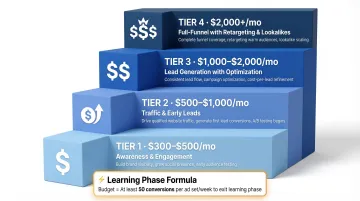
A $300/month budget won't support the same objectives as $1,500/month. Here's what different budget tiers can realistically achieve:
- $300-500/month: Awareness and engagement; limited conversion data
- $500-1,000/month: Traffic generation; early-stage lead campaigns
- $1,000-2,000/month: Solid lead generation with enough data to optimize
- $2,000+/month: Full-funnel campaigns with retargeting and lookalike audiences
The Learning Phase Challenge
Meta's algorithm requires 50 conversion events per ad set per week to exit the learning phase. The practical minimum daily budget per ad set is: (Target CPA × 50) ÷ 7.
If you target a $30 cost per lead, you need roughly $214/day per ad set to exit learning. At $5/day, the ad set generates fewer than 2 conversion events per week, well short of the 50-event threshold, and the result is unstable, inflated costs.
Facebook Audience Targeting Strategies That Actually Work
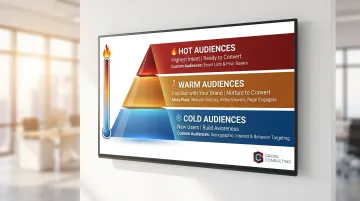
Effective targeting separates profitable campaigns from budget drain. Think of audiences in three temperature tiers:
The Targeting Temperature Stack
Cold Audiences: Brand-new users targeted by demographics, interests, and behaviors. Use these to expand reach and test new markets.
Warm Audiences: People who've interacted with you, website visitors (via Meta Pixel), video viewers, page engagers. These users already know you exist.
Hot Audiences: Custom Audiences from email lists or prior buyers. These are your highest-intent prospects.
Structure multiple campaigns at different funnel stages using this framework. Custom Audiences and Lookalike Audiences are the primary tools for working the warm and hot tiers effectively.
Custom Audiences: Warm and Hot Tier Targeting
Upload your customer email list to create a Custom Audience. This avoids wasting budget on people who already know you and enables:
- Retargeting existing contacts
- Upselling past clients
- Reactivating dormant leads
For service businesses, Custom Audiences prevent you from paying to re-introduce yourself to someone who's already in your CRM.
Lookalike Audiences: Scale Beyond Your Network
Facebook analyzes your best customers and finds users with similar profiles, demographics, interests, behaviors. You choose a percentage range (1% to 10%): smaller percentages match your source more closely; larger percentages yield broader reach.
A solo attorney or boutique firm can reach thousands of new prospects who match their ideal client profile without cold outreach. Lookalike campaigns deliver a median ROAS of 1.80, while retargeting delivers 3.61, but lookalikes let you scale beyond your existing network.
Regulatory note: Lookalike audiences are limited or unavailable for financial services, employment, and housing ads due to compliance restrictions.
The Meta Pixel: Required Infrastructure for Conversion Campaigns
The Meta Pixel is a snippet of code installed on your website that tracks visitor actions. It's required infrastructure for conversion campaigns, not an optional add-on.
What it enables:
- Conversion tracking (form submissions, calls, bookings)
- Retargeting website visitors who didn't convert
- Building Custom Audiences over time
- Optimizing campaigns based on on-site behavior
17 standard events can be tracked, including Lead, Contact, Schedule, CompleteRegistration, SubmitApplication, and ViewContent. Install the Pixel before launching any conversion campaigns - without it, Facebook can't optimize for results.
Precision Over Width
Precise behavioral targeting consistently outperforms broad demographic targeting. Narrowing by specific signals improves both click quality and conversion rates:
- Target people who follow competitor pages
- Target users who've recently searched for legal help
- Target users matching life events (recently moved, recently engaged, new job)
Meta Advantage+ Audience offers AI-powered targeting that treats your inputs as suggestions, then expands to find high-potential users. Meta reports median CPA improvements of 14.8% (upper funnel), 9.7% (middle funnel), and 7.2% (lower funnel) at 99.9% confidence when using Advantage+ versus manual targeting.
Best Practices to Get Better Results from Your Facebook Ads
A/B Test One Variable at a Time
Test ad image vs. ad image, headline vs. headline, or audience vs. audience, never multiple variables simultaneously. Changing everything at once makes it impossible to identify what drove improvement.
Run tests for at least 7 days before declaring a winner. Facebook's split testing tool allows 3-14 day tests; practitioners recommend 5-7 days minimum depending on the variable tested.
Use Creative That Doesn't Look Like an Ad
Content that blends into the feed consistently outperforms polished, "salesy" creative. UGC-style ads generated 28% more trust signals (likes, shares, saves) compared to traditional brand ads in a 2025 Meta study.
For service businesses:
- Behind-the-scenes videos work better than stock imagery
- Client testimonials build trust faster than scripted promotions
- Short educational videos showing the human behind the brand, the attorney, the doctor, the consultant, outperform studio-produced ads

Phone-shot, authentic content costs less to produce and performs better.
Track What Matters, Not Vanity Metrics
Stop obsessing over reach and impressions. Focus on ROI-driving KPIs:
- Cost Per Lead (CPL): What you pay to generate an inquiry
- Conversion Rate: Percentage of clicks that become leads
- Return on Ad Spend (ROAS): Revenue generated per dollar spent
Find these metrics in Meta Ads Manager's reporting dashboard. Set baseline benchmarks for your industry using the tables above.
Know When to Hire a Professional
Self-management works well during early testing. Once monthly spend climbs past $1,000-$2,000, the complexity compounds fast - pixel configuration, creative testing cycles, audience segmentation, and conversion tracking all need to work together.
At that point, a Verified Meta Business Partner brings real value. Gross Consulting, for example, handles the full build: creative development, tracking setup, audience strategy, and ongoing optimization. The goal is campaigns that generate actual leads, not just clicks.
Key signals it's time to bring in help:
- Ad spend is growing but cost per lead isn't improving
- You're unsure whether your pixel is tracking conversions accurately
- Creative is running stale and you lack bandwidth to refresh it
- You've hit a performance plateau despite budget increases
Frequently Asked Questions
Do Facebook (Meta) ads work for small businesses?
Yes, they work when targeting, budget, and offer align, but they amplify what's working, not fix what's broken. Service-based businesses including attorneys, healthcare providers, and consultants regularly generate leads through Meta ads with the right campaign structure.
How much do Facebook ads cost for small businesses?
There's no fixed cost - you control spending via daily or lifetime budgets. Average CPC varies widely by industry: legal and real estate tend to be higher ($0.86-$0.91), while restaurants and entertainment run lower ($0.49-$0.72). Modest budgets of $10-20/day can generate results when targeting and creative are well-configured.
What is the difference between boosting a post and running a Facebook ad?
Boosting is a simplified promotion tool with limited targeting and no access to conversion optimization. Running an ad through Meta Ads Manager gives full access to targeting options, bidding strategies, A/B testing, pixel tracking, and performance data, making it far more effective for growth-focused campaigns.
How long does it take for Facebook ads to show results?
Expect a 3-month arc: Month 1 builds reach and allows the algorithm to learn; Month 2 generates engagement and clicks; Month 3 is when conversion optimization begins. Stopping campaigns before the algorithm has time to optimize is the most common reason for poor results.
What types of Facebook ads work best for service-based businesses?
Lead Generation ads capture inquiries directly on Facebook. Video ads build trust by showing the person behind the service. Retargeting ads re-engage website visitors who didn't convert.
Do I need a large budget to start Facebook ads for my small business?
You can start testing with $10-15/day, but dropping below $10/day per ad set risks permanent "Learning Limited" status and wasted spend. Start small to test audience and creative, then scale once you find a winning combination.
Want campaigns that actually convert? Gross Consulting is a Verified Meta Business Partner that builds and manages full-funnel Facebook ad campaigns for service-based businesses. From pixel setup to creative development to performance tracking, we handle the execution so you can focus on running your business.
Contact Gross Consulting today:
📞 +1 (424) 347-6865
📧 support@grossconsultinginc.com
📍 1942 Broadway, Suite 314C, Boulder, CO 80302
🕒 8:00 AM - 7:00 PM MST