This is one of the most common frustrations among service business owners — attorneys, consultants, real estate firms, medical practices — who are excellent at their craft but lack a repeatable system for turning conversations into clients. The instinct is to hire another salesperson or run more ads. Neither fixes the underlying problem.
That's where sales enablement consulting comes in. It's not about adding headcount or running campaigns. It's about building the infrastructure that makes sales repeatable, predictable, and scalable — regardless of who's doing the selling.
This article covers what sales enablement consulting actually is, how it differs from sales training, the five warning signs you need it, what a consultant delivers, and how to choose the right partner.
Key Takeaways
- Sales enablement consulting builds a durable, repeatable revenue system that outlasts any single training event
- Companies with formal enablement programs hit 49% win rates, compared to 42.5% for those without
- Service businesses benefit most when scaling past the point where the founder closes every deal
- Warning signs include stalled pipelines, inconsistent messaging, slow new-hire ramp-up, and low tool adoption
- The right consulting partner builds the system with you, not just hands you a framework and walks away
What Is Sales Enablement Consulting?
Gartner defines sales enablement as providing sales organizations with the information, content, and tools that help sellers sell more effectively. Sales enablement consulting takes that further — it brings in an outside expert to evaluate, design, and implement that entire function for businesses that don't have one.
Most growing service businesses don't have a dedicated enablement team. A consultant fills that role, then hands it off.
The Four Core Pillars
A quality engagement typically works across four areas:
- Strategy — A data-driven plan connecting daily sales activities to actual revenue goals
- Content — Playbooks, messaging guides, and case studies reps need at every deal stage
- Training and Coaching — Skills development focused on behavior change, not just knowledge transfer
- Technology — Ensuring the tools in place actually support the sales process and get used
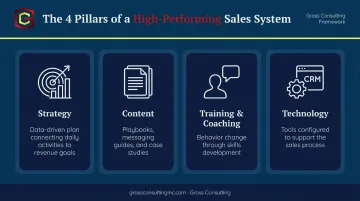
The fourth pillar trips up a lot of businesses. New decks and PDFs don't change outcomes on their own. Without live coaching, role-play, and behavioral reinforcement built into the system, content sits unused. The goal isn't better materials — it's better selling behavior.
Enablement vs. a Hiring Solution
The most common mistake service business owners make when sales slow down: they hire more salespeople.
More reps without a working system doesn't fix the problem. It scales the dysfunction. When messaging is inconsistent, pipeline stages are unclear, and onboarding is handled informally, adding headcount just means more people struggling through the same broken process.
Sales enablement consulting is the infrastructure investment that makes every person on your team more effective. Get the system right first — then adding people actually compounds your results instead of your problems.
Sales Enablement Consulting vs. Sales Training: What's the Difference?
Sales training is a component of enablement — typically a workshop, course, or skills module focused on a specific capability like objection handling or discovery. It's time-bound and event-based.
Sales enablement consulting is broader and ongoing. It diagnoses why a team underperforms, then builds the full ecosystem — strategy, content, process, tools, and coaching — to address those root causes.
Most service business owners have already invested in training — a course, a workshop, a new scripting framework — and seen limited results. The training wasn't the problem. What was missing was any reinforcing system around it.
CSO Insights found that only 37.1% of organizations used formal or dynamic coaching — meaning nearly two-thirds rely on random or informal reinforcement. Dynamic coaching, by contrast, improved win rates by 19% and quota attainment by 21.3% over the study average. The difference isn't the training event. It's what happens after.
That's the gap consulting fills: not more training, but the structure that ensures training translates into consistent, measurable behavior change on the floor.
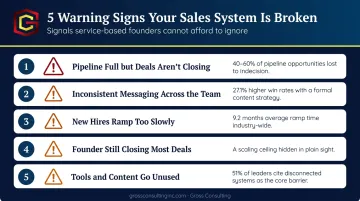
5 Warning Signs Your Business Needs Sales Enablement Consulting
Sign 1: Your Pipeline Is Full, But Deals Aren't Closing
Proposals go unanswered. Follow-ups go nowhere. Conversations that felt promising just stop. Harvard Business Review analysis of 2.5 million sales conversations found that 40–60% of deals are lost to customer indecision after buyers have already expressed intent to purchase. That's not a lead quality problem. It's a process gap: missing deal stages, no exit criteria, no consistent follow-up cadence.
Sign 2: Messaging Is Inconsistent Across Your Team
If different team members pitch your service differently, buyers get confused. Trust erodes. According to CSO Insights, only 31.8% of organizations had a formal content strategy — and those that did saw 27.1% higher win rates. If your pitch depends on who's delivering it, that's a missing playbook problem, not a people problem.
Sign 3: New Hires Take Too Long to Ramp
When onboarding is informal or relies entirely on shadowing, it costs you time, money, and momentum. CSO Insights reported average new-hire ramp time of 9.2 months to full productivity. Research from the Sales Management Association found that structured onboarding reduced that from 9.1 months to 5.7 months — a 37% reduction. Every month of slow ramp is a month of revenue left on the table.
Sign 4: You're Still Closing Most of the Deals
This is the clearest sign of a scaling ceiling. If your revenue depends on your personal presence in every deal, the business cannot grow beyond your individual capacity. Founder-led sales works early. It stops working when your calendar is full and the pipeline still depends entirely on you. Enablement builds the system so others can replicate your results without your constant involvement.
Sign 5: Tools and Content Exist, But No One Uses Them
A CRM no one logs into. A pitch deck no one references. Training materials that were opened once. According to Salesforce's 2025 State of Sales report, 51% of sales leaders say disconnected systems slow their team's effectiveness. When tools fight the workflow instead of supporting it, adoption collapses. A consultant addresses both the configuration and the adoption design.
What Does a Sales Enablement Consultant Actually Deliver?
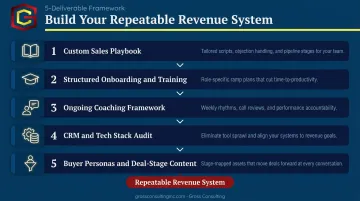
A Custom Sales Playbook
A single source of truth that documents your sales methodology, buyer journey stages, messaging, common objections, and what "good" looks like at each deal stage. This brings consistency across the team — whether it's your third rep or your fifteenth.
Structured Onboarding and Training
Not a one-time event. A repeatable process that gets new team members productive faster using proven frameworks, real scenarios, and milestone-based checkpoints. The goal is cutting that 9-month ramp window down significantly.
An Ongoing Coaching Framework
A cadence for consistently coaching reps on real deals — not just running pipeline reviews. This is where behavior change actually happens: through repeated, contextual practice. Structured coaching programs consistently outperform ad hoc feedback — reps hit quota faster and churn less when the coaching is tied to real deals, not quarterly reviews.
A CRM and Tech Stack Audit
Ensuring existing tools are configured to support the sales process — not fight it. This includes adoption design: making sure the system is set up in a way people actually use. For service businesses running disconnected tools or an underutilized CRM, this alone can unlock meaningful efficiency gains.
Buyer Personas and Deal-Stage Content
Detailed profiles of ideal customers — their goals, objections, and decision criteria — paired with the specific talking points and content needed at each stage of the buying conversation, from initial outreach to close.
Those deliverables aren't abstract — they map directly to what a hands-on engagement should produce. Here's what Gross Consulting builds in practice.
What Gross Consulting Brings to the Table
Gross Consulting's Sales & Communications service is built around this same philosophy: build and optimize the entire sales infrastructure, not just advise on it. That means:
- Sales scripting and messaging development
- Expert coaching and training programs
- Real-time performance coaching on live deals
- Live performance reviews tied to actual pipeline activity
- Recruitment support to build the right team from the start
Unlike firms that hand over a report and disengage, Gross Consulting's approach is hands-on throughout. As founder Jaiden Gross puts it: "We don't stop at making recommendations; we build and improve alongside you." For service businesses scaling from six to seven figures, that distinction matters.
How to Choose the Right Sales Enablement Consulting Partner
Look for Industry and Stage-Specific Experience
A consultant who has spent their career with high-volume transactional businesses may not understand relationship-driven sales cycles or the referral-heavy pipelines that professional service firms rely on. Ask for demonstrated experience with businesses similar to yours in type and growth stage.
Ask the Right Questions Before Committing
Strong consulting partners give you specific, outcome-focused answers. Ask:
- How do you define and measure success in an engagement?
- Can you walk me through a case study with a similar client?
- What does your engagement process look like, and how do you handle team adoption?
- What happens after the engagement ends — how does the team run the system independently?
Vague or deflective answers to these questions are a reason to keep looking.
Watch for These Red Flags
These questions also help surface the patterns that separate capable partners from ones who overpromise:
- Templated proposals that don't reflect your specific situation
- Deliverables described without tying them to revenue outcomes
- Success stories without verifiable metrics
- An engagement model that creates ongoing dependency rather than building internal capability
The right partner leaves your team with documented processes, trained staff, and a system they can run without outside help. If the engagement has no clear exit point, that's worth questioning before you sign.
Frequently Asked Questions
What is the difference between sales enablement and sales training?
Sales training is a time-bound skills event — a workshop, course, or module. Sales enablement is the broader system surrounding and reinforcing that training: content, tools, coaching cadence, and process. Training without enablement rarely produces lasting behavior change.
Do I need a dedicated sales team to benefit from sales enablement consulting?
No. Founder-led sales operations benefit significantly — often most — because enablement consulting documents and transfers the founder's sales approach into a scalable system others can follow. Build the system first. The team comes after.
How long does it take to see results from sales enablement consulting?
Leading indicators — more consistent messaging, higher content usage, faster onboarding — can appear within 60–90 days. Lagging indicators like win rates and quota attainment typically take 6–12 months to fully reflect system changes. Plan to review both categories at the six-month mark for a meaningful read on progress.
What does a sales enablement consultant actually deliver?
Core deliverables include a custom sales playbook, buyer personas, a structured onboarding program, an ongoing coaching framework, and a tech stack optimization plan. Together, these build a repeatable revenue system the team runs independently.
Is sales enablement consulting worth it for small or service-based businesses?
Yes — particularly for service businesses where revenue is capped by the founder's personal selling capacity. Early investment in a formal system prevents expensive trial-and-error during scaling and makes the transition to a sales team far smoother.
How do I know if my sales enablement consulting engagement is working?
Track two categories: leading indicators (content utilization, onboarding speed, meeting-to-proposal conversion) and lagging indicators (win rate, sales cycle length, revenue per rep). A strong consulting partner establishes baseline measurements before the engagement begins so you can compare accurately.