The wrong agency burns your budget on vanity metrics. The right one becomes a genuine growth engine. That gap is significant, and the decision deserves more scrutiny than most businesses give it.
This guide covers what a Facebook ads agency actually does, six criteria that matter specifically for service businesses, how to vet agencies before signing, and what to look for in a trustworthy partner.
Key Takeaways
- A Facebook ads agency manages strategy, creative, targeting, and optimization, from initial setup through ongoing optimization
- Service businesses need vertical experience, not just general eCommerce or SaaS knowledge
- Verified Meta Business Partners with outcome-based reporting are the baseline worth meeting
- Agency fees typically run $2,500–$10,000/month flat or 10–20% of ad spend, billed separately from your Meta budget
- Before signing, ask who manages your account daily and what success looks like at 90 days
What a Facebook Ads Agency Actually Does
A Facebook ads agency manages your paid advertising on Meta end to end: campaign strategy, audience targeting, creative production, budget allocation, and ongoing optimization. The goal is campaigns that generate qualified leads while you focus on running your business.
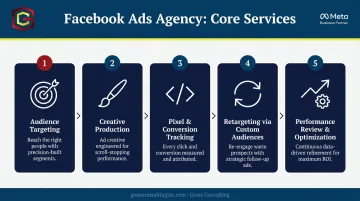
A typical engagement covers:
- Identifies who to target using behavior, demographics, and intent signals
- Produces creative assets — copy, visuals, and video — for feeds, Stories, and Reels
- Configures your Meta Pixel and conversion tracking so ad clicks tie to real business outcomes
- Re-engages warm audiences through Meta Custom Audiences retargeting
- Reviews performance data regularly and adjusts campaigns to improve results
Better agencies go further. They advise on landing pages, lead form structure, and intake workflows — because an ad that generates a click is only valuable if the rest of the funnel converts it. That full-funnel perspective also helps clarify who you're actually hiring.
The Difference Between an Ads Agency and a Social Media Manager
A social media manager typically handles content creation, posting schedules, and community engagement — their metrics are followers and reach. An ads agency is performance-driven. Success means cost per lead, cost per acquisition, and return on ad spend: measurable business outcomes, not platform activity. If an agency can't articulate that difference, that's a problem.
Six Criteria That Matter When Choosing a Facebook Ads Agency
Selecting an agency isn't a one-size-fits-all decision. For service businesses, the stakes are higher because leads are more valuable and harder to convert. These six factors separate agencies that drive qualified revenue from ones that run traffic and report clicks.
1. Industry and Vertical Experience
Service businesses operate differently from eCommerce. Your sales cycle is longer. Trust matters more. And depending on your industry, compliance constraints shape what you can and can't say in an ad.
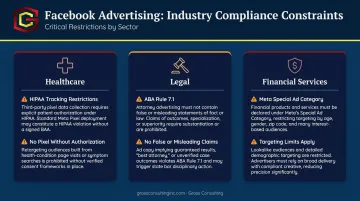
Vertical compliance is one area where generic agencies consistently fall short. A few examples:
- Healthcare: HIPAA guidance from HHS restricts how tracking technologies can be used — cookie banners don't substitute for HIPAA authorization
- Legal: ABA Model Rule 7.1 prohibits false or misleading communications about legal services
- Financial services: Meta's Special Ad Category requirements limit targeting options significantly
Ask for specific examples of campaigns they've run in your vertical, not just a list of industries they've "worked with."
2. Meta Business Partner Status and Certifications
A Verified Meta Business Partner designation means the agency has been vetted by Meta for technical skills and the ability to help businesses grow. This status comes with access to advanced tools, priority support, and greater platform visibility.
Meta also offers role-based certifications — Media Buying Professional, Creative Strategy Professional, AI and Performance Marketing — that signal technical proficiency beyond general familiarity with the platform.
Confirm their Meta credentials and how they stay current as the platform evolves. Partner status alone isn't sufficient — combine it with the criteria below.
3. Transparent Reporting and Attribution
A trustworthy agency ties reporting to business outcomes: cost per qualified lead, booked appointments, revenue attributed to campaigns. If an agency leads with impressions and click-through rates, treat that as a red flag.
Attribution is increasingly complex. Apple's iOS 14.5 changes constrained browser-based tracking, which is why the Meta Conversions API matters. It creates a direct server-to-Meta connection using your CRM data, providing more accurate attribution than pixel-only tracking.
Before signing on, get specific answers to these three questions:
- How do you track leads from ad click to closed revenue?
- Do you implement the Conversions API, and how is it connected to our CRM?
- What does a standard monthly report look like, and which metrics drive decisions?
4. Creative Strategy and Production Capabilities
Creative is the single biggest performance variable in a Facebook campaign. An agency should produce scroll-stopping visuals and copy that speak directly to your audience's specific problems — not recycle stock imagery across every client.
Ask to see ad creative examples from service businesses similar to yours. Then ask about their testing process. The best agencies run systematic creative tests — different headlines, hooks, formats, CTAs — and use performance data to iterate quickly. Running the same ad for months without testing is a sign of a passive management style.
5. Pricing Structure and Budget Alignment
Common agency pricing models:
| Model | Typical Range | Best For |
|---|---|---|
| Flat monthly retainer | $2,500–$10,000/month | Predictable budgets, defined scope |
| Percentage of ad spend | 10–20% of spend | Larger budgets where incentives should align |
| Hybrid | Flat base + % of spend | Scaling accounts that need both |
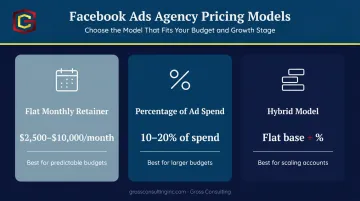
These fees are separate from what you pay Meta directly. Evaluate pricing relative to what's included — a lower retainer that excludes creative production, reporting, or strategic consulting can cost more in missed opportunity than a higher one that covers everything.
6. Full-Funnel Thinking and Lead Quality Focus
Running ads is only part of the job. For service businesses, lead quality matters more than lead volume. Fifty unqualified form fills are worth less than 10 qualified phone calls.
An agency worth hiring thinks about what happens after the click. That means advising on landing page structure, lead form optimization, and how your intake team follows up. WordStream's analysis found that while Meta lead ads converted at a higher rate (12.54% vs. 10.47% for landing pages), landing pages produced higher-quality leads at a lower cost per quality lead — nuances a full-funnel agency should be able to navigate.
Look for agencies that integrate ad data with your CRM, support retargeting sequences, and think about your growth beyond their immediate deliverables.
How to Vet an Agency Before Signing
Treat the initial conversation as a due diligence process, not a sales call. Here are the questions that reveal the most:
- What does your onboarding process look like? Structured agencies have a defined sequence. Vague answers suggest ad hoc execution.
- How do you define success for a service-based business at 90 days? Forces them to articulate business outcomes, not platform metrics.
- Can you share case studies from clients in my industry? Vertical experience should be demonstrable, not theoretical.
- Who manages my account day-to-day? You want a clear name and role, not "the team."
- How do you handle Meta policy changes or account issues? Tests their platform depth and responsiveness.
How they answer those questions tells you plenty. So does what they avoid saying altogether.
Red Flags to Watch
- Guaranteed results — No ethical agency promises 100 leads/month. Meta's algorithm doesn't work that way.
- Vanity metric reporting — If their sample reports show impressions and likes instead of CPL or booked calls, walk away.
- No references or case studies — every experienced agency has clients willing to vouch for them.
- Account managers unfamiliar with your industry — ask directly. You'll know within two minutes.
- No transparency on ad spend — you should always know exactly where your media budget is going.
Client retention tells you what a sales pitch won't. According to 4A's and ANA research, average client-agency relationship tenure now sits around seven years. If an agency struggles to keep clients past six months, that's your answer before you sign anything.
How Gross Consulting Helps Service Businesses Win with Facebook Ads
Gross Consulting is a Boulder-based growth consulting firm built specifically for service-based businesses — attorneys, doctors, real estate investors, and local service companies. As a Verified Meta Business Partner, the firm brings platform-level credibility alongside a scope of service most agencies don't offer.
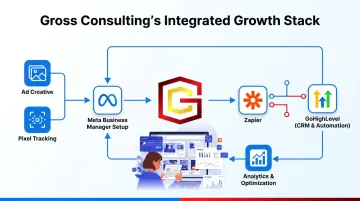
The core differentiator is scope. Where most agencies stop at the ad account, Gross Consulting extends into the full growth stack:
- Ad creative and copy developed in-house for service business audiences
- Pixel configuration and advanced tracking that captures accurate attribution
- Business Manager infrastructure optimization so campaigns perform, not just run
- CRM and automation integration via GoHighLevel and Zapier, connecting leads directly to client systems
Getting traffic is only half the equation. Gross Consulting's CRO and operational services handle landing page optimization, lead funnel development, and sales infrastructure — so the leads campaigns generate have somewhere effective to land.
Founder Jaiden Gross built the firm after years working alongside service-based business owners who had strong businesses but scattered systems and underperforming marketing. Pairing ads with the right operational infrastructure is what moves businesses from six-figure revenue toward seven- and eight-figure growth.
For service businesses evaluating partners, the combination of Meta Business Partner status, hybrid AI-and-human campaign management, and integrated operational support means you're not just buying ad spend — you're building the full system to convert it.
Conclusion
The right Facebook ads agency isn't the biggest or the cheapest. It's the one that understands your industry, can prove results for businesses like yours, operates with full transparency, and thinks about your growth beyond the ad account.
Meta's ad platform is shifting faster than most businesses can track. Algorithm updates, AI-driven campaign features, privacy constraints, and Special Ad Category expansions all change what's possible — and what's compliant — on a rolling basis. An agency that was strong two years ago may not be keeping pace today.
Treat this as an active partnership. Review performance quarterly and hold your agency accountable to business outcomes, not just platform activity.
Frequently Asked Questions
What does a Facebook ads agency do?
A Facebook ads agency manages the full lifecycle of your paid Meta campaigns — audience targeting, creative development, tracking setup, and ongoing optimization — with the goal of generating qualified leads or clients. They own the execution so your team isn't stretched across a platform that demands constant attention.
How much does a Facebook ads agency cost?
Agency fees typically run $2,500–$10,000/month on a flat retainer, or 10–20% of your monthly ad spend on a percentage model. Hybrid models combine a flat base with a percentage. These fees are always separate from the budget you pay directly to Meta.
Is $5 a day enough for Facebook ads?
Meta recommends at least $5/day as a technical starting point, but it's not enough for meaningful lead optimization. With an average cost per lead of $27.66 across Facebook campaigns, $5/day gives you roughly $35/week — not enough to exit Meta's learning phase or generate consistent, optimizable results.
How do I know if my Facebook ads agency is actually delivering results?
Performance should be measured in business outcomes: cost per qualified lead, booked appointments, or revenue attributed to campaigns. A reliable agency provides regular reporting tied directly to these KPIs — not reach, impressions, or engagement metrics that don't connect to revenue.
Should I hire a Facebook ads agency or manage ads in-house?
In-house management offers control but requires significant time and ongoing platform expertise. Agencies make sense when you need speed, specialized skill, and the ability to scale without adding headcount — particularly on a platform that changes as frequently as Meta.
What makes a Facebook ads agency the right fit for a service-based business?
Service businesses need an agency with direct vertical experience and an understanding of longer sales cycles — where lead quality matters more than raw volume. For regulated industries, compliance fluency (HIPAA, attorney advertising rules, FINRA guidelines) is non-negotiable, not a bonus.