
This is the operational reality for many service-based business owners. The marketing activity is there. The results aren't keeping pace.
The term "full-stack marketing agency" gets used frequently, but its real value only becomes clear when you examine what fragmented marketing actually costs a growing business. This article breaks down what full-stack marketing means in practice, the specific advantages it provides, and why it matters for service businesses trying to scale without adding complexity.
Key Takeaways
- A full-stack marketing agency handles strategy, creative, paid media, automation, and analytics as one integrated system
- Fragmented marketing creates inconsistent messaging, rising vendor costs, and growth that stalls as complexity scales
- Unified strategy directly improves conversion rate, cost per lead, and lead quality
- The systems layer — CRM, automation, dashboards — is what turns marketing activity into measurable revenue
- The right full-stack partner builds the growth infrastructure your business runs on, not just individual campaigns
What Is a Full-Stack Marketing Agency?
A full-stack marketing agency is a single partner that holds practical expertise across every discipline needed to plan, build, and run a complete marketing program. That includes brand strategy, content creation, paid advertising, SEO, automation, CRM integration, and performance tracking — all under one roof, operated by one team.
This model is most commonly applied by:
- Service-based businesses (professional services, medical practices, legal firms)
- eCommerce brands that need consistent marketing output without managing multiple vendors
- Growth-focused companies at the six-to-seven-figure transition who need structured marketing, not ad-hoc campaigns
The critical distinction: a full-stack agency isn't a service bundle. The value isn't having access to more services — it's having all those services working toward the same growth goals, informed by the same data, owned by the same strategic partner.
Gross Consulting operates this way in practice. Rather than delivering a strategy deck and stepping back, the firm designs, builds, and manages the full growth stack within a single engagement — covering Meta ads, branding, CRO, automation, sales systems, and operational infrastructure. Clients get one accountable partner, not a roster of vendors pointing fingers at each other when results stall.
Key Advantages of Working with a Full-Stack Marketing Agency
The three advantages below aren't theoretical. They reflect the operational and growth challenges that consistently emerge when marketing is split across multiple vendors or handled inconsistently.
Advantage 1: Unified Strategy Across Every Channel
Most businesses running separate agencies for paid ads, SEO, and content end up with three teams operating on three different strategies, often pulling in different directions without realizing it.
A full-stack agency eliminates that fragmentation. One team holds the complete picture of your brand positioning, customer journey, and revenue goals. Every campaign, channel, and piece of content reinforces a single strategy.
Why this matters:
Research from Demand Gen Report found that 80% of B2B buyers initiate first contact only after they're 70% through the buying journey — and the average buying cycle runs 11.3 months. That means prospects are encountering your brand across search, social, ads, and referrals long before they raise their hand. If those touchpoints tell different stories, trust erodes before you ever have a conversation.
Channel fragmentation is one of the most common reasons marketing spend fails to convert. When messaging is inconsistent, prospects drop out of the funnel. Not because your offer is wrong. Because the brand experience feels disjointed.
Unified strategy also prevents budget waste. Ads that contradict organic content, or SEO traffic landing on pages that don't match the brand promise: these are direct revenue leaks that only exist when channels operate in silos.
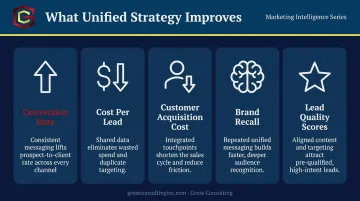
KPIs this advantage improves:
- Conversion rate
- Cost per lead
- Customer acquisition cost
- Brand recall
- Lead quality scores
When it matters most: This advantage is highest-impact for service businesses with relationship-driven sales cycles (attorneys, healthcare providers, real estate investment firms), where a single inconsistent touchpoint can end a prospect relationship that took months to build.
Advantage 2: Agility Without the Vendor Management Tax
Working with multiple specialist agencies carries a hidden cost that doesn't show up on any invoice: the time and energy spent briefing, aligning, and managing vendors who each have limited scope and limited ability to adapt.
When business priorities shift from lead generation one quarter to nurture and retention the next, a multi-vendor setup requires re-briefing new teams, renegotiating scope, and often losing weeks of momentum.
A full-stack partner can redirect resources, reallocate budget, and update strategy without the friction of switching vendors. The team already knows your audience, your offers, and what has worked. That institutional knowledge stays intact.
The coordination tax shows up in ways that compound over time:
- Alignment meetings that eat into leadership time without advancing the strategy
- Duplicate reporting across tools, teams, and dashboards
- Handoff errors and scope gaps that fall between agencies
- Lost institutional knowledge when a vendor relationship ends or underperforms
For founders without a dedicated marketing director, that last point stings most. When a specialist agency exits, they take with them everything learned about your campaigns, audiences, and messaging. A full-stack partner retains that continuity.
KPIs this advantage improves:
- Time-to-launch for new campaigns
- Marketing overhead costs
- Leadership hours recovered
- Retention of strategic knowledge across campaigns
When it matters most: Small to mid-sized service businesses without a dedicated marketing director, where the founder is personally absorbing the vendor management burden, feel this advantage most acutely.
Advantage 3: Marketing Built Into Your Business Systems
Most businesses focus on campaigns. Few invest in the operational layer that makes those campaigns measurable. Full-stack agencies build both: the CRM pipelines, tracking infrastructure, and automation sequences that connect marketing activity to revenue.
This means CRM pipelines connected to ad data, automated lead follow-up sequences, dashboards that show actual revenue impact, and continuous optimization based on what the data reveals, not vanity metrics reported in isolation.
The measurement gap is significant:
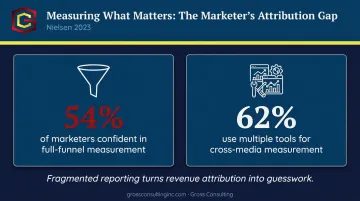
Nielsen's 2023 Annual Marketing Report found that only 54% of global marketers were confident in their full-funnel media measurement capabilities, and 62% used multiple tools for cross-media measurement. When reporting is fragmented across tools and vendors, revenue attribution becomes guesswork.
. Without proper tracking in place at that stage, there's no reliable way to know what's actually driving results.
What Happens When Full-Stack Support Is Missing
When marketing support is fragmented, campaigns stop compounding. Messaging drifts across channels. More activity gets added — more vendors, more platforms, more spend — but revenue growth doesn't follow at the same pace.
The compounding cost of fragmentation over time:
- Brand messaging becomes inconsistent across touchpoints — especially damaging in professional services, where credibility drives the decision to even take a call
- Each vendor optimizes for their own channel metrics, not your revenue — so costs rise while no one owns the full picture
- The marketing "system" lives nowhere — spread across multiple contractors, it becomes nearly impossible to scale, document, or hand off
- Every underperforming campaign triggers a crisis response instead of informing a larger growth strategy — reactive by default, never by design
Salesforce research found that 79% of customers expect consistent interactions across departments, while 55% say it feels like they're communicating with separate departments. For service businesses, that gap directly reduces conversion. When prospects sense disconnection between touchpoints, trust erodes before the first conversation happens.
How to Get the Most from a Full-Stack Marketing Partnership
A full-stack agency delivers its best results when the engagement is treated as a strategic partnership, not a vendor relationship. That requires context from the business side — revenue goals, operational constraints, growth timelines — not just campaign briefs.
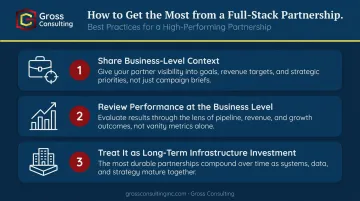
Three practices that separate high-performing partnerships from average ones:
Share business-level context upfront. The more your agency understands about where the business is going (not just which campaigns to run), the better they can align marketing to those outcomes from day one.
Review performance at the business level, not just the channel level. Establish a regular cadence for connecting marketing KPIs — leads generated, conversion rates, pipeline velocity — to actual revenue outcomes. Channel-level metrics in isolation don't answer the only question that matters: is marketing actually driving revenue?
Treat it as a long-term infrastructure investment. The compounding advantage of a full-stack partner builds over time. The longer the relationship, the more institutional knowledge the agency holds about your audience, your offers, and what actually converts. Businesses that treat marketing as a monthly expense miss the gains that only come from a partner who knows the business deeply.
Conclusion
The real value of a full-stack marketing agency is architectural. When strategy, execution, and revenue tracking all live under one roof, the entire marketing engine operates without the coordination gaps that fragment most growing businesses.
For service businesses navigating the six-to-seven-figure transition, fragmented marketing isn't just inefficient — it's a structural ceiling on growth. A full-stack partner removes that ceiling by connecting every part of the marketing engine — so nothing runs in isolation and results are actually traceable to revenue.
Businesses that treat this kind of partnership as long-term infrastructure — not a monthly campaign spend — are the ones that see results stack over time. If that's the direction you're heading, Gross Consulting works directly with service businesses to build the strategy, systems, and execution capacity behind sustainable growth. You can start with a free strategy call or reach the team directly at support@grossconsultinginc.com.
Frequently Asked Questions
What is a full-stack marketing agency?
A full-stack marketing agency covers every layer of marketing — strategy, creative, SEO, paid media, automation, and analytics — under a single team. Unlike specialist agencies that focus on one or two channels, a full-stack agency coordinates all disciplines toward a unified strategy and shared revenue goals.
How is a full-stack marketing agency different from a specialist agency?
Specialist agencies offer deep expertise in one area but limited scope beyond it. A full-stack agency provides coordinated coverage across all channels with a single strategic owner, which cuts messaging inconsistency, vendor overhead, and the blind spots that come from optimizing one channel in isolation.
What services does a full-stack marketing agency typically offer?
Core service categories include brand strategy, content marketing, SEO, paid advertising, social media, web design and CRO, email and automation, CRM integration, and performance reporting. Firms like Gross Consulting extend this further into sales systems, operational infrastructure, and financial systems.
Is a full-stack marketing agency worth the cost for a small service business?
For service businesses without a large internal marketing team, a full-stack agency typically costs less than juggling multiple specialist vendors while delivering stronger alignment and faster results. The BLS reports marketing managers alone earn a median of $161,030 annually. A full-stack agency provides that same strategic leadership plus execution, at a fraction of building it in-house.
How do I know if my business is ready for a full-stack marketing agency?
If you're managing more than one marketing vendor, struggling to connect marketing activity to revenue results, or finding that marketing isn't keeping pace with your growth goals, you're likely ready to bring everything under one partner.
Can a full-stack marketing agency replace an in-house marketing team?
For many service businesses, yes. A full-stack agency delivers the equivalent of a complete marketing department: strategist, content creator, ad manager, and analyst. You get that full capability at a fraction of in-house hiring costs, with the strategic continuity that freelancers and siloed agencies rarely provide.