Introduction
You've built real revenue. You have paying clients and a team that's working hard. But somehow, every week feels like controlled chaos — tasks falling through the cracks, tools that don't connect, and processes that exist only in someone's head. Sound familiar?
That's where a business systems consultant (BSC) steps in. The Bureau of Labor Statistics projects computer systems analyst roles — the closest federal classification to BSC work — will grow 9% through 2034, faster than average. The demand is real, and it's accelerating.
This guide breaks down the BSC role in full: what they do day-to-day, the responsibilities they own, the skills that matter most, and how to tell if your business is ready for one.
Key Takeaways
- A BSC evaluates operational systems, identifies inefficiencies, and designs integrated solutions aligned with business strategy
- Their responsibilities span analysis, solution design, implementation, project management, and post-launch support
- Unlike general advisors, BSCs don't just recommend — they design and implement the solutions themselves
- Service-based businesses benefit most when scaling creates operational bottlenecks or manual processes are consuming team capacity
- Hiring the right BSC separates incremental fixes from lasting operational change
What Is a Business Systems Consultant?
A business systems consultant evaluates an organization's existing systems and processes, identifies inefficiencies, and designs integrated solutions that align operations with strategic goals. Unlike most advisory roles, they bridge business operations and technology — handling both the strategic diagnosis and the hands-on implementation.
How a BSC Differs From Other Roles
Here's how the BSC role compares to similar titles:
| Role | Primary Focus |
|---|---|
| Business Systems Consultant | Evaluates, designs, and implements end-to-end systems changes |
| Business Analyst | Focuses primarily on requirements gathering and documentation |
| IT Analyst | Focuses on technical infrastructure and systems maintenance |
| General Business Advisor | Provides strategic recommendations without operational execution |
The key differentiator: a BSC owns the full cycle, from identifying what needs to change to managing how that change gets built and rolled out.
Internal vs. External BSCs
BSCs operate in two main contexts:
- Internal: Embedded within an organization's IT or operations team, typically managing ongoing systems improvement
- External: Engaged as independent consultants or through firms on a project or retainer basis — the more common model for growing service-based businesses
The demand for both is rising. The BLS projects 9% growth for management analysts through 2034, a role that closely overlaps with BSC responsibilities in many organizations.
Core Responsibilities of a Business Systems Consultant
BSC engagements follow a recognizable arc: diagnosis, design, execution, and support. Here's what each phase actually involves.
Systems Analysis and Evaluation
Every engagement starts here. A BSC audits your existing systems by:
- Mapping current workflows end to end
- Identifying redundancies, bottlenecks, and process gaps
- Documenting where data gets lost or decisions slow down
- Distinguishing root causes from surface-level symptoms
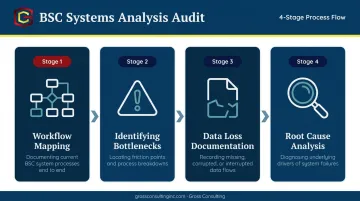
This is a structured assessment designed to give the consultant a complete picture before recommending anything.
Requirements Gathering and Stakeholder Alignment
Before any solution is proposed, a BSC works cross-functionally. They gather input from department leads, owners, and frontline staff — translating operational pain points into clear technical requirements. This step is what separates well-adopted systems from ones that collect dust after launch.
The goal is alignment across every level:
- Executive leadership understands the strategic rationale
- Department leads can translate changes for their teams
- Frontline staff — including whoever processes invoices — knows what's changing and why
Solution Design and Implementation
After diagnosis, the BSC moves to action:
- Recommend whether to customize an existing platform (CRM, ERP), integrate new tools, or redesign workflows entirely
- Build the solution — not just document it
- Oversee implementation through to completion
At Gross Consulting, that means exactly what it sounds like: "We don't just give advice. We build." The distinction matters — a strategy deck doesn't transform operations. Execution does.
Project Management
Many BSCs own the execution timeline, not just the strategy. This means:
- Coordinating across vendors, internal teams, and leadership
- Managing scope, budget, and deadlines
- Keeping implementations on track when priorities shift or complications arise
Training, Documentation, and Ongoing Support
Deployment is only the beginning. The transition period — when staff are learning new systems and old habits are hardest to break — is where a BSC's support matters most:
- Creating process documentation and SOPs
- Training staff on new systems
- Providing support during adoption to reduce disruption and resistance
This post-implementation phase is often what determines whether a new system actually gets used — or abandoned within the first 90 days.
Key Skills That Define an Effective Business Systems Consultant
Technical and Analytical Proficiency
Effective BSCs are fluent across multiple domains:
- ERP and CRM platform configuration
- Data analysis and visualization
- Workflow automation design
- Root cause analysis (identifying the actual problem, not just what's visible)
Technical knowledge without analytical depth produces solutions that fix the wrong things — the symptom gets addressed while the cause goes untouched. Strong analytical instincts are what separate a competent implementer from a genuine problem-solver.
Communication and Stakeholder Management
A BSC has to earn trust from the C-suite and the person doing data entry — simultaneously. That's a wider communication range than most roles require. It means:
- Translating technical concepts into plain business language without losing accuracy
- Managing expectations clearly when timelines shift or solutions grow more complex
- Keeping both leadership and front-line staff aligned throughout the engagement
Problem-Solving and Change Management
Implementing new systems always creates organizational friction. Resistance isn't a sign that the solution is wrong — it's a predictable human response to change. Effective BSCs:
- Anticipate where resistance will emerge
- Build change management plans into the engagement
- Guide teams through transitions with minimum disruption to daily operations
Tools and Technologies BSCs Rely On
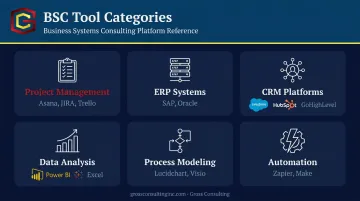
A BSC's toolkit spans several categories:
Project Management
- Asana, JIRA, Trello — for tracking implementation timelines and cross-team coordination
ERP Systems
- SAP, Oracle — enterprise-grade platforms for finance, supply chain, and operations management
CRM Platforms
- Salesforce, HubSpot, GoHighLevel — for managing customer relationships and sales pipelines
Data Analysis and Visualization
- Excel, Power BI, Tableau — for spotting trends, tracking KPIs, and turning raw operational data into decisions
Business Process Modeling
- Lucidchart, Visio — for mapping workflows visually before redesigning them
Automation Platforms
- Zapier, Make — for connecting disparate tools and cutting out repetitive manual work
The automation category deserves special mention. According to McKinsey's 2025 State of AI survey, 88% of organizations now use AI regularly in at least one business function — up from 78% the prior year. Modern BSCs who can't navigate automation and AI tooling are already operating at a disadvantage.
Gross Consulting's operational engagements, for example, center on deploying Zapier, GoHighLevel, and CRM platforms to automate backend workflows — so founders spend less time on administrative overhead and more time running their businesses.
Signs Your Business Needs a Business Systems Consultant
Your Systems Haven't Kept Up With Your Growth
When a business moves from six to seven figures, the informal processes that worked at small scale start to create real problems. What ran on tribal knowledge and manual workarounds now needs documented, repeatable infrastructure. That's when a BSC becomes essential — before the bottleneck hits, not after.
Your Team Is Doing Work That Should Be Automated
Zapier's State of Business Automation report found that 94% of SMB employees perform repetitive, time-consuming tasks, and 44% don't feel highly productive in their daily work. A BSC identifies which tasks can be systematized and redirects that capacity toward growth.
Your Tools Don't Talk to Each Other
When your CRM, accounting software, project management platform, and communication tools all operate independently, data gets duplicated, lost, or misinterpreted. Decisions slow. Errors multiply. A BSC maps the integration gaps and builds a connected system where information flows without manual handoffs.
You're Preparing for a Major Transition
Rapid hiring, new service lines, enterprise clients, geographic expansion — any of these create operational stress. The worst time to build infrastructure is after the bottleneck hits. A BSC helps you build ahead of the need.
You're Scaling Without Operational Infrastructure Behind You
Service-based businesses — attorneys, doctors, real estate firms, accountants — face a specific version of this problem. Revenue grows, but the systems underneath don't keep pace. Gross Consulting works with these firms to design and implement operational infrastructure using tools like Zapier and GoHighLevel, pairing automation with direct human implementation rather than leaving clients to figure it out alone.
What to Look for When Hiring a Business Systems Consultant
Industry and Process Experience
Generic systems expertise is less valuable than someone who understands your workflows, compliance environment, and client expectations. A BSC who has worked with law firms will recognize billing system nuances that a general consultant simply won't. Prioritize sector-relevant experience.
Implementation Track Record vs. Advisory-Only Work
Ask directly: do they build, or do they recommend? For most small and mid-sized service businesses, a 40-page strategy document you have to implement yourself has limited value. Look for consultants who own execution — not just diagnosis.
Fit With Your Existing Tech Stack
A strong BSC evaluates what you already have before recommending replacements. Platform migrations are expensive and disruptive — and most are avoidable. The first question should be: can we optimize and integrate what's already here? If that answer is yes, a good consultant will find it.
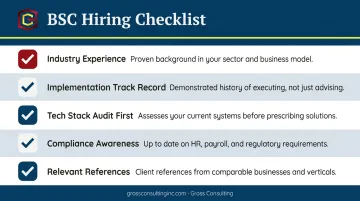
Quick Hiring Checklist
Before signing any engagement, verify your BSC candidate meets these criteria:
- Has direct experience in your industry or a closely adjacent one
- Can point to implementations they owned, not just strategies they advised on
- Audits your current tech stack before recommending new tools
- Understands compliance requirements relevant to your business type
- Provides references from businesses at a similar stage or size
Frequently Asked Questions
What is a business systems consultant?
A business systems consultant is a professional who evaluates an organization's processes and systems, identifies inefficiencies, and designs and implements solutions — sitting at the intersection of business operations and technology. Unlike general advisors, they typically own implementation, not just strategy.
What is the difference between a business analyst and a business systems consultant?
A business analyst typically focuses on requirements gathering and documentation. A BSC takes a broader scope — leading solution design, managing project execution, and driving implementation from strategy through go-live.
When should a small business hire a business systems consultant?
The clearest triggers are scaling-related chaos, manual processes consuming team capacity, and disconnected tools causing errors or slowing decisions. If your team is growing but your systems aren't, that gap is the signal.
What industries benefit most from business systems consulting?
Professional services — legal, medical, financial, real estate — along with eCommerce and other service-based businesses are the primary beneficiaries. These are industries where operational efficiency directly affects client experience, compliance, and profit margins.
How much does a business systems consultant typically cost?
Compensation data from PayScale puts business systems consultant salaries between $74K–$145K for salaried roles. Independent consulting rates vary based on engagement scope, industry specialization, and whether the work is project-based or retainer.
What is the career path for a business systems consultant?
Most BSCs start as business or systems analysts, progress to senior consultant and project management roles, and can advance to IT Director or CIO. Certifications like CBAP (IIBA) and PMP (PMI) support each stage of that progression.