Introduction
You built a successful service business. Clients trust you, revenue is growing, and your team has expanded. But somewhere along the way, you became the bottleneck.
Every hiring decision runs through you. Every process lives in your head. Your team delivers inconsistently, and profitability isn't keeping pace with revenue.
You're great at your craft. But you're spending more time managing daily chaos than actually leading.
This is the exact pattern Jaiden Gross saw repeatedly while working with attorneys, doctors, real estate investors, and local service owners before founding Gross Consulting. Talented, driven professionals held back by the absence of operational infrastructure — not a shortage of ambition.
A fractional operations consultant provides senior-level operational leadership part-time, without the cost or commitment of a full-time executive hire.
This guide covers:
- What a fractional operations consultant is and what they actually do
- The signs your business needs one
- How they compare to other options
- How to choose the right fit for your business
Key Takeaways
- A fractional operations consultant delivers part-time, embedded leadership — owning systems, processes, and accountability without a full-time salary
- Best suited for service businesses that have outgrown founder-led operations but can't yet justify a full-time COO
- Unlike traditional consultants who hand off recommendations, fractional ops consultants stay embedded and own execution
- Growing businesses get senior-level expertise at a fraction of full-time cost, usually through a retainer
- Common trigger signals: the founder is the bottleneck, team performance is inconsistent, or growth keeps hitting the same walls
What Is a Fractional Operations Consultant?
The "Fractional" Model Explained
"Fractional" simply means the consultant works part-time on a contractual basis — typically 15 to 25 hours per week — rather than as a full-time employee. They often serve multiple clients simultaneously, which means you get senior-level expertise without funding a full executive salary.
The operations side is just as defined. An operations consultant focuses on the internal systems, people, processes, and infrastructure that allow a business to function and scale. Their work is distinct from marketing, finance, or HR — yet it touches all three.
A fractional operations consultant combines both. They embed into your leadership team, attend meetings, drive decisions, and own outcomes — the same way a full-time COO or Operations Director would, without the full-time price tag.
Who Benefits Most
The fractional model is most valuable for service-based businesses that have grown past the startup phase but haven't yet built a full executive team. Based on guidance from KORE1, businesses below $5M in revenue may lack sufficient operational complexity to justify this role, with the sweet spot running from roughly $5M through $50M.
The businesses that typically benefit most share a few common traits:
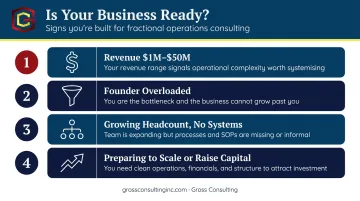
- Revenue between $1M–$50M with operational complexity outpacing internal capacity
- Founders handling too much personally — scheduling, process gaps, team bottlenecks
- Growing headcount with no clear systems, SOPs, or accountability structures
- Companies preparing to scale, raise capital, or bring on a leadership hire
LinkedIn profiles identifying as fractional leaders grew from approximately 2,000 in 2022 to more than 110,000 by late 2024, according to an HBR IdeaCast report. That growth reflects real demand: businesses need executive-level thinking without the full-time payroll to match.
What Does a Fractional Operations Consultant Do?
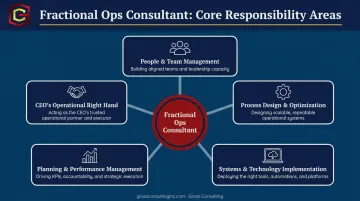
This role covers significant ground. Here's what a fractional operations consultant typically owns:
People and Team Management
They assess your existing team structure, clarify roles and responsibilities, and build accountability systems so you're not managing every person directly. Org charts get rebuilt, roles get defined, and performance expectations become explicit rather than assumed.
Process Design and Optimization
They audit current workflows, identify inefficiencies, and build or improve the standard operating procedures (SOPs) that allow work to be delegated and repeated consistently. Without documented processes, your business can only scale as fast as you can personally supervise — which isn't very fast.
Systems and Technology Implementation
They evaluate the tools, platforms, and automation your business uses and implement solutions that improve efficiency. In practice, this often includes CRMs, project management systems, and automation platforms like Zapier and GoHighLevel. Gross Consulting's operational engagements, for example, deploy exactly these tools to eliminate manual bottlenecks and give founders their time back.
Modern fractional operations consultants increasingly use AI and automation to accelerate this work — not as a replacement for strategic judgment, but to implement faster and reduce the manual lift on your team.
Planning and Performance Management
They establish KPIs and operational metrics, create reporting rhythms, and translate the owner's vision into an executable plan with clear milestones. Revenue goals get broken into operational targets with owners, deadlines, and a clear path to execution.
Acting as the CEO's Operational Right Hand
The most important outcome: freeing the founder from day-to-day operational chaos so they can focus on strategy, client relationships, and growth. When every operational decision flows through the founder, growth has a hard ceiling. For most growing service businesses, breaking that dependency is what finally makes consistent growth possible.
Signs Your Service-Based Business Needs a Fractional Operations Consultant
You Are the Bottleneck
When every decision, approval, or process runs through you, growth stalls. If your business cannot function or advance without your constant involvement, that's not a leadership strength — it's a structural problem.
Your Team Is Growing but Accountability Isn't
Hiring has happened, but roles are unclear, accountability is missing, and quality varies week to week. The systems and management structure simply haven't kept pace with the team.
Revenue Is Growing but Profitability Isn't
Operational inefficiencies often get buried inside growing revenue. The 2025 Professional Services Maturity Benchmark from Kantata and SPI found that average professional services revenue leakage runs at 6.0% — nearly double the 3.1% rate for high-performing firms. EBITDA margins in the sector fell to a historic low of 9.8%.
The usual culprits:
- Missed billing and under-documented work
- Undercosted services that erode margin at the project level
- Inefficient team utilization pulling delivery costs up
An operations consultant can diagnose which of these applies — and build the fix into your processes.
You've Hit a Growth Ceiling and Don't Know Why
Many service businesses reach a revenue point where, despite the founder's effort, growth stalls. This is frequently an operational structure problem, not a sales or marketing problem. The business has outgrown the systems (or absence of systems) that got it this far.
Scaling Efforts Keep Failing
You've tried to implement new processes, hire for key roles, or expand services — and nothing sticks. What's usually missing is someone with operational authority and the expertise to drive change and hold the team accountable.
Gross Consulting has worked with attorneys, doctors, and real estate investors in exactly this position — businesses with strong revenue and capable teams that were being held back by the absence of operational infrastructure.
Key Benefits of Hiring a Fractional Operations Consultant
Cost Efficiency vs. a Full-Time Hire
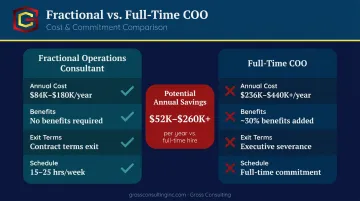
A full-time COO is expensive. Glassdoor's 2026 data puts U.S. COO total compensation between $236K and $440K annually, and that's before benefits — which BLS data shows add roughly 30% to base compensation costs.
By contrast, fractional COO retainers typically run $7,000–$15,000 per month for 15–25 hours per week (per KORE1 staffing estimates). That's $84K–$180K annually for senior-level operational leadership — with no benefits, no equity, and no severance exposure.
| Fractional Operations Consultant | Full-Time COO | |
|---|---|---|
| Annual Cost | ~$84K–$180K | $236K–$440K+ |
| Benefits Required | No | Yes (~30% of salary) |
| Notice to End | Contract terms | Executive severance |
| Time Commitment | 15–25 hrs/week | Full-time |
Faster Results with Lower Risk
Fractional consultants bring cross-industry pattern recognition. They've seen similar operational problems across multiple businesses, which means they can identify the highest-leverage fixes quickly — without the extended ramp-up that new executive hires require.
There's also a structural risk advantage. Ending a consulting contract is far simpler than terminating a senior executive, once equity, severance, and transition costs are factored in. That lower exit cost changes the calculus on when — and whether — to bring in senior operational help:
- No severance negotiations or departure packages
- No equity clawback complications
- No executive transition period that stalls operations
- Clean contract termination on agreed terms
Flexible, Scalable Engagement
The fractional model grows with you. A founder might start with a lighter engagement (focused on a specific systems build or operational audit) and scale up hours as complexity increases. That means you're paying for operational leadership that matches your current stage — not locking into a full executive salary before the business is ready to support one.
Fractional Operations Consultant vs. Full-Time COO vs. Traditional Consultant
Here's how the three models compare across the dimensions that matter most:
| Fractional Ops Consultant | Full-Time COO | Traditional Consultant | |
|---|---|---|---|
| Time Commitment | Part-time (15–25 hrs/wk) | Full-time | Project-based |
| Outcome Ownership | Yes — implements and stays | Yes — owns ops function | No — delivers recommendations |
| Engagement Length | Ongoing (6–18+ months) | Indefinite employment | Bounded project |
| Typical Cost | $7K–$15K/month | $236K–$440K+/year | Variable; often higher per hour |
| Best Fit | Needs operational leadership; can't justify full-time | $50M+ with complex operations | One-time, bounded problem |
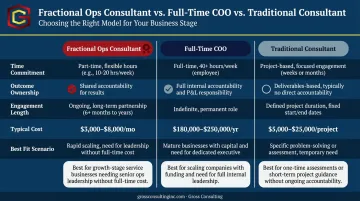
The core distinction between fractional and traditional consulting is implementation ownership. Traditional consultants deliver recommendations and step back. A fractional operations consultant stays embedded, builds the systems, and owns the outcomes — not just the report.
Gross Consulting captures this directly: "We don't just give advice. We build." That means staying inside the business through execution, not handing off a playbook and walking away.
Simple decision guide:
- Bounded, one-time problem → Traditional consultant
- Ongoing operational leadership needed, full-time hire not yet justified → Fractional operations consultant
- $50M+ business requiring dedicated full-time leadership → Full-time COO
How to Choose the Right Fractional Operations Consultant
Evaluate Their Track Record with Similar Businesses
The consultant should have demonstrable experience with businesses of a similar size, industry, or growth stage. Ask for specific examples of operational changes they implemented and the measurable outcomes that followed. Generalists exist, but specialists in service-based businesses (attorneys, medical practices, real estate firms) understand the pressures and constraints those businesses actually face.
Gross Consulting was built specifically around this client base, with Jaiden Gross developing the firm's approach after working directly alongside attorneys, doctors, real estate investors, and local service owners.
Assess Their Bias Toward Implementation
The right fractional operations consultant builds alongside your team, not someone who produces a report and disappears. Before committing, ask directly:
- How do you handle change management?
- What happens when your recommendations face internal resistance?
- What does the first 90 days look like?
The answers reveal whether a consultant is wired for execution or advice. Gross Consulting's model, which blends tools like Zapier and GoHighLevel with hands-on strategic work, is built around the former.
Start with a Scoped Engagement
Before committing to a long-term retainer, begin with a defined initial project: an operational audit, a workflow analysis, or a specific systems build. This lets both sides assess fit, establish trust, and demonstrate early value. If the early engagement delivers, expanding the relationship is a straightforward decision. If it doesn't, you've limited your exposure without a long-term contract on the line.
Frequently Asked Questions
What does a fractional operations consultant do?
A fractional operations consultant works part-time within your business to build systems, optimize processes, manage team accountability, and translate your vision into executable operations — without the cost of a full-time executive. They stay embedded and own implementation, not just recommendations.
How is a fractional operations consultant different from a full-time COO?
A full-time COO is a dedicated in-house executive with a full salary, benefits, and indefinite employment. A fractional consultant delivers the same strategic and operational leadership part-time — across one or more client businesses — at a fraction of the cost and with far less commitment from either side.
How much does a fractional operations consultant cost?
Costs vary based on hours and scope. Based on staffing-firm estimates, fractional COO-level engagements typically run $7,000–$15,000 per month for 15–25 hours per week. That's substantially less than a full-time COO salary of $236K–$440K+ annually, before benefits.
When should a service-based business hire a fractional operations consultant?
Common trigger signals include: the founder is the operational bottleneck, team performance is inconsistent despite hiring, revenue is growing but profitability is flat, or scaling efforts keep stalling despite clear momentum. If any one of these applies, the cost of waiting typically exceeds the cost of bringing in help.
How long does a fractional operations consulting engagement typically last?
Most engagements run 6–18 months, with many extending as the business grows into the systems built during that time. Shorter entry points — like an audit or a targeted systems build — are common before committing to an ongoing retainer.
What should I look for when hiring a fractional operations consultant?
Focus on three things: proven experience with businesses similar to yours in size and industry, a clear bias toward implementation over advice-only delivery, and a defined process for starting with a scoped engagement before expanding the relationship. Verify all three before signing anything.