The consequences aren't abstract. The IRS charges 5% per month on unpaid taxes for failure to file, and late payroll deposit penalties start at 2% and climb to 10% — penalties that clean, consistent bookkeeping typically prevents entirely.
This guide covers what professional bookkeeping services actually include, the unique challenges service businesses face, the tools that make financial management scalable, what outsourced bookkeeping costs, and how to decide between in-house and external support.
Key Takeaways
- Bookkeeping records daily transactions; accounting uses those records for tax strategy — both depend on each other
- Service businesses face unique challenges around retainer revenue recognition, billable cost separation, and payroll compliance
- Outsourced bookkeeping typically starts at $250–$350/month, far below the fully-loaded cost of an in-house hire
- QuickBooks Online, Xero, Gusto, and receipt-capture tools like Dext form the core bookkeeping tech stack
- Books more than 30 days behind consistently? The cost of financial errors already exceeds the cost of professional help
What Bookkeeping Services Actually Cover for Professional Services
Bookkeeping is the ongoing, transaction-level work: recording every dollar in and out, categorizing expenses, reconciling accounts, and producing clean monthly records. Accounting takes those records and uses them for tax filing, financial planning, compliance reporting, and strategic analysis.
The two functions depend on each other. A CPA working from messy, uncategorized books spends time cleaning records instead of finding deductions — which makes bookkeeping faster and less expensive to act on.
Core Bookkeeping Services to Expect
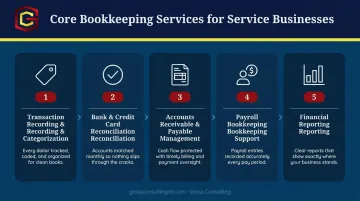
A standard professional bookkeeping engagement for a service business covers:
- Transaction recording and expense categorization — every payment is assigned to the right category (payroll, client expenses, software, overhead), so reports reflect actual performance rather than just account balances
- Bank and credit card reconciliation — monthly matching of recorded transactions against actual bank statements; skipping this creates errors that compound silently over months
- Accounts receivable and payable management — unpaid invoices and outstanding vendor payments directly affect cash flow; bookkeeping tracks both and flags aging balances
- Payroll bookkeeping support — recording payroll runs, contractor payments, and tax withholdings; especially important for service firms where labor is the largest cost center
- Financial reporting — P&Ls, balance sheets, and cash flow summaries are what lenders, investors, and CPAs ask for as a business grows
Gross Consulting's bookkeeping service is built around this foundation-first model — keeping clients financially organized and audit-ready, with budgeting and compensation planning built in to support real growth decisions alongside compliance.
Key Bookkeeping Challenges Unique to Service-Based Businesses
Service businesses sell time and expertise. Revenue is often irregular, milestone-based, or tied to retainers — which makes income tracking more complex than straightforward product sales.
Professional services EBITDA fell from 15.4% in 2023 to 9.8% in 2024, according to Deltek. At that level of margin pressure, bookkeeping that tracks labor costs, billing, collections, and overhead with precision isn't optional — it's the difference between catching a problem early and missing it entirely.
Revenue Recognition and Cash Flow Irregularity
When a client pays a retainer upfront, that payment cannot be booked as income immediately. Under both ASC 606 and IRS Publication 538, revenue is recognized as services are delivered — meaning the bookkeeping system must track deferred revenue and project progress separately from cash received.
That deferred revenue tracking directly shapes how owners read their cash position. Service businesses swing between high-revenue and slow months, and without categorized monthly expense reports, an owner cannot distinguish between a structural profitability problem and a short-term timing gap — responses that look nothing alike.
Billable vs. Non-Billable Cost Tracking
Service businesses carry two distinct cost streams:
- Billable project costs — Expenses passed through to clients, which should be tracked by project or client
- Non-billable overhead — Internal operations, software, admin, and facilities that support the business as a whole
If these aren't tracked separately in the chart of accounts, profitability reports mislead the owner about which clients and services actually generate margin.
Weak cost tracking also creates compliance risk. When contractor and vendor records aren't maintained cleanly, misclassification errors follow — and the IRS penalties are specific:
- Payroll tax deposits: 2% for 1–5 days late, 5% for 6–15 days late, 10% beyond 15 days
- 1099 filing errors: $60 to $680 per return, with no cap for intentional disregard
Consistent monthly bookkeeping closes most of these gaps before they become penalty notices.
Essential Bookkeeping Tools for Service-Based Businesses
Modern bookkeeping runs on software. The right stack reduces manual data entry, automates reconciliation, and gives owners real-time visibility into their financials. Tools fall into three layers: accounting platforms, payroll and HR software, and automation add-ons.
Intuit's 2024 survey found that businesses spend 25 hours per week on manual data entry and reconciling data across disconnected apps. A connected stack eliminates most of that.
Accounting Platforms
| Platform | Monthly Price | Best For |
|---|---|---|
| QuickBooks Online | $38–$275/mo | US-based businesses; strong CPA ecosystem |
| Xero | $25–$90/mo | Multi-user access; cleaner interface; lower cost |
| FreshBooks | $23–$70/mo | Solo practitioners; invoice-heavy workflows |
QuickBooks Online is the dominant U.S. small-business accounting platform. Intuit reported a 22% revenue increase in QuickBooks Online Accounting in fiscal 2025, reflecting its entrenched market position. Most US-based CPAs work natively in QuickBooks, which simplifies the handoff at tax time.
Xero has 4.4 million subscribers globally and is often preferred for its interface clarity and stronger multi-user controls, which matters when multiple team members or an external bookkeeper need account access.
FreshBooks is a practical fit for solo practitioners and smaller service firms that prioritize invoice management and time tracking over full double-entry accounting.
Payroll and HR Integration
Gusto handles payroll runs, contractor payments, benefits administration, and tax filings — and integrates directly with both QuickBooks Online and Xero so payroll data flows automatically into the bookkeeping ledger. Over 209,000 companies have connected Gusto to QuickBooks Online alone.
Gross Consulting is a Verified Gusto Accountancy Partner, so payroll setup, compliance, and virtual onboarding are handled within the same integrated system that feeds clean data into the bookkeeping ledger. No manual journal entries required.
Automation and Receipt Capture
Tools like Hubdoc and Dext sit upstream of the accounting platform, capturing receipts, vendor invoices, and expense documentation automatically. Key capabilities include:
- Extracts data from receipts and invoices with 99.9% accuracy (Dext's reported figure)
- Eliminates manual data entry by pushing records directly into the accounting platform
- Builds an audit-ready document trail without additional administrative work
How Bookkeeping Costs Are Structured for Professional Services
Bookkeeping services are typically priced one of three ways:
- Monthly flat-fee packages — Most common for ongoing engagements; predictable cost for the client
- Hourly billing — More common for catch-up or cleanup projects with variable scope
- Tiered service packages — Bundle basic bookkeeping with add-ons like payroll support, AR/AP management, and reporting
Outsourced Monthly Pricing
NerdWallet's 2026 guide benchmarks outsourced bookkeeping at:
- Basic (low transaction volume): $250–$350/month
- Mid-tier (payroll, more accounts): $500–$700/month
- Premium (AR/AP, reporting, advisory): $1,000+/month
What Drives Cost Up
Transaction volume, number of bank accounts, payroll complexity, reporting frequency, and whether catch-up work is needed all increase the monthly fee. A business with five bank accounts, active payroll, and client-level project tracking costs more to maintain than a single-entity service firm with one account.
In-House vs. Outsourced
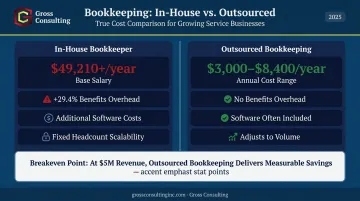
The BLS reports a $49,210 median annual wage for bookkeeping and accounting clerks as of May 2024. Add employer benefits — which averaged 29.4% of total compensation in Q1 2026 — plus software licenses, and the fully-loaded cost of an in-house bookkeeper climbs well above outsourced rates at comparable service levels. In-house only wins once transaction volume and complexity justify a dedicated role.
For most service businesses under $5M in revenue, the math favors outsourcing:
| Cost Factor | In-House | Outsourced |
|---|---|---|
| Base cost | $49,210+/year salary | $3,000–$8,400/year |
| Benefits overhead | +29.4% | None |
| Software licenses | Additional | Often included |
| Scalability | Fixed headcount | Adjusts to volume |
Catch-Up Bookkeeping
When books are months or years behind, cleanup is typically priced as a separate one-time project. Some providers start catch-up engagements at $1,000 or more, with cost scaling based on how far back records need to be reconstructed and how many accounts are involved. Every month of delay adds another month's worth of transactions to untangle — waiting rarely saves money.
Signs It's Time to Stop Doing Your Own Bookkeeping
DIY bookkeeping works until it doesn't. These are the most reliable indicators it has become a liability:
- Books are more than 30 days behind on a recurring basis
- Tax season requires emergency catch-up every year
- You cannot answer basic questions about profit margin or cash runway without pulling up a spreadsheet
- Personal and business accounts have been mixed
- A loan application or investor conversation has stalled because financials aren't clean
- You're spending more than a few hours per month on financial admin instead of running the business
Once a service business reaches consistent six-figure monthly revenue, the cost of financial errors — missed deductions, poor cash flow visibility, payroll compliance gaps — routinely outpaces what professional bookkeeping actually costs.
That's also when clean financials stop being a back-office concern and become a prerequisite for raising capital or bringing on key hires. Lenders and investors evaluate clean books, reliable payroll, and consistent reporting before almost anything else. Gross Consulting works with service businesses at exactly this stage — combining bookkeeping, compliance, and growth strategy so the financial foundation keeps pace with the business.
Frequently Asked Questions
How much should I pay for bookkeeping services for professional services?
Most professional services firms pay between $250–$700/month for outsourced bookkeeping, depending on transaction volume, account complexity, and whether payroll or AR/AP support is included. Every hour spent on bookkeeping is an hour not spent serving clients or growing the practice.
Is a bookkeeper a professional service provider?
Yes. Bookkeeping requires specialized knowledge of accounting principles, tax compliance rules, and financial software. Professional bookkeepers bridge day-to-day operations and CPA-level advisory work. Clean books make everything downstream more accurate and less expensive.
What services should a bookkeeper offer for professional services?
Core services include transaction recording, bank reconciliation, accounts payable and receivable management, payroll bookkeeping support, and monthly financial reporting. For service firms specifically, project-based cost tracking — separating billable and non-billable expenses — should also be part of the engagement.
What is the difference between bookkeeping and accounting for professional services?
Bookkeeping is the ongoing process of recording and organizing transactions. Accounting uses those records for tax filing, financial planning, and strategic analysis. Both are necessary — and clean bookkeeping makes accounting faster, more accurate, and less costly for your CPA.
What bookkeeping tools are best for service-based businesses?
Start with QuickBooks Online or Xero as the accounting platform, Gusto for payroll integration, and a receipt-capture tool like Dext or Hubdoc to eliminate manual data entry. The right combination depends on business size, team structure, and reporting complexity.
When should a service-based business outsource bookkeeping?
When the owner spends more than a few hours per month on financial admin or books are consistently falling behind, it's time to bring in professional support. The same applies when the business is preparing for growth that requires clean financials — for lending, investment, or key hiring decisions.