Why Branding Is No Longer Optional for Professional Service Firms
For decades, professional service firms, law offices, accounting practices, medical clinics, consulting agencies, built their reputations the old-fashioned way: referrals, handshakes, and word-of-mouth. That playbook no longer works. The market has changed.
Consider the numbers: over 417,700 law firms and 85,200 accounting firms now compete in the US alone. Firm counts aren't growing - they're contracting slightly each year, signaling consolidation pressure. The winners in this environment aren't necessarily the most experienced firms; they're the ones buyers can find, recognize, and trust before the first contact.
Buyer behavior has shifted just as sharply. Almost 70% of professional services buyers now use digital channels to research problems and evaluate firms before making contact. Yet perceived relevance of professional services has dropped more than 10.5% since 2020, even as buyers say they value these services 33% more than before.
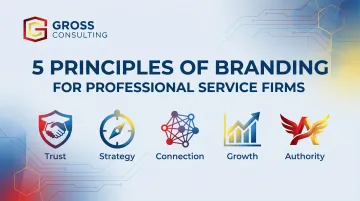
The firms winning today's shortlists aren't just credentialed. They're branded: clear, recognizable, and trusted before the first meeting. The five principles below give service firm owners a practical framework to compete on brand, not just on credentials.
TLDR
- Branding drives shortlist decisions - reputation plus visibility get you hired before you pitch
- Leadership sponsorship is essential; without it, brand initiatives stall in committee debates
- Purpose-driven positioning outperforms capability lists because clients care what drives you, not just what you do
- Internal alignment closes the cross-sell gap: 79% of buyers want more services, but 50% don't know what you offer
- Own 2-3 specific differentiators, generic claims like "trusted advisor" create sameness, not selection
Principle 1: Start from the Top - Leadership Must Champion the Brand
Branding is not a marketing department project. In professional service firms, brand-building requires active, visible sponsorship from senior leadership or founding partners. Without that, any initiative will stall the moment it hits a roadblock or requires a tough decision.
Leadership involvement means more than approval. In practice, it looks like:
- Setting the strategic direction before any creative work begins
- Participating directly in the brand development process
- Approving the final brand platform, not delegating it
- Embedding brand messaging into speeches, thought leadership, and client meetings
When partners or executives champion the brand publicly, it signals to employees and clients that the brand matters.
This becomes especially critical in partnership structures. Hinge Research Institute found that brand development in professional services firms is frequently hindered by internal leadership issues, particularly when logo and visual identity decisions become protracted battles over unresolved control issues among partners.
Without explicit leadership sponsorship, brand initiatives devolve into committee debates about personal preferences rather than strategic positioning.
The outcome of leadership engagement is measurable. The 2024 High Growth Study analyzed 824 firms representing $52.9 billion in combined revenue and found that high-growth firms grow 4X faster and are almost 2X as profitable as average-growth peers.
The common thread: superior marketing-leadership collaboration. Brand strategy in these firms isn't siloed in marketing - it's owned at the executive level.
That profitability edge connects directly to credibility. The 2026 Edelman Trust Barometer found that employers hold the best performance score among all institutions for brokering trust, with the smallest expectation-performance gap. Firm leadership is the most credible voice for brand communication, and no amount of marketing spend replaces it.
Principle 2: Define Your Purpose Before You Define Your Positioning
Most professional service firms start branding with positioning: "We serve mid-market manufacturers" or "We specialize in estate planning for high-net-worth families." Positioning describes what you do and for whom. Purpose answers why your firm exists beyond revenue.
Brands built on purpose connect more directly with clients and employees - they communicate values, not just capabilities.
The "Sea of Sameness" Problem
Capability and scale messaging has become table stakes. Hinge Research Institute identifies specific brand claims that fail differentiation tests because every competitor makes them:
- "Our employees set us apart"
- "We are trusted advisors"
- "We strive for excellence"
- "We provide fantastic client service"
- "We have a proprietary process"
When every firm in a market claims the same attributes, those claims become baseline expectations, not competitive differentiators. The result is commoditization. Firms that lead with these messages compete primarily on price, not brand.
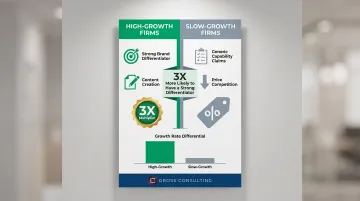
The data backs this up. High-growth professional services firms are nearly 3X more likely to have a strong, easy-to-understand differentiator than slow-growth firms. Brand differentiation is the second highest marketing priority for high-growth firms, surpassed only by content creation.
Surfacing Your Purpose: Five Diagnostic Questions
To surface purpose, work through these five questions:
- What is our core reason for existing beyond making money?
- What do we stand for?
- Who is our ideal client?
- What do we do that competitors genuinely cannot?
- How do we want clients to feel after working with us?
These questions shift the conversation from "what we do" to "why we exist." The answers form the foundation of a brand framework: a positioning statement, a brand promise, and core messages that communicate powerfully and consistently at every client touchpoint.
Purpose in Practice
Purpose is not a tagline - it's a strategic anchor that drives decisions about messaging, hiring, service design, and market positioning.
Consider a law firm that positioned around "See Beyond" rather than generic legal excellence. That message communicated foresight, strategic thinking, and advisory depth, attributes that stood out in a market saturated with "trusted advisor" claims.
Any purpose statement must pass three tests:
- True - grounded in what your firm actually does and believes
- Relevant - matters to the clients you want to attract
- Provable - demonstrable to outsiders, not just claimed internally
LBMC Information Security applied this framework by specializing exclusively in IT security for healthcare, addressing specific needs like electronic health records compliance rather than offering generic cybersecurity. That focus made their purpose True, Relevant, and Provable simultaneously.
At Gross Consulting, this principle shapes how we approach every branding engagement. Purpose isn't a deliverable we hand over - it's the lens through which messaging, positioning, and client experience get built. When that foundation is clear, the rest of the brand follows naturally.
Principle 3: Listen to the Market Before You Message
Unlike consumer brands with access to syndicated category data, professional service firms must proactively build their own fact base through research before developing or refreshing a brand. Without it, firms operate on assumptions, and assumptions are almost always wrong.
The Perception Gap
Hinge Research Institute states that internal staff and partners "almost always have a distorted view" of what clients actually think. This perception gap, the distance between how firms believe they're perceived and how clients actually see them, creates strategic risk. Firms that invest in brand messaging without validating their assumptions waste resources on messages that don't resonate.
A 2025 BTI Consulting survey of over 100 law firm leaders put numbers to this gap. Only 12.9% saw themselves as "extremely innovative," 38.9% as "strong innovators," and 48.2% as laggards.
Meanwhile, 86% of clients say they face "unprecedented transformational change." That divergence between how firms see themselves and what clients are actually experiencing has real consequences for brand strategy.
Research That Matters
Closing that gap requires deliberate research, not intuition. Effective brand research covers three areas:
- Client interviews - Reveal the language clients actually use, attributes they value, and gaps in how the firm communicates. These qualitative conversations surface what no internal meeting will.
- Competitor brand analysis - Identifies the claims every firm in your market makes, so you can avoid them as differentiators. If five competitors all claim "client-centricity," that attribute is already table stakes.
- Surveys - Quantify what actually drives category selection decisions.
Hinge Buyer Study data shows:
| Factor | Impact on Selection |
|---|---|
| Reputation | Single most important characteristic |
| Specialized expertise | Most attractive attribute |
| Cost | Tipped the scales only 8% of the time |
| Customer service | Rarely an important criterion |
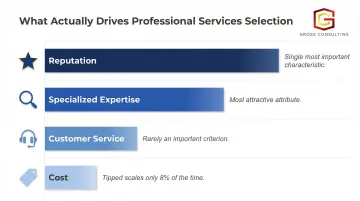
Cost is nearly irrelevant in professional services selection. Yet most firms' marketing still leads with capabilities and price competitiveness, precisely the factors that move clients least.
Research Frequency Matters
Firms that conduct research on their target audience at least once per quarter grow faster than those that research less frequently. Treat research as an ongoing discipline, not a launch-phase task. Firms that stay close to client sentiment reduce messaging risk and catch perception gaps before they erode positioning.
Principle 4: Build Your Brand from the Inside Out
A professional service firm's brand is ultimately delivered by its people, not its marketing materials. Every client interaction, a proposal, a meeting, a phone call, a follow-up email, either reinforces or undermines the brand promise. If your brand claims "exceptional partnership" but employees can't articulate what makes your firm different, the brand creates confusion rather than loyalty.
The Awareness Gap
The data reveals a striking missed opportunity. 79% of professional services buyers would like to buy additional services from their current provider. But approximately 50% do not know what other services the firm offers. This means roughly 40% of a firm's existing client base represents untapped cross-sell revenue blocked solely by an internal brand communication failure, not by lack of demand.
Closing this awareness gap requires more than external marketing. It requires internal brand activation: ensuring every team member understands the firm's full offering, can articulate what makes the firm different, and knows their individual role in delivering the brand promise.
The Inside-Out Process
Launch externally only after achieving internal alignment:
- Socialize the new brand with employees first - explain the brand platform, positioning, and messaging in clear, accessible language
- Help every team member understand their role - connect individual responsibilities to brand delivery
- Activate externally once internal alignment is achieved - ensure the brand promise can be delivered consistently
Firms that skip this step risk launching campaigns that outpace their internal capacity to deliver. The result: brand promises that feel hollow or inconsistent.
Employee Engagement Drives Business Outcomes
Gallup's meta-analysis of 112,312 business units found that top-quartile engaged teams produce:
- 23% higher profitability
- 18% higher productivity
- 10% higher customer loyalty
- 43% lower turnover (in low-turnover organizations)
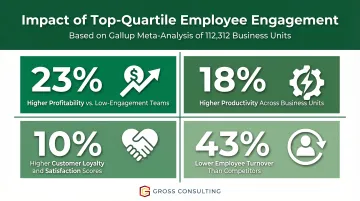
These outcomes aren't accidental. Engaged teams understand and can articulate the firm's full value proposition. They close the awareness gap, deliver consistent brand experiences, and drive measurable business results.
Building Brand into Operations
Executing this consistently requires more than a brand guide. It requires operational systems that embed the brand into how the firm works day-to-day, turning positioning statements into repeatable team behaviors and client-facing processes.
Gross Consulting works with service firms at exactly this stage, translating brand strategy into the SOPs, communication standards, and operational workflows that make consistent delivery possible. The goal isn't a polished brand guide that sits in a shared folder. It's a brand that your team actually lives when they pick up the phone, send a proposal, or walk into a client meeting.
Principle 5: Differentiate or Disappear - Breaking the Sea of Sameness
Identifying What Makes Your Firm Truly Different
Most professional service firms cluster around the same handful of attributes: client focus, quality, integrity, global reach. These are baseline expectations, not competitive differentiators. Buying decisions are rarely influenced by these claims alone.
To break through, firms need a practical differentiation framework that distinguishes between four types of brand attributes:
- Issues: Challenges to address or negative perceptions to overcome
- Neutrals: Factors that are neither positive nor negative
- Required: Table stakes every competitor also claims (client-centricity, integrity, quality)
- Differentiators: The 2-3 attributes only your firm can credibly own
The goal is to find and lead with the Differentiators. These are the attributes that pass the True/Relevant/Provable test: grounded in reality, matters to clients, and demonstrable to outsiders.
Examples of firms that differentiated successfully:
RS&H (Architecture/Engineering): Specialized in large-scale transportation infrastructure and developed Visible Experts who shape national policy. Rather than claiming "we do everything," RS&H narrowed its brand around specific domain expertise.
Summit Executive Resources: Flipped the traditional executive search model so candidates pay for coaching while companies access the network at no cost. This structural differentiation became the brand itself, True, Relevant, and Provable.
Heller Consulting: After implementing a brand development strategy, achieved a 400% increase in website conversions and 50% increase in organic search traffic over two years. The firm discovered it had unintentionally developed a narrow reputation (known only for fundraising technology rather than broader consulting), illustrating the need for purposeful brand positioning.
Building Thought Leadership as a Differentiator
Content and thought leadership have become primary differentiation tools for professional service firms. Today's buyers want to be informed and educated before they engage, not pitched. White papers, webinars, industry reports, and high-value blog content position a firm as the go-to voice in its space.
The 2025 Edelman-LinkedIn B2B Thought Leadership Impact Report, based on 1,934 global executives, found:
- 73% of hidden buyers say thought leadership is the best way to sense the caliber of thinking a firm would deliver as a client
- 71% say thought leadership is more effective than conventional marketing at demonstrating value
- 95% are more receptive to sales outreach due to strong thought leadership
- 79% are more likely to advocate for a vendor in an RFP process due to thought leadership
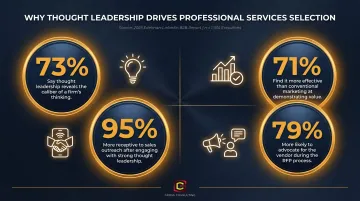
For professional services, thought leadership is a direct proxy for service quality assessment. When buyers can't test-drive your expertise before hiring you, they evaluate your thinking through your content.
Publishing alone won't cut it. 96% of B2B organizations now produce thought leadership content, yet only 7% rate their programs as "advanced" and 4% as "leading." That gap is the opportunity - firms that prioritize quality over volume can stand out in a crowded field.
The firms that win build a clear, specific point of view on problems their ideal clients are actively trying to solve, then get that content in front of decision-makers consistently. Top channels include LinkedIn (76%), email newsletters (54%), and speaking events or webinars (52%).
Frequently Asked Questions
What makes professional services branding different from product branding?
Professional services branding centers on trust, expertise, and relationships rather than visual and emotional product appeal. The stakes of a wrong decision are far higher for buyers, making reputation and visibility the primary brand drivers. Buyers can't test-drive expertise before hiring, so brand becomes a proxy for service quality.
What are the 7 steps in the brand development process?
The Hinge Research Institute outlines a 10-step framework, but the core sequence includes research and discovery, brand strategy, positioning, messaging, visual identity, internal activation, and external launch. Professional service firms often underinvest in the research and internal activation steps, leading to disconnects between brand promise and brand delivery.
What are the 7 pillars of branding?
A widely used framework covers purpose, positioning, personality, perception, promotion, visual identity, and consistency. These pillars work together to shape how a firm is recognized and trusted in its market. In professional services, consistency and purpose are especially critical because expertise-based trust builds over time through repeated, reliable brand experiences.
What are the 5 C's of branding?
The 5 C's, Clarity, Consistency, Content, Connection, and Credibility, are especially critical in professional services where purchasing decisions hinge on trust. Together, they guide buyers from first awareness to a confident hiring decision, with each element reinforcing the next.
What is the 3-7-27 rule of branding?
The 3-7-27 rule describes how it takes roughly 3 exposures for someone to notice a brand, 7 to associate it with a feeling or message, and 27 to develop genuine loyalty. For service firms, this means a single campaign rarely moves the needle - sustained, consistent presence across multiple channels is what converts awareness into trust.