The numbers reflect genuine strain. According to the Federal Reserve's 2025 Report on Employer Firms, 57% of small employer firms cited reaching customers and growing sales as an operational challenge in 2024 — up from 53% the year prior. Firms were also more likely to report declining revenues than increasing ones, the first time that's been true since 2021.
Yet despite this pressure, most business owners don't actually know what sales consulting involves. Many assume it's glorified coaching or a one-time training session. That misunderstanding leads to hiring the wrong help — or skipping the investment entirely.
This guide breaks down what sales consulting actually is, how the process works in practice, and when it makes sense to pursue it.
Key Takeaways
- Sales consulting builds the systems a business uses to generate, convert, and retain customers — not just strategic advice.
- The process moves through four stages: discovery, strategy development, implementation, and measurement.
- Service-based businesses — attorneys, doctors, real estate firms, accountants — are among the highest-value beneficiaries.
- Hiring salespeople before building a sales system usually leads to high costs and poor results.
- The best consultants implement alongside clients — not hand over a deck and disappear.
What Is Sales Consulting?
Sales consulting is a professional service where an external expert works with a business to assess, design, and improve the systems, strategies, and behaviors that drive revenue: from how leads are generated to how deals close and clients are retained.
It exists because of a specific operational gap. Most service-based business owners (attorneys, doctors, contractors, accountants) are domain experts who were never trained in sales. Growth stalls not because the service is poor, but because the pipeline is scattered, follow-up is inconsistent, and there's no structured process managing how prospects become clients.
What Sales Consulting Is Not
Understanding the difference prevents a misaligned hire:
- Not sales coaching — Coaching focuses on individual mindset and skill development. Consulting focuses on the business's operational systems.
- Not a marketing service — Lead generation may be part of the scope, but the work covers the full revenue cycle.
- Not a one-time training session — A consulting engagement produces tangible infrastructure: strategies, processes, playbooks, and implemented tools.
As the Hackett Group defines it, sales consulting helps organizations optimize sales strategy, processes, and performance to drive revenue growth and improve customer engagement. The emphasis on optimization is deliberate: the goal is a repeatable system, not a one-off recommendation.
Why Technology Hasn't Replaced It
AI and digital tools are reshaping how buyers engage with sellers. Gartner research shows buyers are 1.8x more likely to complete a high-quality deal when using digital tools alongside a sales representative — meaning technology amplifies good sales process, it doesn't replace it. Strategy still requires human judgment. Most businesses need someone to translate available tools into a plan that fits their specific market.
The Main Types of Sales Consulting Engagements
Engagements typically fall into one or more categories:
- Sales process consulting — Fixing how the pipeline operates from first contact to close
- Sales strategy consulting — Defining target markets and go-to-market approach
- Sales training consulting — Coaching teams on technique and conversion behavior
- Sales hiring consulting — Recruiting and selecting the right sales talent
- Sales leadership consulting — Developing managers to run high-performing teams
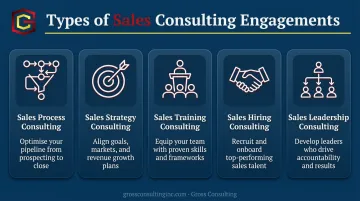
Most engagements combine several of these. The right mix depends on where the revenue gap actually lives — which is typically what the initial assessment is designed to uncover.
How Does Sales Consulting Work?
Sales consulting follows a defined sequence of stages, each building on the last. The depth of each stage depends on the client's needs and scope of engagement.
Discovery and Assessment
The engagement begins with a structured diagnostic. A consultant interviews leadership and sales staff, reviews pipeline data, audits current messaging, and identifies where leads are being lost.
This stage is where assumptions get challenged. Many businesses believe their problem is lead volume. Often, the real issue is conversion, inconsistent follow-up, or misaligned positioning. A good consultant surfaces those hidden causes before proposing any solution — diagnosis before prescription.
For service businesses in particular, the gaps can be striking. Clio's Legal Trends research found that only 40% of law firms responded to client emails, and more than half didn't respond to voicemail within 72 hours. That's not a lead problem. That's a process problem — and it's exactly what a discovery phase uncovers.
Strategy Development
Once the assessment is complete, the consultant develops a customized sales strategy that:
- Defines the ideal customer profile
- Clarifies the value proposition for the target market
- Maps the full sales process from first contact to close
- Sets measurable performance targets
Strategy here is not generic. It accounts for the client's industry, deal size, sales cycle length, and the team's actual capacity to execute. A credit repair company's sales process looks nothing like an attorney's — the approach has to fit.
Implementation and Execution
This is the central working phase. The consultant moves from planning to building:
- Creating sales playbooks and messaging frameworks
- Developing call scripts and objection-handling approaches
- Configuring CRM systems and automation sequences
- Training the team on the new process
- In some cases, managing execution directly during the ramp period
Gross Consulting, for example, builds out the full sales infrastructure for clients — not just recommending a CRM, but configuring platforms like GoHighLevel and Zapier to automate pipeline management and lead follow-up. The stated philosophy: "We don't just give advice. We build." That's the difference between an engagement that produces lasting change and one that produces a nice document nobody uses.
Measurement and Iteration
Implementation without measurement is guesswork. This phase establishes KPIs and reviews performance at regular intervals:
- Pipeline conversion rate
- Average deal cycle length
- Close rate by stage
- Revenue growth over the engagement period
Regular reviews identify what's working and where the process needs adjustment. This keeps the strategy alive — not locked in a deck from month one.
Who Needs Sales Consulting?
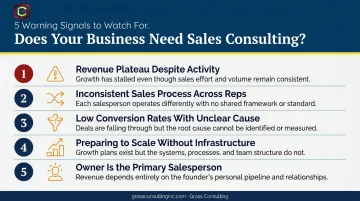
Several business situations are strong signals that a sales consultant would add measurable value:
- Revenue has plateaued despite consistent activity — the effort is there, but the results aren't following
- The sales process varies by rep or by day — no two people sell the same way, so results are unpredictable
- Conversion rates are low and the cause is unclear — leads are coming in, but they're not closing
- The business is preparing to scale and needs infrastructure first — hiring before the system is built is expensive
- The owner is the primary salesperson — and can't grow the business while also being responsible for every sale
Why Service-Based Businesses Benefit Most
Attorneys, physicians, accountants, real estate firms, and credit repair companies share a common trait: their expertise is in their discipline, not in selling. Their sales cycles depend on trust-building conversations — and those conversations rarely follow a structured process by default.
The data reflects how acute this gap is. CPA.com's 2024 CAS Benchmark Survey found that 50% of accounting firms hadn't clearly articulated an ideal client profile — a foundational positioning gap that no amount of lead generation can compensate for.
Sales Consulting Applies at Multiple Business Stages
| Stage | Primary Need |
|---|---|
| Early-stage | Establishing a repeatable process from scratch |
| Mid-stage | Breaking through a growth plateau |
| Established | Modernizing systems, integrating technology, aligning a growing team |
Across all three stages, one pattern holds: businesses scaling from six to seven figures need process and strategy work before adding headcount. Hiring into a broken or nonexistent sales system produces expensive underperformance.
What to Look for in a Sales Consultant
Three questions cut through most of the noise when evaluating a sales consultant:
- Do they diagnose before they prescribe? A consultant who pitches a solution in the first conversation is selling, not consulting. The discovery process should come first.
- Do they have experience with businesses of your size and type? A firm that works exclusively with enterprise clients has limited relevance to a 10-person professional services firm.
- Do they build, or do they just advise? Ask directly: will they help set up the CRM or just recommend one? Will they help the team execute the strategy or hand over a deck?
That third question matters more than it might seem. McKinsey's research on transformation failures found that 70% of transformations fail, with weak execution and poor change management among the most common causes. A consultant's involvement in execution — not just strategy — is often what separates engagements that deliver results from those that don't.
Practical Vetting Steps
- Ask for case studies from your industry or a comparable business type
- Ask how success is measured and what reporting looks like during the engagement
- Pay attention to how they sell to you — their discovery process with you is a preview of how they'll help you develop one for your own customers
If a consultant can't clearly articulate what they'll build alongside you — not just advise on — that's worth taking seriously before signing anything.
Frequently Asked Questions
What is sales consulting?
Sales consulting is a structured advisory and implementation service focused on improving how a business generates leads, converts prospects, and retains customers. Unlike generic coaching, it produces tangible deliverables — strategies, processes, playbooks, and implemented systems — rather than guidance alone.
What does a sales consultant actually do?
Day-to-day, a sales consultant diagnoses gaps in the current sales operation, develops a strategy tailored to the business, builds or optimizes processes and tools, trains the team on execution, and tracks results over time. The work spans both strategy and hands-on implementation.
How is sales consulting different from business coaching?
Business coaching focuses on the individual's mindset, decisions, and personal development. Sales consulting focuses on the operational systems and strategies of the business itself, producing deliverables like CRM configurations, hiring frameworks, sales playbooks, and measurable performance targets.
When should a service-based business hire a sales consultant?
A few clear signals point to the right time:
- Revenue has stalled despite consistent activity
- The owner is still the primary salesperson with no path to delegate
- The business is adding headcount and needs a repeatable process first
How long does a sales consulting engagement typically last?
Engagements typically run a few weeks for a focused audit or two to six months for full strategy development and implementation, depending on scope.
What results can a business realistically expect?
Realistic outcomes include improved pipeline conversion rates, shorter sales cycles, and a more consistent process across the team. Revenue growth follows, but it depends on how thoroughly the strategies are implemented and measured, not just designed.