A/B testing removes the guesswork. Instead of redesigning on instinct, you show two versions of a page, email, or ad to real users, measure what actually happens, and let the data decide. For attorneys running lead gen campaigns, healthcare providers testing appointment booking flows, or eCommerce brands optimizing product pages, this one discipline can meaningfully shift how your marketing spend performs.
This guide covers everything you need to get started: what A/B testing is, what to test, how to run a test properly, real examples from service-based industries, and the common mistakes that turn good ideas into wasted budget.
Key Takeaways
- A/B testing compares two versions of a digital asset to determine which drives better results based on real user behavior
- Every test needs a clear hypothesis — a specific, measurable prediction about what change will improve which metric
- Statistical significance separates a reliable result from a lucky coincidence; always wait for it
- Service businesses can test email subject lines, landing pages, ad copy, and CTAs across every digital touchpoint
- The most common mistakes: testing multiple variables at once, stopping too early, and failing to diagnose what actually caused the result
What Is A/B Testing and Why Does It Matter?
A/B testing — also called split testing — is a method of showing two versions of a digital element to randomly divided audiences and measuring which performs better against a defined goal. Version A is the control (your existing asset), and Version B is the variation (the change you're testing). Users see one or the other, never both.
The critical distinction from gut-feel decisions: A/B testing captures what users actually do, not what they say they'll do. Surveys and focus groups tell you intent. A/B tests tell you behavior.
Two Statistical Concepts You Need to Know
Before running any test, understand these two principles:
- Random selection — The audience must be divided randomly so each group is representative and unbiased. If your control sees mostly mobile users and your variation sees mostly desktop users, the results are meaningless.
- Statistical significance — This measures whether your results reflect a real difference or just random chance. It's typically expressed as a confidence level (90% or 95%). A 95% confidence level means there's only a 5% probability that the observed difference happened by chance.
Why This Matters for Growth
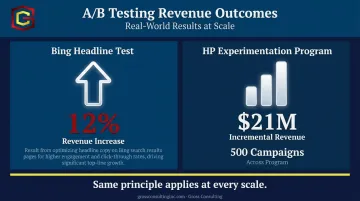
The business case is well-documented. Harvard Business Review reported that a single headline change in a Bing online experiment increased revenue by 12%. Optimizely cites HP generating $21 million in incremental revenue across nearly 500 experimentation campaigns.
Those are enterprise examples, but the same principle applies at every scale. For attorneys, doctors, real estate investment firms, and service businesses running paid campaigns, A/B testing replaces opinion with evidence — so marketing spend produces measurable results instead of expensive assumptions. That's precisely why Gross Consulting builds testing into paid campaigns for its clients from the start.
What Can You A/B Test?
The range is wider than most teams use. According to Ascend2's 2025 survey of active A/B testers, the most commonly tested channels are:
- Websites (60% of active testers)
- Email marketing (57%)
- Paid social campaigns (41%)
- Landing pages (32%)
- Display and programmatic advertising (31%)
What to Test by Channel
Websites and landing pages:
- Headlines and body copy
- CTA button text, color, and placement
- Form length and field order
- Page layout (above-the-fold form vs. trust content first)
- Images and social proof placement
Email campaigns:
- Subject lines and preview text
- From name
- Send time
- Content structure and CTA placement
Paid ads:
- Headlines and descriptions
- Outcome-based vs. feature-based messaging
- Visual creative
- Promotional offers
How to Prioritize What to Test First
Each channel above gives you a long list of candidates. Since you can only test one variable at a time, you need a way to choose. Use this framework:
- Start with high-traffic pages or high-volume campaigns, where you'll accumulate enough data to reach statistical significance faster.
- Target elements closest to the conversion action — a CTA test on a landing page will move the needle far more than a footer link test.
- Weight by expected impact relative to effort — a headline change is low effort and high impact; a full page redesign inverts that ratio.
How to Run an A/B Test: Step-by-Step
Step 1: Identify the Problem with Data
Don't start with a solution. Start with your analytics.
Look at conversion funnels, heatmaps, and session recordings to pinpoint exactly where users drop off or hesitate. A high bounce rate on a landing page tells you something is wrong. The data tells you where — your hypothesis tells you why and what to fix.
Jumping to solutions without this diagnostic step wastes tests on the wrong problems.
Step 2: Write a Proper Hypothesis
There's a meaningful difference between an idea and a hypothesis.
- Idea: "Let's change the CTA button to green."
- Hypothesis: "Changing the CTA button from gray to green will increase click-through rate because it creates stronger visual contrast against the white background, making the action more obvious."
A proper hypothesis includes three elements: the specific change, the expected outcome, and the reason why. That third part is what makes your next test smarter regardless of the result.
Step 3: Define Success Before You Launch
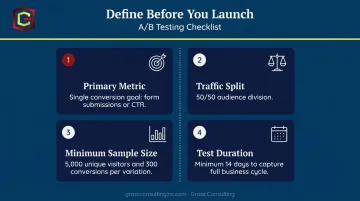
Set these parameters before the test goes live:
- Primary metric — the single number that determines the winner (form submissions, click-through rate, purchases)
- Traffic split — typically 50/50 for equal comparison
- Minimum sample size — AB Tasty recommends at least 5,000 unique visitors and 300 conversions per variation for reliable results
- Test duration — AB Tasty recommends a minimum of 14 days to account for business cycle variation (weekday vs. weekend patterns distort shorter tests)
Step 4: Build, QA, and Launch
With your parameters set, use a testing tool to build the variation and verify:
- Audience allocation is genuinely random
- Tracking is firing correctly on both versions
- The test passes a full QA check before going live
Monitor the test after launch. Backend changes or tool errors can silently break data collection mid-test — catching this early saves weeks of wasted data.
Step 5: Analyze Results and Act
Once the test reaches statistical significance (or hits your pre-set duration), read the results honestly.
- A win — implement the variation and document what worked
- A loss — the hypothesis was wrong; document why and refine the next one
- Inconclusive — insufficient data; run longer or increase traffic
Either way, document the reasoning behind the result — a losing test that explains why users didn't respond gives you a sharper brief for the next one.
Real-World A/B Testing Examples for Service-Based Businesses
Example 1: Law Firm Consultation Page
Scenario: A law firm's intake page has a contact form at the top, but form submissions are low relative to traffic.
Hypothesis: Adding a brief trust-building paragraph — attorney credentials, a client testimonial, and a privacy reassurance — before the form will increase submissions because visitors to high-consideration services need credibility signals before committing personal information.
What to measure: Form submission rate
What it reveals: Baymard research found that 19% of users abandoned checkout because they didn't trust the site with their information. For legal services, trust signals before the ask can be the difference between a lead and a bounce. The result tells you whether your audience needs persuasion before conversion — or whether friction is elsewhere.
Example 2: Service Business Email Campaign
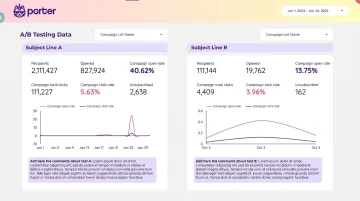
Scenario: A local service business is running a promotional email and wants to know which subject line drives more opens and clicks.
- Version A (benefit-focused): "Save 20% on Your Next Appointment"
- Version B (urgency-focused): "Last Chance: 20% Off Ends Tonight"
What to measure: Open rate (does one get more opens?) and click-through rate (of those who open, which drives more action?)
What it reveals: These two metrics together tell you whether the audience responds to value or to scarcity. An email that gets higher opens but lower clicks suggests the subject line attracted the wrong expectation. A Litmus-documented Emerson case study found that a white-paper subject line produced a 23% higher open rate than a free trial offer — sometimes the "softer" approach wins.
Example 3: Paid Ad Headlines for a Healthcare or Real Estate Brand
Scenario: A campaign is running two ad headline variations:
- Version A (outcome-based): "Get Pre-Approved in 24 Hours"
- Version B (feature-based): "Our 3-Step Process Gets You Approved Faster"
What to measure: Click-through rate and downstream conversion rate (did those clicks become leads?)
Why it matters: CTR alone doesn't tell the full story. Version A might drive more clicks but attract less qualified prospects. Tracking downstream conversions reveals whether the headline is matching the right audience to the right offer. For service businesses running Meta Ads, this is where pixel configuration and conversion tracking earn their keep — the full funnel gets measured, not just ad-level clicks. Gross Consulting builds this tracking infrastructure into every paid campaign it manages.
Example 4: CTA Button Copy
Scenario: Testing two CTA variations on a service landing page:
- Version A: "Schedule a Free Call"
- Version B: "Get My Free Consultation"
What to measure: Click-through rate on the CTA button
What it reveals: First-person copy ("My") often outperforms second-person ("a") because it creates ownership and specificity. Going increased premium trial starts by 104% month-over-month after a three-word CTA change. Small copy tweaks aren't trivial — and the learning applies to every future landing page, not just the one tested.
Common A/B Testing Mistakes to Avoid
Mistake 1: Testing Multiple Variables at Once
If you change the headline, image, and CTA simultaneously and conversions go up, you have no idea which change caused it. You can't replicate the result reliably, and you can't learn from it.
Fix: one variable per test. Always.
Mistake 2: Stopping Tests Too Early
Seeing an early lead and calling the test done is one of the most common — and costly — mistakes in A/B testing. CXL reports that peeking at results and stopping early can more than triple false positive rates. Weekend vs. weekday traffic patterns alone can skew interim results dramatically.
Set your duration and sample size before launch, then don't touch the results until you hit them.
Mistake 3: Ignoring the "Why" Behind the Numbers
Knowing that Version B won is half the insight. Knowing why it won is what makes the next test smarter.
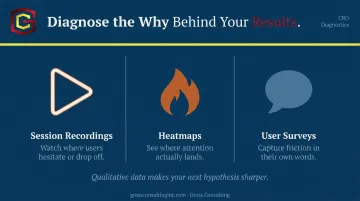
Pair test results with qualitative data to understand the story behind the numbers:
- Session recordings to watch where users hesitate or drop off
- Heatmaps to see where attention actually lands
- Short user surveys to capture friction in their own words
If a new form layout increased submissions, session recordings might reveal that users were confused by the original field order. That "why" informs every hypothesis you run next.
Popular A/B Testing Tools and Platforms
Tools by Use Case
| Category | Tools | Best For |
|---|---|---|
| Beginner-friendly | Crazy Egg ($29/month), Unbounce ($99/month) | Visual testing without developer support |
| Mid-market | VWO (Growth from ~$173/month), AB Tasty (custom pricing) | Teams needing deeper segmentation and targeting |
| Enterprise | Optimizely (custom pricing), Kameleoon (Starter from $495/month) | Full-stack experimentation at scale |
| Behavioral analytics | Hotjar, Microsoft Clarity | Generating hypotheses via heatmaps and session recordings |
Note: Hotjar and Microsoft Clarity are not A/B test execution platforms — they integrate with testing tools to help you understand results and identify what to test next.
How to Choose
For small teams and service businesses just starting out, prioritize:
- Visual editors that let marketers build and launch tests without developer support
- Statistical significance reporting so you know when results are actually reliable
- Clean integrations with your CRM, email platform, and analytics tool
At the early stage, getting your first test live matters more than advanced features. Crazy Egg's claim of getting up to speed in under 60 seconds and Unbounce's drag-and-drop landing page builder are useful starting points for service businesses running lead generation campaigns.
Frequently Asked Questions
What exactly is A/B testing?
A/B testing (also called split testing) compares two versions of a digital element — a webpage, email, or ad — by showing each to a randomly divided audience and measuring which performs better against a defined goal. It's a quantitative method that replaces guesswork with real user behavior data.
What is A/B testing in CRM?
In a CRM context, A/B testing typically refers to testing email campaign variations — subject lines, follow-up sequences, send times, or messaging — to identify which version drives higher open rates, click-throughs, or conversions. Over time, this makes lead nurturing and automated communication more effective.
What are some A/B testing platforms?
Widely used platforms include VWO, Optimizely, AB Tasty, Crazy Egg, Unbounce, and Kameleoon. The right choice depends on your team's technical skill, budget, and whether you're focused on web pages, email, or full-stack experimentation.
How much do A/B testing services cost?
Tool pricing ranges from ~$29/month (Crazy Egg) to $495+/month (Kameleoon Starter), with enterprise tools like Optimizely on custom quotes. Managed CRO agency services typically start around $1,800/month for essential programs and $10,000/month for comprehensive engagements.
How long should an A/B test run?
At minimum, two full weeks — long enough to capture at least one complete business cycle and account for weekday/weekend variation. Never stop a test early based on a promising interim result — early data is frequently misleading and can point to the wrong winner.
What is the difference between A/B testing and multivariate testing?
A/B testing compares two versions of a single element. Multivariate testing simultaneously tests multiple elements and their combinations to find the best-performing mix. It's more powerful, but requires significantly more traffic to reach reliable results — making A/B testing the practical choice for most service businesses.